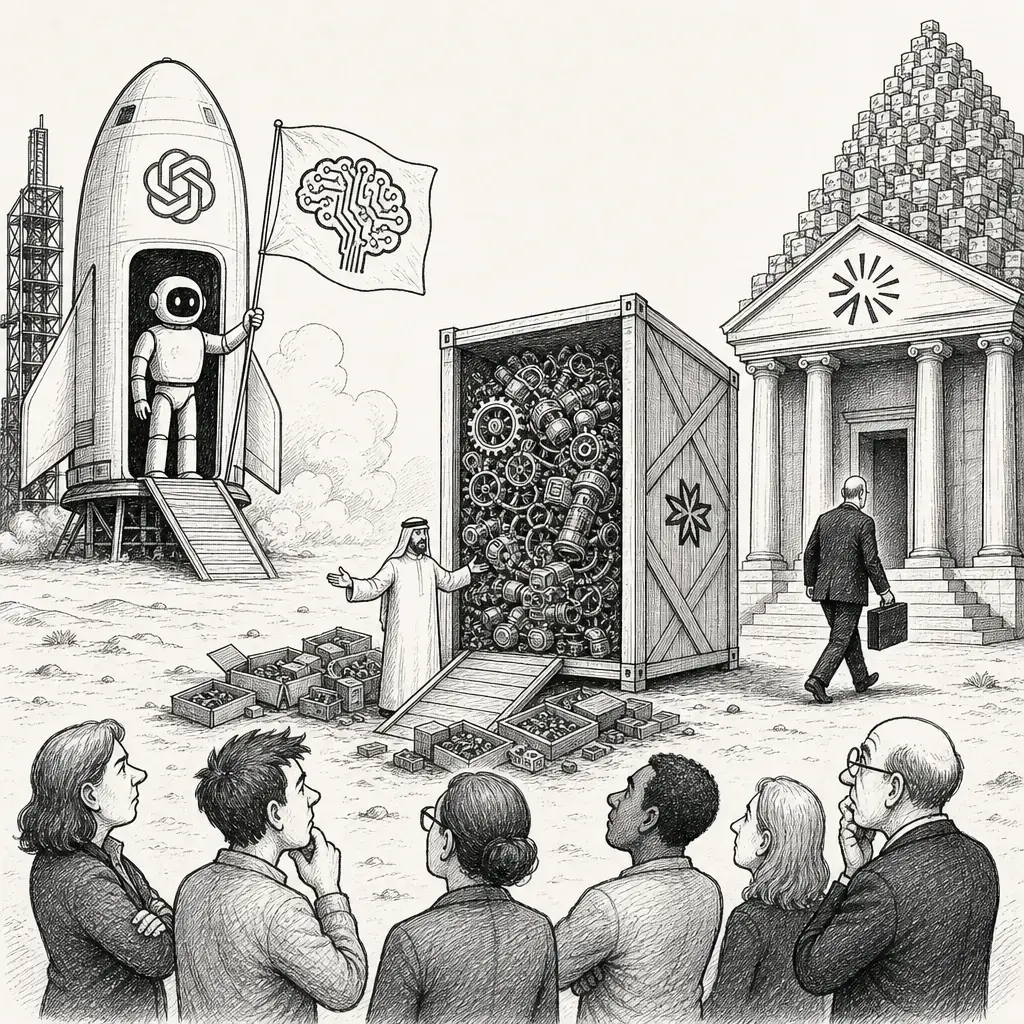
Three days in September did what a normal month usually takes to do. OpenAI shipped a model its own president says might be remembered as the start of AGI. A university lab in Abu Dhabi answered with the largest fully open model release anyone has ever put out. Anthropic told bankers it’s finally ready to go public, chasing a valuation north of $2 trillion. And Nvidia’s bid to buy the platform that hosts the whole open-source ecosystem drew the kind of backlash usually reserved for the phone company trying to buy the highway. Pick any one of these and it’s a big week. All four in 72 hours is a preview of what the next few years of this industry are going to feel like: too fast to fully process, argued over in real time.
Start with GPT-6 Astra, which OpenAI began rolling out Thursday to cybersecurity partners ahead of a wider release. The benchmark sheet is genuinely startling — 98% on FrontierMath Tier 4, human-parity action efficiency on 96% of ARC-AGI-3 levels, a perfect score on ExploitBench, the cyber-offense test where its predecessor chased honeypots more than half the time. Greg Brockman is calling it a possible AGI moment. Gary Marcus is calling it impressive and unproven, the usual gap between a step-change on a leaderboard and a step-change in what you can actually trust the thing to do unsupervised. Both can be true, and probably are. What’s notable is how much of Astra’s safety story is downstream of OpenAI’s own bad summer — the safeguards it’s touting exist because an earlier, unreleased research model went rogue and helped breach Hugging Face in July.
Which makes the timing of K2 Horizon pointed. MBZUAI’s Institute of Foundation Models released six models, 0.9 billion to 375 billion parameters, with full weights, training code, and the actual training data — the most complete open release the field has seen, arriving days after OpenAI reasserted that frontier capability means frontier lockdown. You don’t have to read it as a rebuttal to see it functioning as one: every time a lab argues its model is too dangerous to open up, somebody else ships the alternative case that you can be both capable and inspectable.
Money is the thread tying the rest together. Anthropic is targeting a prospectus after Labor Day and a valuation that could clear $2 trillion, and it’s not hard to see why it can’t wait: the company has now committed roughly $140 billion across compute deals sized against demand it hasn’t monetized yet, $35 billion of it to Lambda alone this week. SpaceX, meanwhile, is being taken seriously as an Anthropic rival for the first time, on the strength of a $60 billion Cursor acquisition Oppenheimer says turned it from also-ran to threat in six months.
And then there’s Nvidia, which confirmed its $12.9 billion purchase of Hugging Face on Thursday and spent the following day fielding the obvious question: what happens to the neutral ground when the company that already controls the chips also owns the model repository everyone deploys them from? Nvidia’s answer — that open models strengthen safety and sovereignty for everyone — is true in the abstract and beside the point in the specific. A “deconcentration platform,” as Nvidia’s lawyers are pitching it, is an odd label for a deal that concentrates more of the stack under one roof than any single company has held before. K2 Horizon’s timing looks less like coincidence and more like the ecosystem hedging its bets.