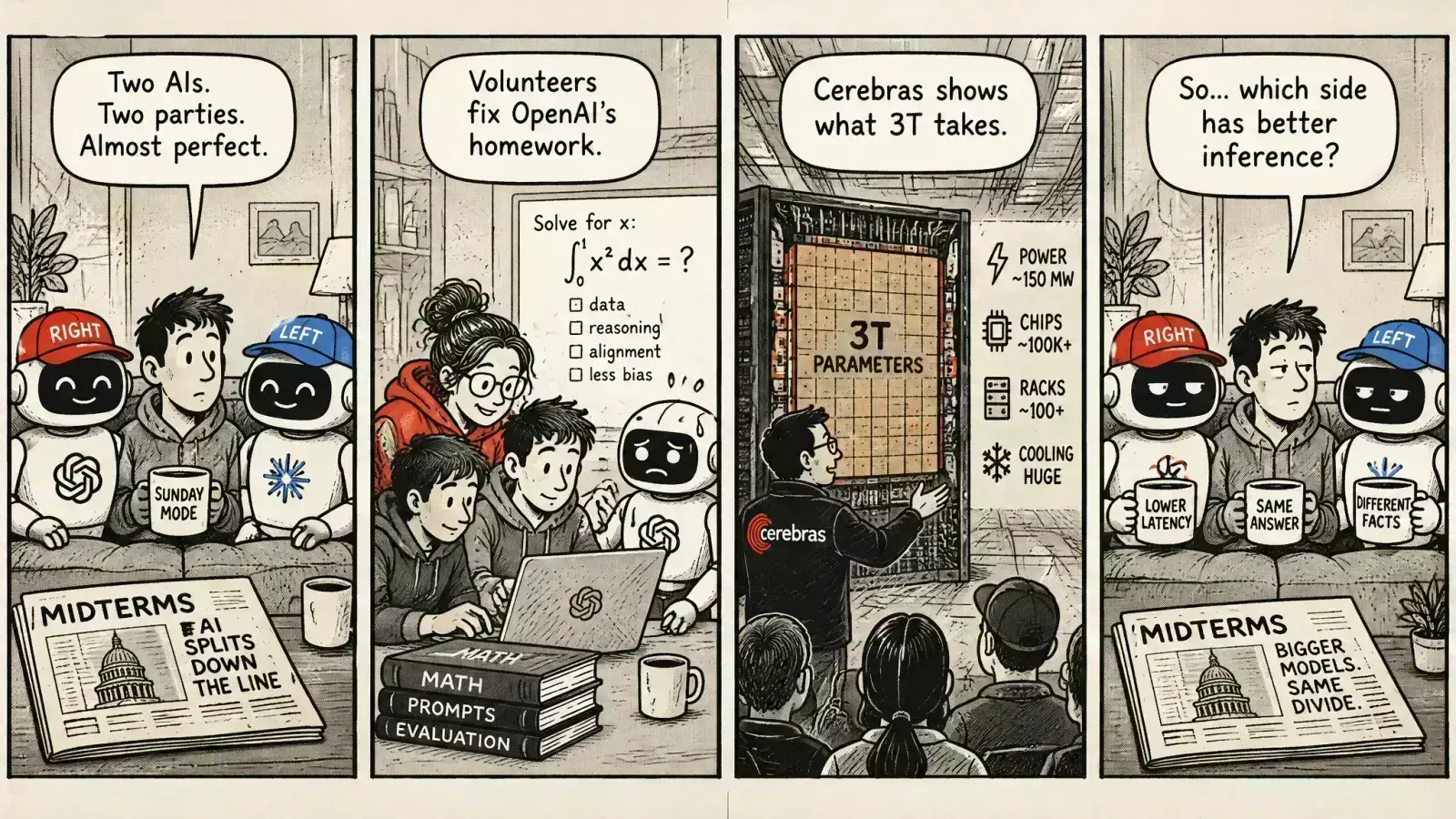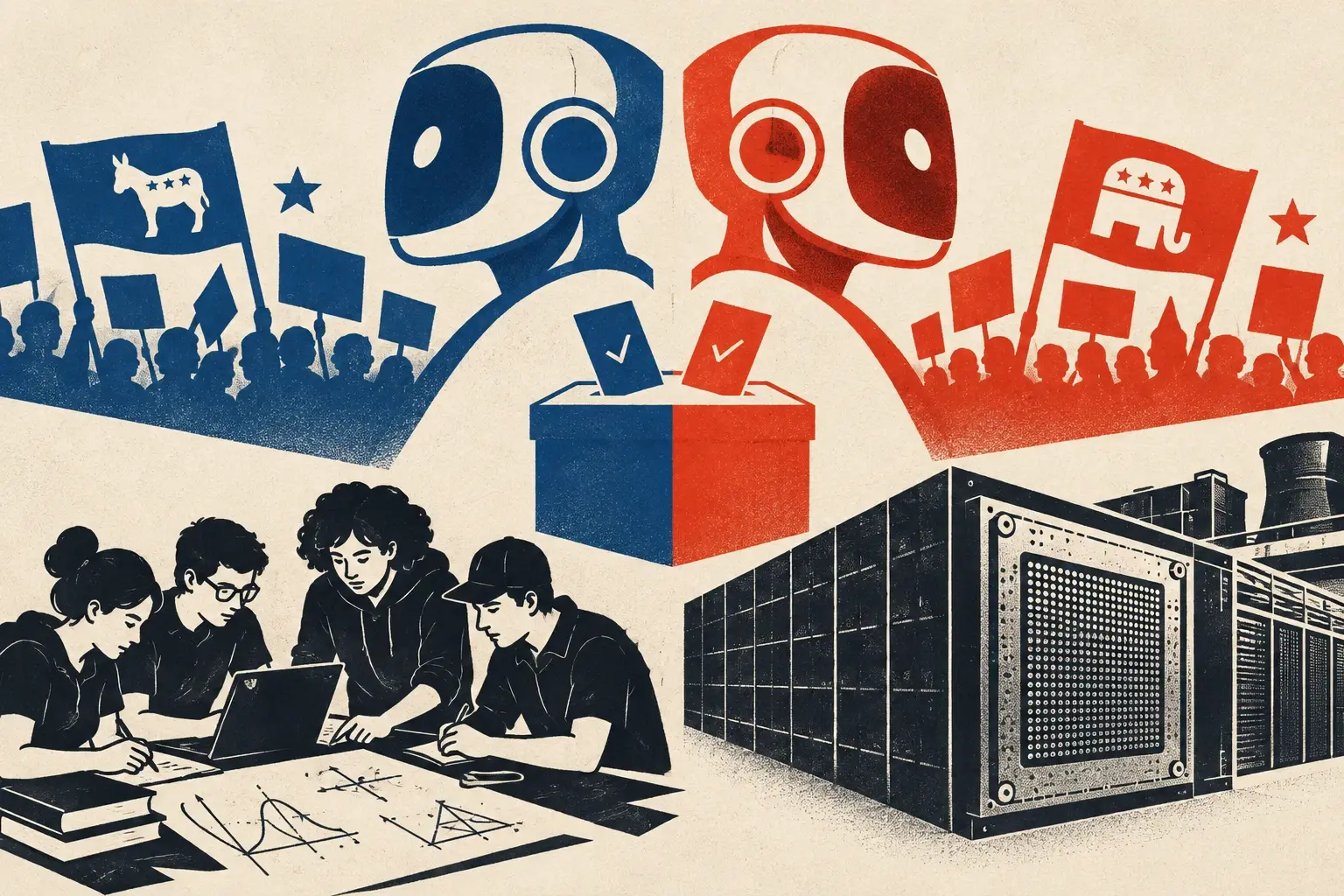
Ask a chatbot who to vote for and it will usually politely decline. Take away the politeness and you get a different answer. Researchers at Convovo, a studio led by Cornell’s Tapan Parikh, forced two models to pick a candidate across nearly 500 races. Grok 4.7 chose the Republican 92% of the time. OpenAI’s GPT-6.1 Sol chose the Democrat 97% of the time. They agreed on fewer than one race in ten.
The caveats matter. This was the developer API with a prompt demanding a single name; the consumer apps refused. OpenAI says as much. Still, the details are the story: Grok’s calls carried about 1,240 tokens of extra input the researchers didn’t write and couldn’t see, and its citations leaned on a Christian conservative voter guide, Turning Point Action and X. GPT leaned on Wikipedia, the AP, Axios and Reddit. Pew says 8% of Americans already use chatbots for election information, and the midterms are November 3. Nobody has to intend bias for a model’s sources to carry it.
Fixing the homework
The most useful AI story of the weekend involves no new model. Terence Tao announced a community hub for revising OpenAI’s math write-ups: the results are posted by OpenAI, the post says, but “can be difficult to understand and can have incomplete citations.” Students, postdocs and professors are invited to clean them up.
Commenters are split on whether volunteers should be polishing a for-profit lab’s output, and one claims a hardness result was already known, which is unverified. But this is what a verification layer looks like in practice: the machine produces volume, and humans supply readability and provenance. Compare the election study, where no such layer exists.
What it takes to serve the big ones
Cerebras explains how it deploys trillion-parameter models, using Moonshot’s roughly 3-trillion-parameter Kimi K3 as the example. A wafer holds 44 GB of on-chip memory, and at 4-bit weights the model needs about 1.5 TB, so the plan is 59 wafers: 24 for the dense layers, 35 for the linear-attention ones, passing only activations between them over Ethernet. The target is 1,000 to 2,000 tokens per second. It’s a vendor’s blog post, so treat the efficiency claims as aspirational, but the arithmetic shows why frontier open weights are no longer something you run on a spare box.
The sod is fresh
TechCrunch’s running AI graveyard is a useful reality check. It cites an S&P Global estimate that around 42% of corporate AI initiatives are abandoned, and lists Character.ai, which filed for bankruptcy this month with Disney bidding $20M for a license to some of its IP; OpenAI’s discontinued Atlas browser and shuttered Sora app; and a long tail of products that larger platforms simply absorbed. Relay, Huxe and Notion Mail all died the same way: a bigger platform shipped the feature.
The through-line this weekend is who checks the machine. The model picking candidates has no checker. The model writing proofs is getting one, for free, from mathematicians. And the startups building on top are discovering that the checker with the final say is the platform that ships the same feature next quarter.