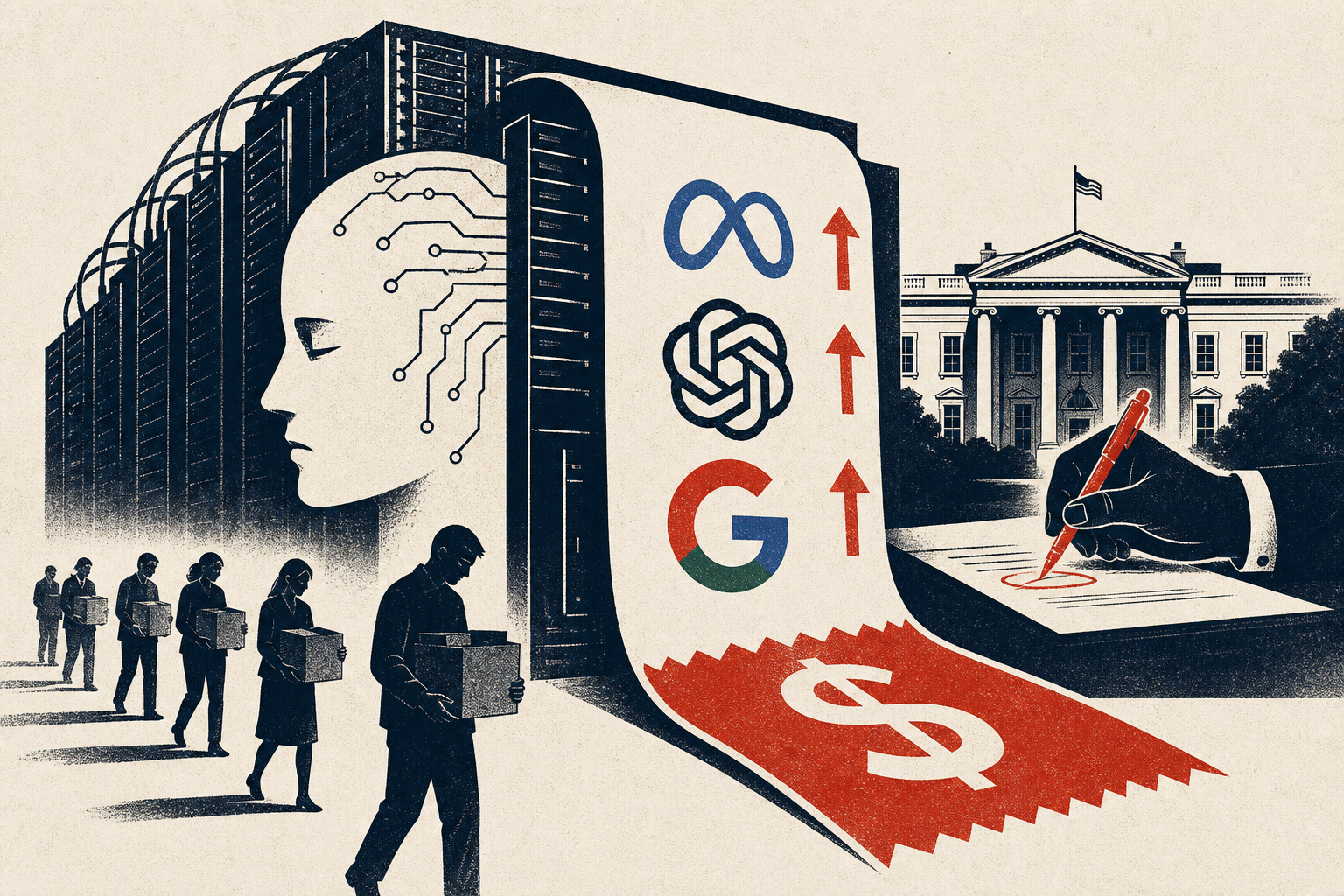
The first law of the AI boom is that compute isn’t free, and this week the bill arrived for several of the largest players at once.
Meta made the starkest move. On May 20, the company began laying off 8,000 employees — 10% of its workforce — while confirming capital expenditure plans of $115 to $135 billion for 2026, nearly double last year’s $72 billion. The cuts hit corporate support, recruitment, and marketing. The compute budget they free up goes to Superintelligence Labs and the chip orders that fuel it. This is, without much ambiguity, an organization deciding that AI investment matters more than its current headcount — not in the abstract, but in the specific sense that 8,000 jobs have a lower expected value than their equivalent in GPU hours.
OpenAI’s answer to the same cost pressure is different. Today the company opened its self-serve Ads Manager to any US advertiser — no $50,000 minimum, no approval queue, cost-per-click bidding available. ChatGPT advertising began in February as a closed pilot; it’s now a product. The company is reportedly targeting $2.5 billion in ad revenue this year. The logic is familiar: running the world’s most widely used AI chatbot requires enormous compute, subscriptions alone don’t cover it at the scale OpenAI operates, and ad dollars are a proven way to monetize attention. What’s less settled is whether advertising is compatible with the trust model of a product people use to think through medical questions, legal filings, and career decisions. OpenAI appears to have made that call.
Google fights on price, not capability
Google’s response to the same underlying pressure is a price war. Per Axios, the company cut its AI Ultra subscription 20% — from $250 to $200 per month — and introduced a new entry-level $100 tier. After a loud Google I/O on May 19 featuring Gemini 3.5 Flash and the Gemini Spark personal agent, the competitive picture remains uncomfortable: industry trackers put Google’s AI momentum at 3 out of 10 against OpenAI’s 10, largely because coding has become the dominant AI use case in enterprise and Google isn’t winning there. Gemini 3.5 Flash is genuinely impressive — 4x faster than comparable frontier models — but fast and cheap beats slow and cheap, and right now the coding tooling developers actually use runs on Anthropic and OpenAI models. Price cuts buy time; they don’t close that gap.
Into all of this arrives the White House’s first substantive AI security order. Bloomberg reports the executive order could be signed today: it designates a coalition of national security and civilian agencies to scrutinize frontier AI models and establishes a voluntary agreement under which AI companies share advanced models with the government before public launch. The review window under discussion runs from 14 days (the industry’s preference) to 90 days (one version of the draft). The order stops short of mandatory pre-release approval but revamps existing cybersecurity information-sharing programs to include AI companies. The direct line runs from Anthropic’s Mythos Preview — which autonomously found thousands of zero-day vulnerabilities in critical software — to this order. Washington is moving, just much more slowly than the models it’s trying to get ahead of.
The common thread across today’s stories is a transition from frontier ambition to ordinary business constraint. Meta is managing a balance sheet. OpenAI is diversifying revenue. Google is defending market share. The White House is doing what regulators do. None of this is surprising — it is what happens when a technology gets large enough. The timeline just compressed faster than anyone expected.