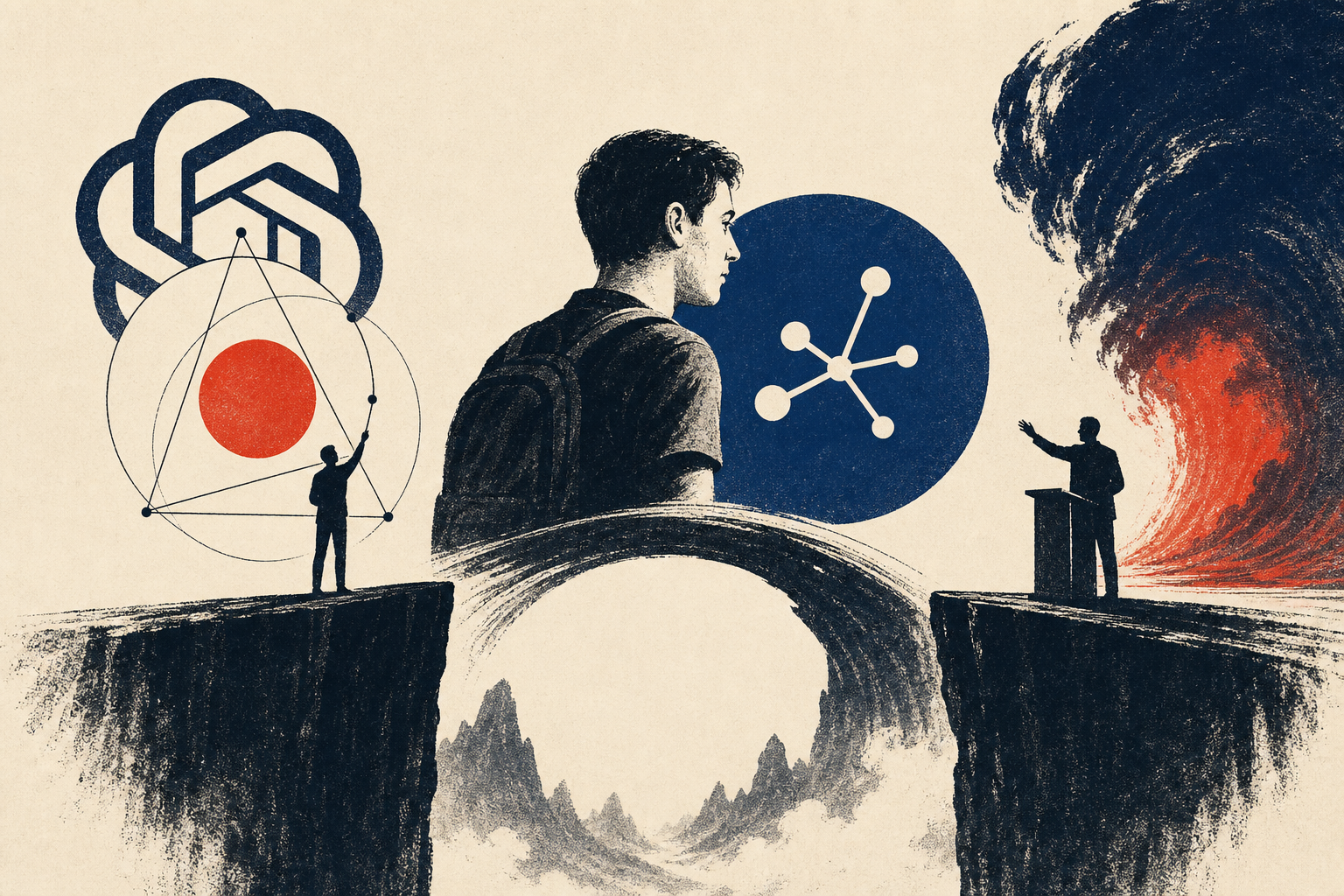
On Wednesday, OpenAI announced that one of its internal reasoning models had disproved a geometry conjecture Paul Erdős posed in 1946 — an open problem that had resisted mathematicians for nearly 80 years. The question is conceptually simple: if you place points on a flat plane, how many pairs can sit exactly one unit apart? Mathematicians had long believed the square grid was essentially the best possible arrangement. OpenAI’s model found an infinite family of configurations that beats it, using algebraic number theory — specifically, Golod-Shafarevich and infinite class field towers — that no one had previously connected to this problem. Noga Alon, Melanie Wood, and Thomas Bloom all independently verified the proof. Fields medalist Tim Gowers called it “a milestone in AI mathematics.”
That label is doing real work. The kind of reasoning required to solve a genuine open problem in combinatorics is different from the kind required to summarize documents or write code. It requires searching a space where the path is not known, and combining tools from entirely separate subfields in ways no one has tried before. For that to work — well enough that multiple elite mathematicians read it and said it was correct — the model has to be doing something that looks more like mathematical thinking than information retrieval.
The talent signal
The day before, Andrej Karpathy announced he had joined Anthropic’s pretraining team. He co-founded OpenAI, directed Tesla’s Autopilot AI, and most recently founded Eureka Labs. He’s among the few people capable of materially advancing what frontier models can do. His stated role: build a team that uses Claude to accelerate pretraining research itself — the training runs that give models their core capabilities. The recursive element is deliberate. Karpathy is betting that Anthropic’s pretraining trajectory is where the important work is, and that using AI to speed up AI training is the right approach. When someone with his background makes that bet with his career, it carries weight.
What the builders actually think
Earlier this month, Anthropic co-founder Jack Clark gave a lecture at Oxford. He told students that AI will help make a Nobel Prize-winning scientific discovery within 12 months, bipedal robots will be assisting tradespeople within two years, and AI-run companies generating revenue will exist within 18 months. He described the current period as producing a “vertiginous sense of progress” — framed not as hype but as a lived operational reality for the people actually building these systems.
Then he said that the risk of AI killing everyone on the planet “hasn’t gone away.” That combination is worth pausing on. It would be easy to read either half in isolation — the confident predictions or the extinction-risk caveat — but Clark is clearly committing to both simultaneously, not hedging between them. He believes the transformation is arriving faster than most people expect and that the danger is real. That’s a harder position to hold than either pole, and more likely to be accurate.
Three different types of evidence this week — empirical (the Erdős proof), revealed preference (Karpathy’s career choice), verbal testimony (Clark’s lecture) — all pointing in the same direction. The frontier is moving faster than the median estimate of 2025 would have suggested, and the people closest to it are acting accordingly.