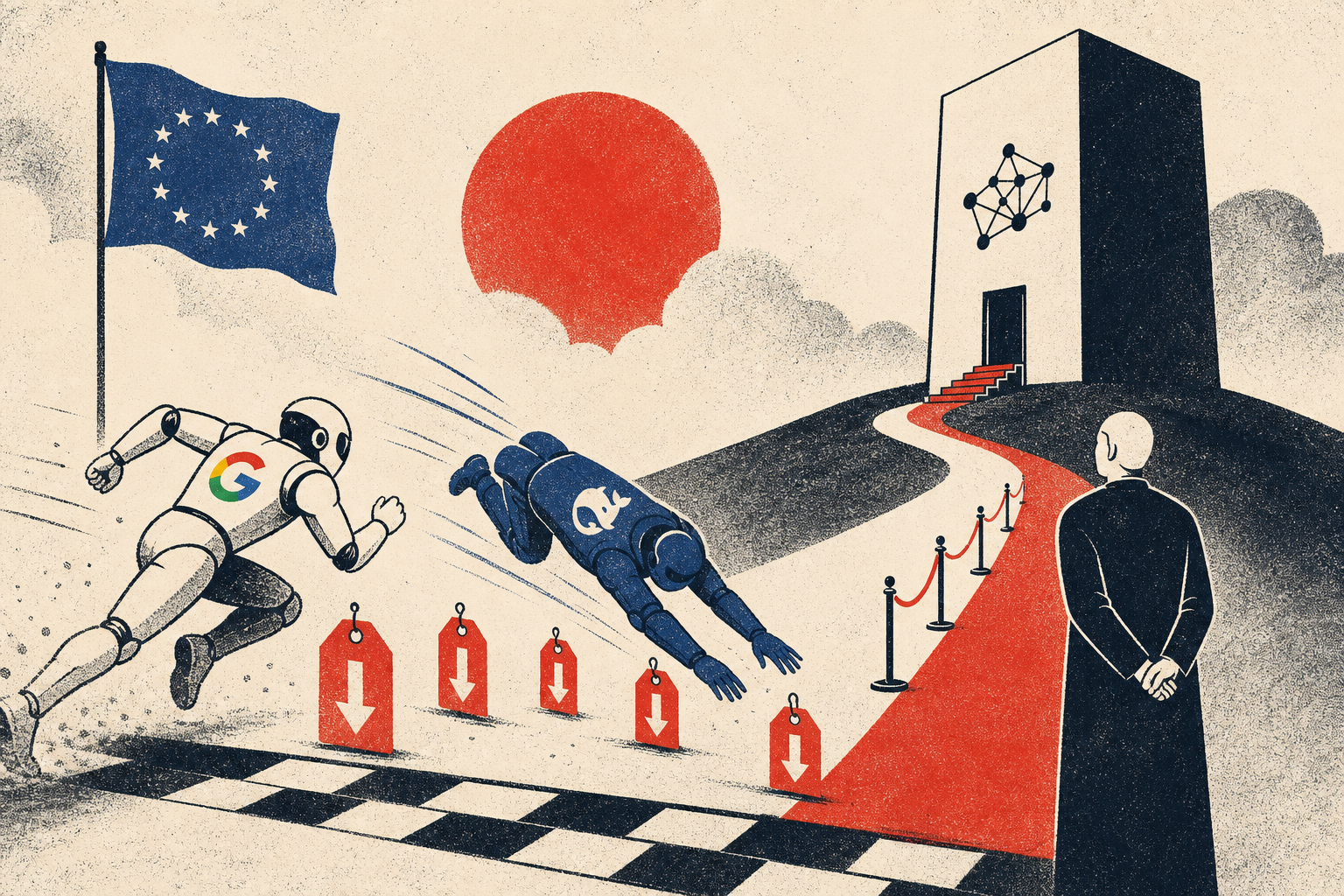
The dominant stories of the week share a curious tension: models are getting faster and cheaper while the companies making them are becoming more expensive.
Google kicked off the theme at I/O, announcing that its AI Ultra subscription would drop from $250 to $200 per month while a new entry tier launches at $100. The same keynote made Gemini 3.5 Flash generally available — Google claims it outperforms Gemini 3.1 Pro across coding, agentic, and multimodal benchmarks at four times the output-token throughput of comparable frontier models. Google also began rolling out Gemini Spark, a persistent AI agent running on dedicated cloud VMs around the clock, to trusted testers this week. The price restructuring reads as a direct response to Gemini’s documented market share climb: from 6% of AI-assistant usage a year ago to 25% now, largely at ChatGPT’s expense.
On Friday, DeepSeek made permanent what was supposed to be a temporary promotion. Its V4-Pro model, originally discounted 75% through May 31, will stay at that price indefinitely. Output tokens now run about 34 times cheaper than GPT-5.5. The decision locks in a pricing baseline that other providers can’t simply wait out.
That is the landscape Anthropic is raising into. According to Bloomberg, the company is in late-stage talks to close at least $30 billion in new financing at a valuation north of $900 billion — its second $30 billion raise inside a single calendar year. If it closes at that number, Anthropic would overtake OpenAI as the most valuable private AI company on the planet. The round is expected to close this month.
The surface contradiction — prices floor, valuations ceiling — resolves if you assume that the companies closest to the frontier will continue capturing outsize value regardless of what commodity models cost. At $900 billion, Anthropic’s investors are betting the frontier itself stays valuable even as the models one generation behind become nearly free. That bet requires the frontier to keep moving faster than the floor drops. So far that assumption has held. The key question is whether it holds structurally or only until DeepSeek’s next model.
The EU clears the board
The European Parliament and Council agreed on May 7 to push the high-risk AI compliance deadline from August 2026 to December 2027 — a 16-month extension. The amendment package is labeled Digital Omnibus and styled as simplification, but the operative effect is that regulated industries get another year and a half before they have to demonstrate compliance with the Act’s requirements. Two new prohibitions were added: AI systems that generate non-consensual intimate imagery, and systems that produce child sexual abuse material. Both take effect December 2026. The extension is probably honest. The AI Act was written against a pace of deployment the industry never produced, then far exceeded.