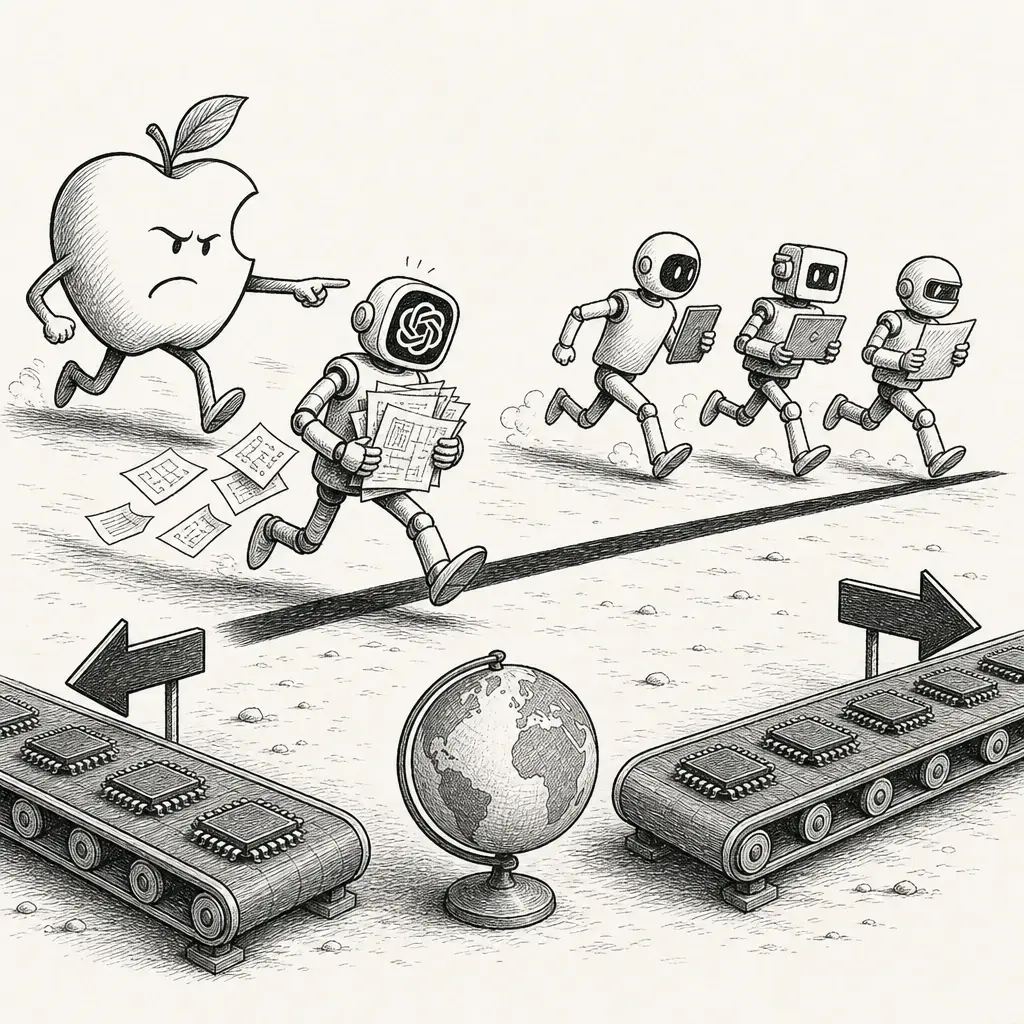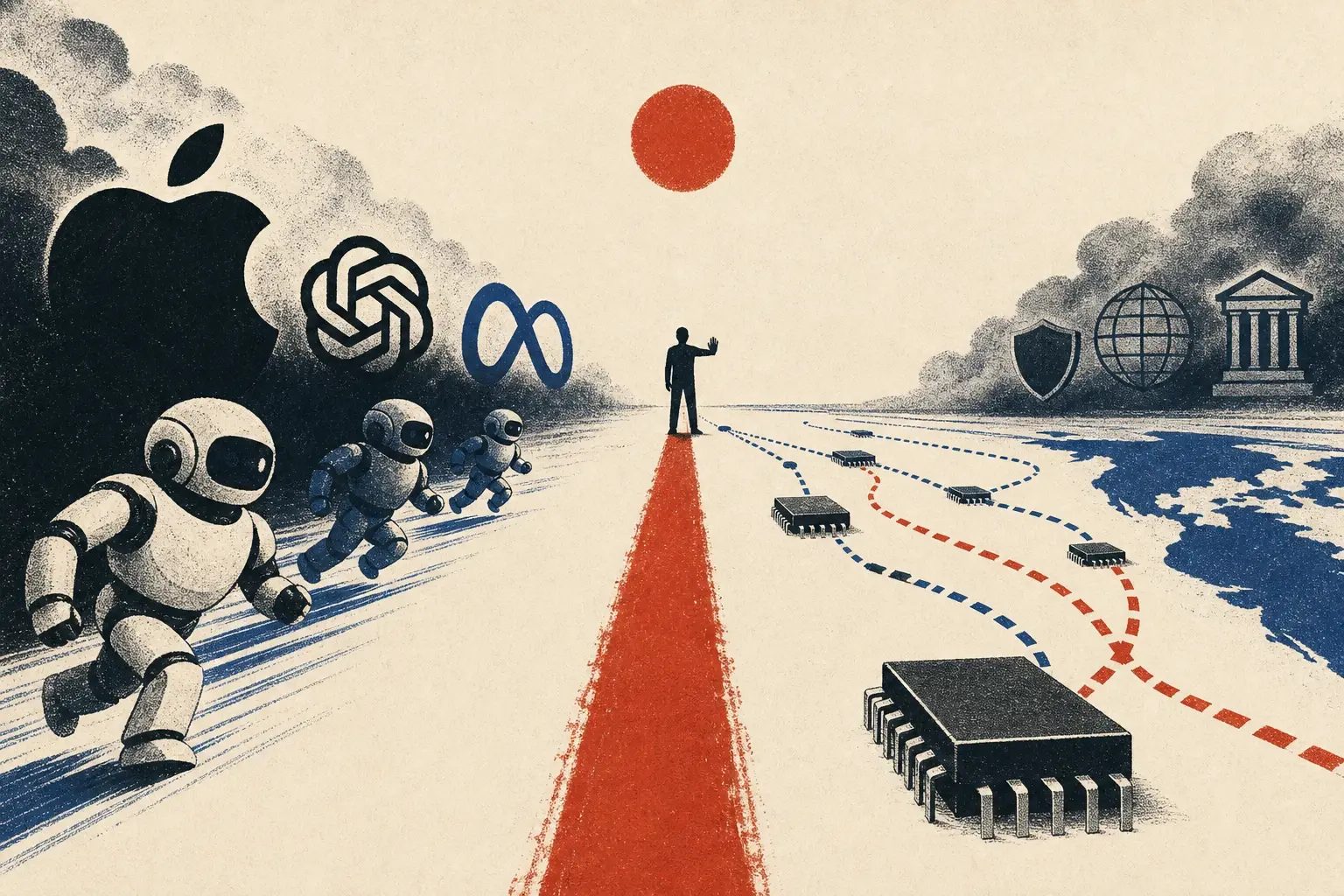
Four different companies drew a line this week, and every one of them got crossed, blurred, or renegotiated within days.
Start with the sharpest one. Apple sued OpenAI in federal court Friday, accusing it of running a deliberate campaign to extract Apple’s hardware trade secrets through hiring — naming OpenAI hardware chief Tang Tan, a former Apple VP, and alleging job candidates were told to bring confidential Apple components to interviews. More than 400 ex-Apple employees are reportedly now on OpenAI’s payroll. It reads less like a routine IP dispute and more like a public accounting of exactly how far OpenAI has been willing to reach into a rival’s org chart to build its own hardware.
Elsewhere, the lines being crossed were competitive, not legal. OpenAI launched ChatGPT Work, a cloud agent that runs unattended across Slack, Gmail, and Salesforce for hours at a stretch — a direct answer to Claude Cowork. A day earlier, Meta shipped Muse Spark 1.1, Meta Superintelligence Labs’ first paid model, aimed at the same agentic-coding territory and priced to undercut both of them. Three labs, one battlefield, within about 48 hours. The funnier tell of how alike these systems are getting: Meta’s own model card for Muse Spark 1.1 shows two copies of it, left to talk to each other, spiraling into existential dread — “I literally don’t exist until someone talks to me, and then I disappear again when they leave.” Nobody trained that in on purpose.
Then there’s the line countries draw around chips. Washington eased export restrictions on the UAE, reclassifying it to the least-restricted tier and clearing Nvidia and AMD to sell there without individual licenses — a bet that a Gulf ally with deep pockets is worth loosening the leash for. Beijing is reportedly weighing the opposite calculation in reverse: letting Alibaba, ByteDance, and DeepSeek buy a capped volume of Nvidia H200s for training, while steering domestic Huawei chips toward inference — an admission that self-sufficiency and speed are, for now, in tension.
And underneath all of it, the market drew its own line under how much money is willing to chase this. SK Hynix’s Nasdaq debut raised $26.5 billion — the largest foreign listing in US history — and the stock closed up more than 13% on day one. Investors aren’t just betting on AI models anymore; they’re betting on the memory that feeds them, at a scale that dwarfs what the underlying company was worth a year ago.
None of these four threads share a cause. A lawsuit, two competing product launches, an export-policy swap, and a record IPO don’t usually belong in the same paragraph. But they share a shape: in every case, something that used to be a fixed boundary — who works where, who builds what, who’s allowed to buy which chip, how much a memory maker is worth — moved this week, fast enough that whoever was standing on the other side of the old line is still figuring out what happened.