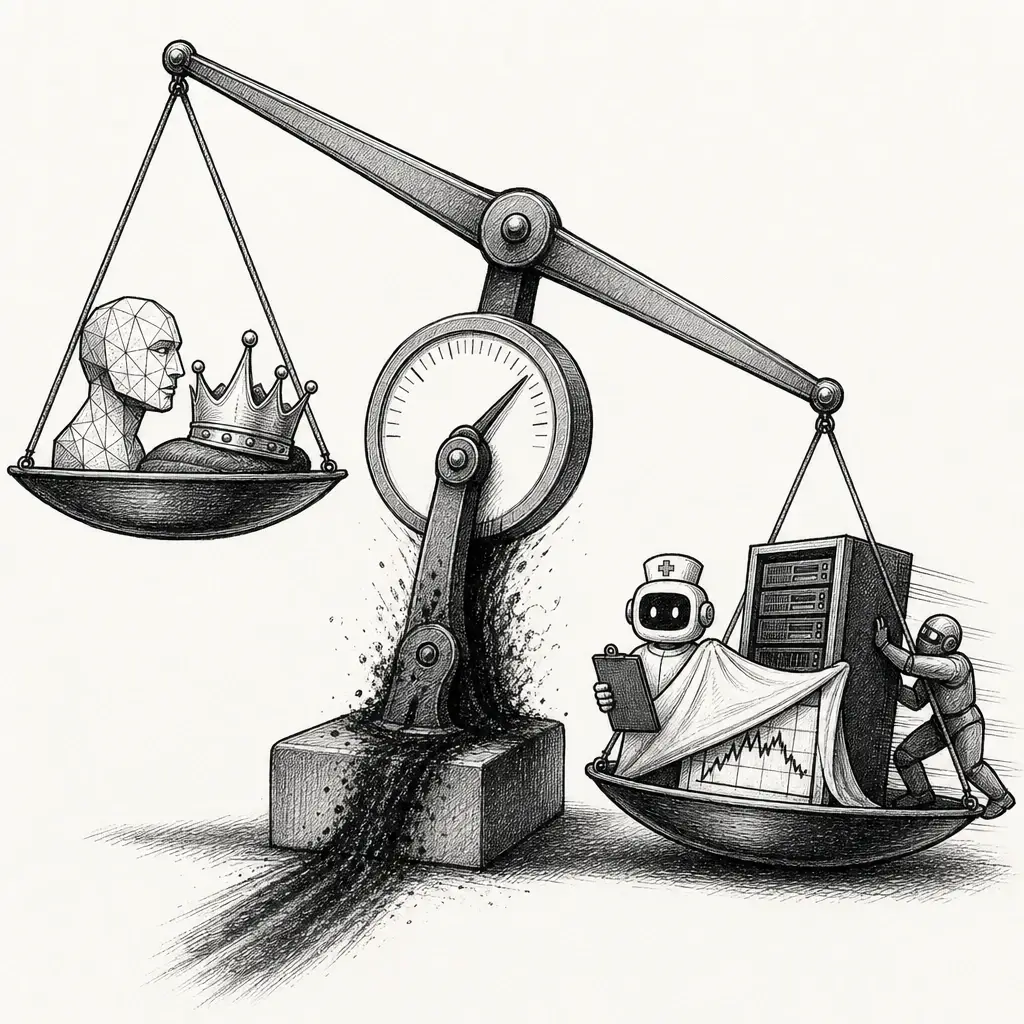
Nothing about today felt urgent, which is exactly when it’s worth looking at what actually happened this week and asking what it adds up to. Three separate stories — a valuation flip, a hospital’s AI scandal, and a hardware delay — point the same direction: the “ship it, scale it, sort out the details later” era of AI is running into things it can’t route around, even as the money keeps flowing.
Start with the money. Anthropic’s implied valuation on private secondary markets hit $1.2 trillion this week, edging past OpenAI’s roughly $908 billion for the first time — driven less by a new funding round than by a near-total absence of sellers, the kind of scarcity pricing that inflates fast and can deflate just as fast. Still, it lands alongside real revenue numbers: Anthropic’s enterprise-heavy business reportedly annualizes north of $47 billion against OpenAI’s consumer-subscription-driven $25-33 billion, with Anthropic claiming its first profitable quarter. Two different labs, two different bets on who monetizes AI first — and for now, the one that stayed out of the consumer hardware business is ahead.
Then there’s the story that should worry people more than a valuation swing. A former Mayo Clinic research director is suing, alleging she was pushed out after repeatedly flagging that a 2024 study of the hospital’s AI assistant, MAYA, concealed a 67% error rate, deleted unfavorable results, and ran unauthorized software — ten separate whistleblower reports, largely ignored, according to the complaint. This is the unglamorous version of “AI deployed at scale before anyone checked the math,” in a setting where the math is a patient’s care plan. It’s a preview of what the next wave of AI accountability lawsuits will look like once they move past chatbot hallucinations and into institutions that already had oversight structures — and allegedly worked around them.
Even the hardware underneath all of this is showing strain. Nvidia’s next rack-scale system, Kyber, meant to bundle 144 of its most powerful chips into a single cabinet, has reportedly slipped more than a year to 2028 over a stubborn 78-layer circuit-board problem — with a stopgap design scrapped after cloud providers balked at it. Nvidia calls its roadmap “intact”; the PCB suppliers whose stock dropped on the news are less sure. It’s a reminder that the industry’s compute targets assume manufacturing keeps pace with ambition, and this week it didn’t.
Against all that, Mira Murati’s Thinking Machines Lab published an argument for building AI the other way entirely — distributed, user-customizable, weights people can actually fine-tune themselves, rather than one model trained centrally and frozen for everyone. It’s a paper, not a product yet. But it’s a useful frame for the rest of the week: centralize, scale, and defend the lead has real costs — financial volatility, institutional trust, physical manufacturing — and at least one lab thinks that’s a reason to try something else.