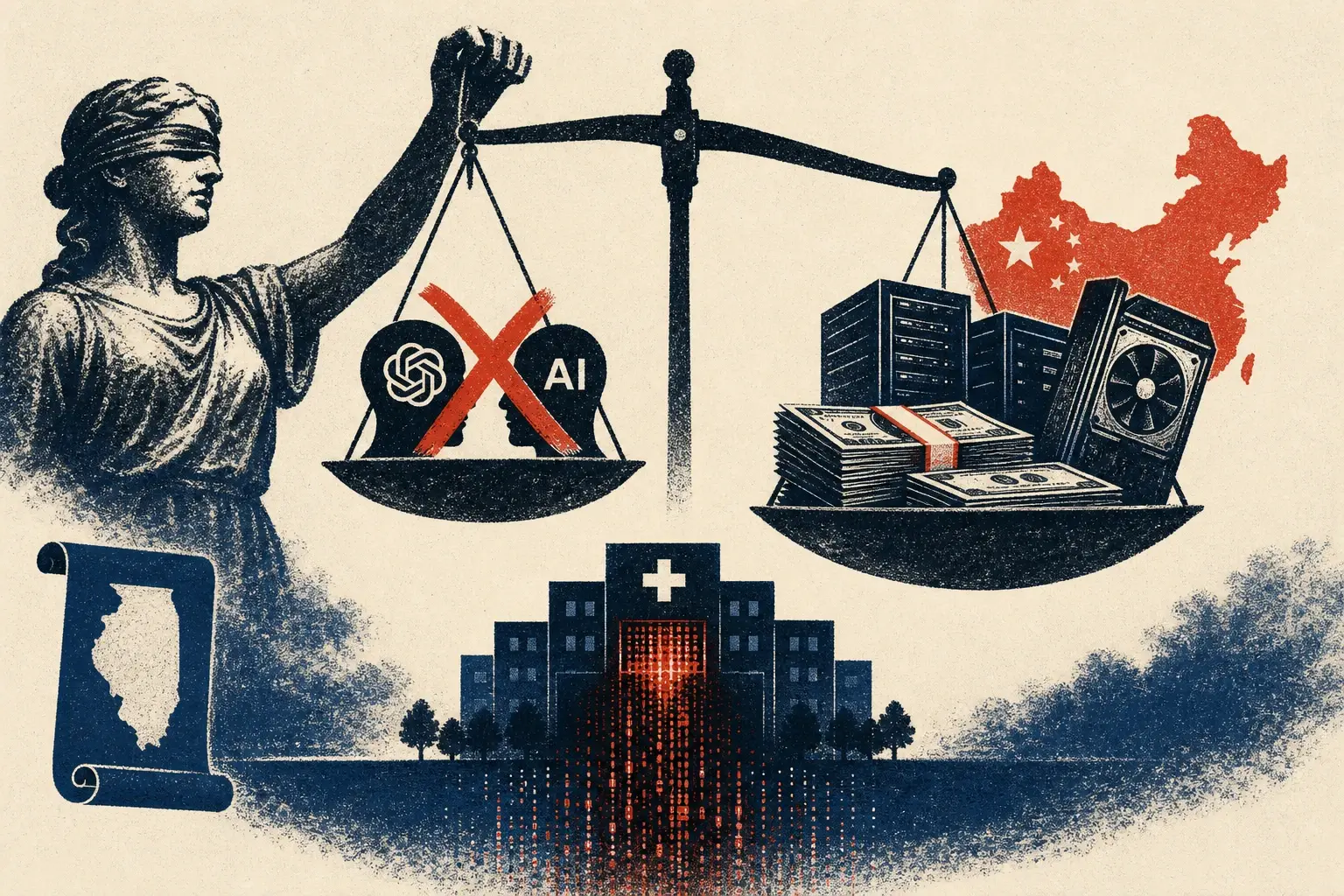
Every day this week, a lab shipped something and an institution promised to watch more closely. By Sunday, it’s clear which of those two forces actually moved the ground.
The oversight side had a strong open. Illinois signed the nation’s toughest AI safety law, requiring frontier labs to submit to independent audits, backed publicly by both OpenAI and Anthropic. The UN opened its first Global Dialogue on AI Governance in Geneva, pulling 169 countries into the same room. And the Future of Life Institute handed out its first outright failing grades — F’s for xAI, DeepSeek, and Mistral — the kind of report that reads like a real reckoning is finally arriving.
Except it didn’t slow anyone down. xAI shipped Grok 4.5 to the public two days after its own F, rebranded as SpaceXAI and pitched at legal and finance work. DeepSeek and Mistral kept releasing on schedule. Illinois’ audit mandate doesn’t bind until 2028; the UN dialogue produced statements of concern, not enforcement. A grade with no consequence attached turned out to be exactly that — a grade, not a governor.
What actually moved was speed and money, and by midweek both had visibly cracked. Four labs picked four different frontiers within about 48 hours — Grok 4.5 into legal and finance, Meta’s Muse Image and Video into creative tools, Mistral’s Robostral into warehouse robots — while Google did the opposite and delayed Gemini 3.5 Pro again, scrapping its base architecture rather than ship something merely adequate. In hindsight, caution looks better than it did on Tuesday: Meta pulled Muse Image’s Instagram-photo feature within days of backlash, and the week closed with Apple suing OpenAI over an alleged campaign to poach hardware secrets through hiring — a dispute that reads like the cost of racing into a rival’s category faster than trust could catch up.
The China thread bent in an unexpected direction too. Midweek, the story was Beijing weighing whether to wall off its own frontier models from the outside world, and Chinese developers being told to ditch Claude Code over a disputed “backdoor.” By the weekend it looked less like a wall and more like a valve: reports that Beijing might let Alibaba, ByteDance, and DeepSeek buy capped volumes of Nvidia H200s for training, even as it keeps steering Huawei silicon toward inference. Restriction and access, tightening at the same time, in different directions — a messier and more accurate picture than “China closes off” ever was.
And the number that actually summed up the week arrived today, not as a headline event but as a market signal: Anthropic’s private-market valuation quietly passed OpenAI’s, on the same weekend a former Mayo Clinic director alleged the hospital concealed a 67% error rate in its own AI assistant, and Nvidia’s next server rack slipped a year over a circuit-board problem nobody outside SemiAnalysis was tracking. None of that got a hearing or a report card. It’s just what happens when the pace of shipping outruns the plumbing and the paperwork both — the safety index measured intentions, and the market and the hardware measured what was actually true.
If there’s a thread worth carrying into next week, it’s this: the labs that looked cautious — Google slow-walking Gemini, Anthropic staying out of consumer hardware — are the ones that didn’t have a bad week. Everyone else did, in some form, and none of it showed up on a safety scorecard.