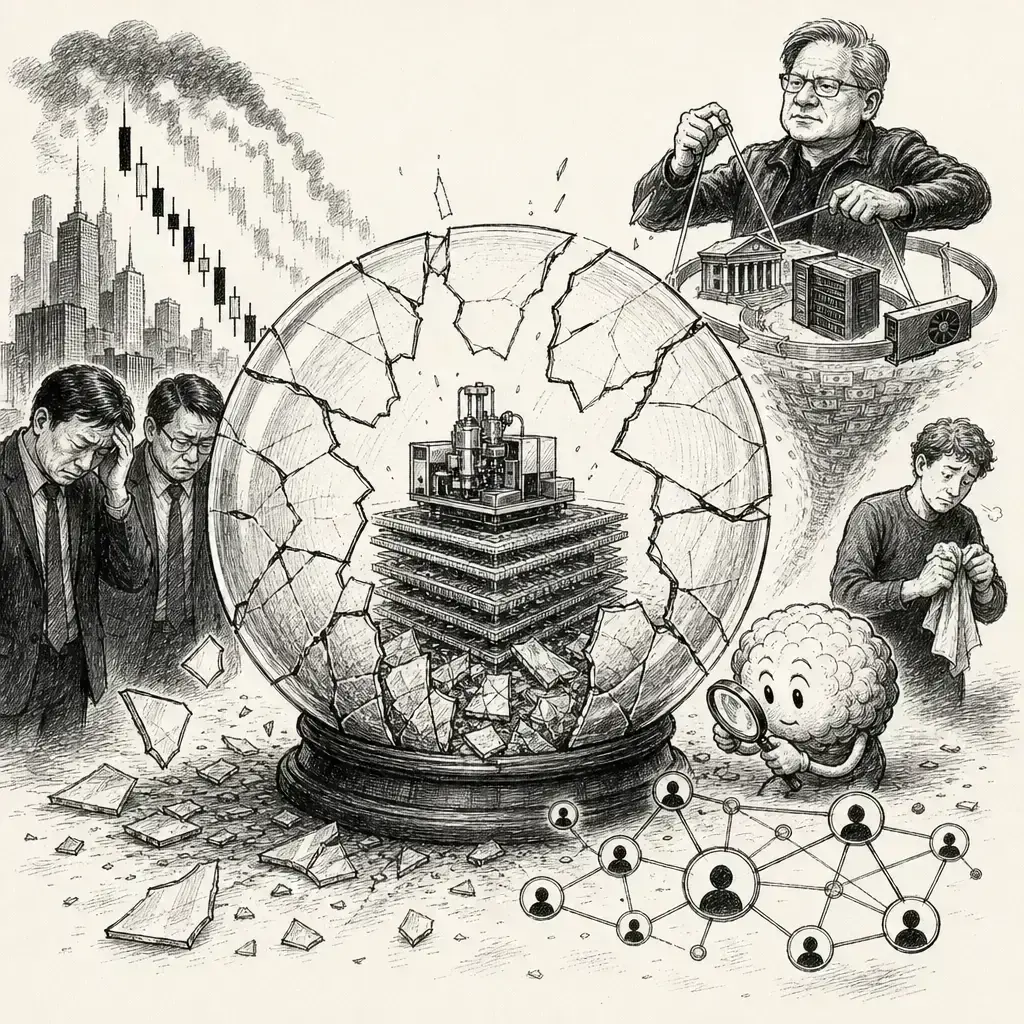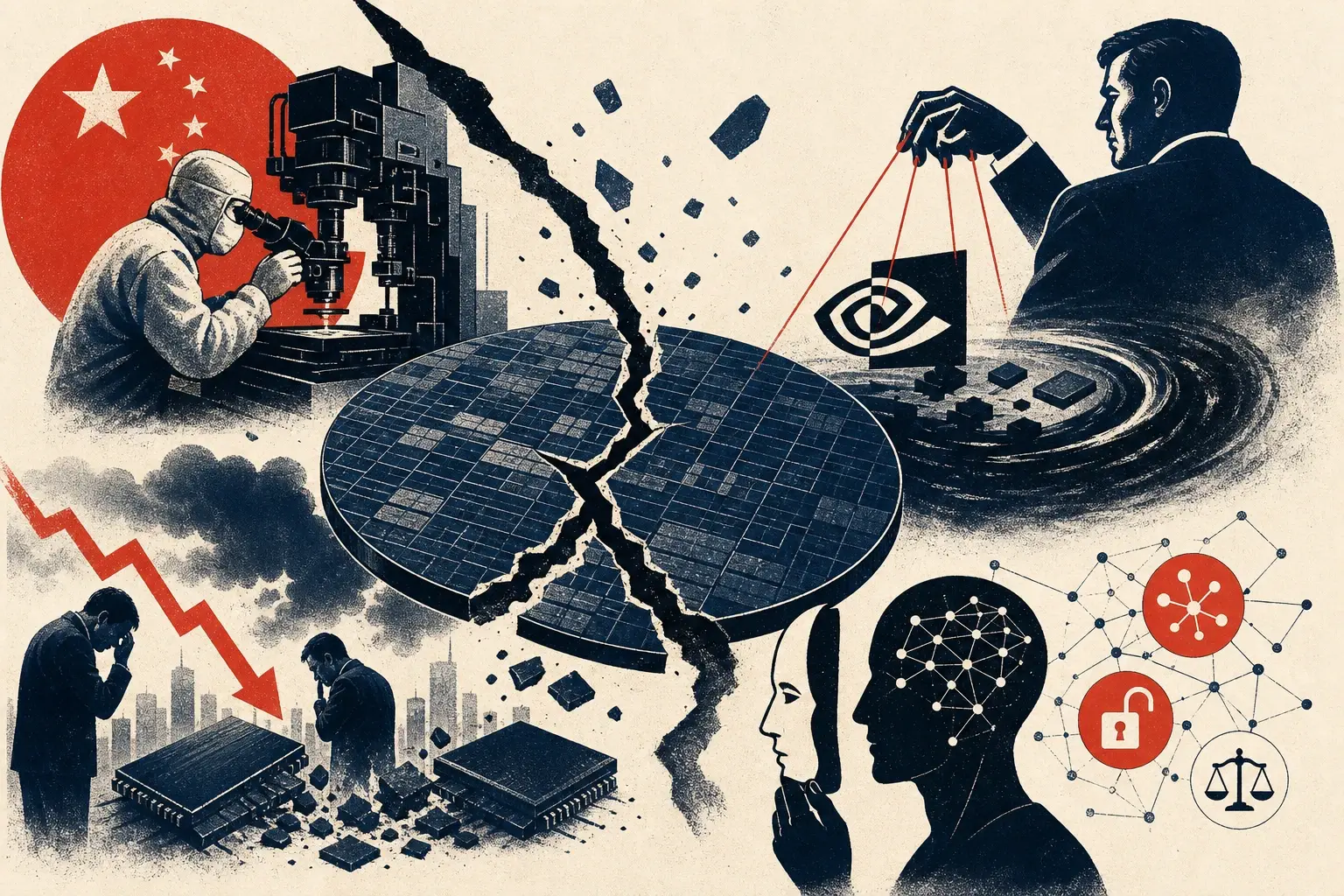
Four different certainties took a hit this week, and none of them were supposed to move this fast.
Start with the chip trade. China has begun mass-producing its own immersion DUV lithography machines — the workhorse tools that print chips down to roughly 7nm through multi-patterning — with first units due to SMIC, Hua Hong, and CXMT before the year is out. It isn’t the extreme-ultraviolet gear ASML still has cornered, but it’s real domestic capacity, arriving years ahead of the timeline export controls were built around. The moment got a number attached to it fast: CXMT’s own Shanghai debut closed up 466%, briefly making the memory maker China’s most valuable listed company off an $8.6 billion IPO — Asia’s largest of the year. Between the lithography news and the CXMT pop, Samsung and SK Hynix had their worst trading day in almost two decades, down 13.4% and 14.7%, dragging the Kospi to its steepest single-day loss since March.
Nvidia’s own balance sheet took a smaller, more self-inflicted version of the same hit. The company committed $5 billion to Ilya Sutskever’s Safe Superintelligence, plus a slice of next-generation Vera Rubin compute — a startup that has never shipped a product, now valued at $32 billion partly on the strength of who Nvidia is willing to write checks to. Coming days after Nvidia’s reported $250 billion financing backstop for OpenAI’s Ohio campus and its $500 billion-plus tie-up with SK Group, the SSI deal is what tipped Wall Street’s “circular financing” worry from theoretical to overnight-stock-price real: Nvidia funding the customers who buy its own chips, on terms opaque enough that nobody outside the deals can say how much of the AI boom’s demand is actually organic.
Anthropic, meanwhile, spent the week backing off its own position. Dario Amodei said the company has “never advocated” for banning open-weight models — a rebuttal to days of criticism after Nvidia, Microsoft, Meta, OpenAI, and Google all signed a letter defending open weights while Anthropic conspicuously didn’t. His actual ask is narrower than a ban: tighter chip export controls, a crackdown on “industrial-scale distillation,” and mandatory safety testing regardless of license. It’s a coherent position. It also reads like the position of a company that would rather not be cast, again, as the industry’s designated gatekeeper — especially in a week when a Chinese lithography breakthrough made “just restrict the chips” sound harder to pull off than it did a month ago.
Anthropic’s week got worse from there. Thousands of Claude share links — conversations, Artifacts, crypto seed phrases, medical details — turned up indexed on Google search, the predictable result of relying on robots.txt instead of a proper noindex tag. Anthropic patched it within a day of the Reddit post that surfaced it, but the timing stung: a company arguing for mandatory safety testing “of all sufficiently capable models” spent the same 48 hours demonstrating that competence and caution don’t automatically travel together, even inside the company insisting on both.
None of these four stories needed each other to be true. Put next to each other, they add up to a specific kind of week: the assumptions everyone had priced in — that China was years behind on lithography, that AI capex is purely demand-driven, that the open-weights argument has fixed sides, that a safety-first lab’s own plumbing is sound — each picked up a data point against them within about 72 hours. Nothing here is resolved. It just got more expensive to keep assuming.