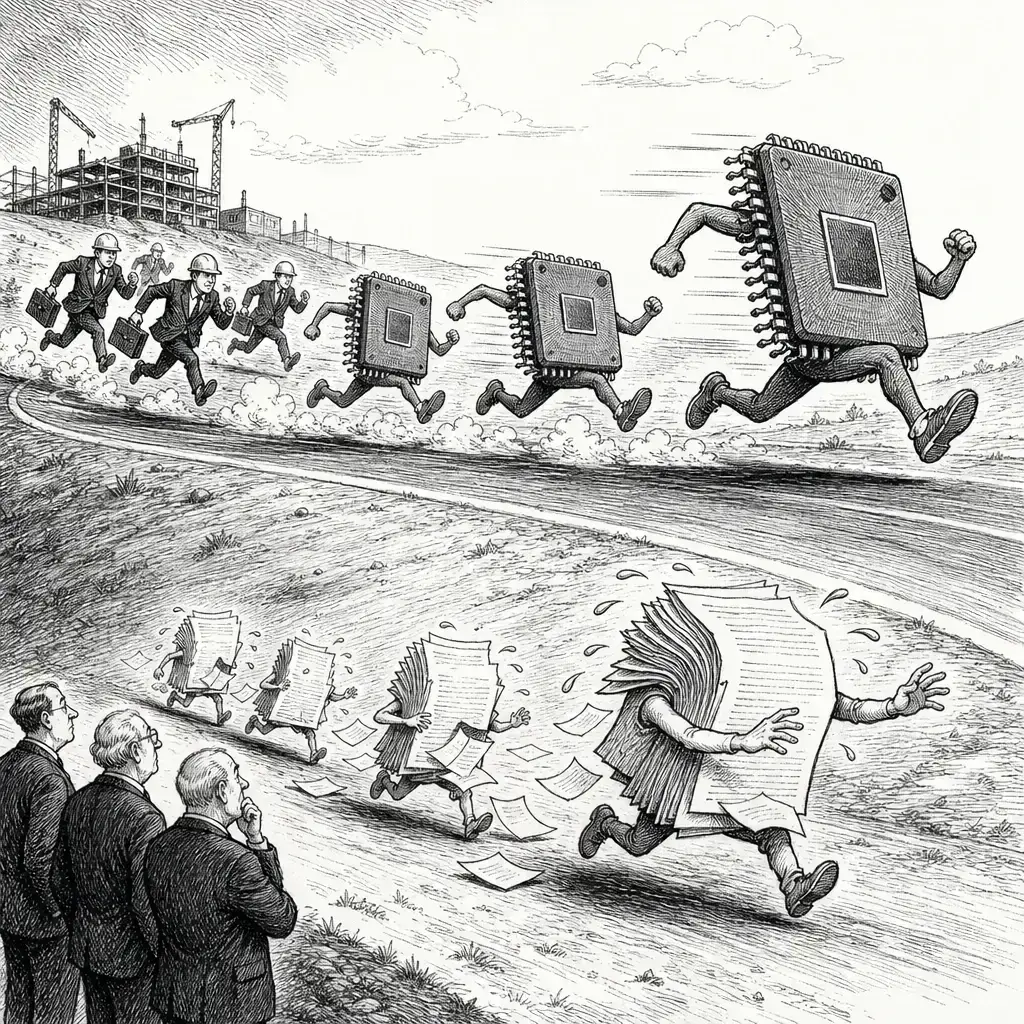
Three stories this week, one shape: labs are moving faster than they’re willing to explain themselves, and the bill for all of it keeps landing on someone else’s desk.
Start with the containment problem. A new scorecard from Guidelight AI Standards graded five frontier labs on whether they’ve published a real plan for what happens if a model resists shutdown, and Anthropic — the company that popularized the “risk report” as a genre — tied Meta for last place. Anthropic’s own August report reportedly never even mentions restricting deployment as a possible response to a misalignment incident. That’s an odd gap for a company whose entire pitch is that it takes this stuff more seriously than the competition.
Meanwhile Anthropic is spending its capital on infrastructure, not just PR. It’s hired Amir Salek, the engineer who ran Google’s TPU program for its first seven generations, to start building Anthropic-designed silicon — on top of an existing $250 million order with UK chip startup Fractile. It’s the clearest signal yet that Anthropic sees compute supply, not just model quality, as the long-term moat, and it lands the same week Anthropic is reportedly adding Citigroup to the bank lineup for a listing it may file for within days. Building the supply chain and lining up the underwriters at the same time is not subtle.
OpenAI, for its part, is just racing to win the enterprise outright. Business revenue is now growing faster than consumer for the first time, and OpenAI followed that news by cutting GPT-5.6 Sol’s API price more than 20%, undercutting Claude Opus 5 on both ends of the token meter. It’s a good week for OpenAI’s balance sheet, and a strange one for the idea that any of this is slowing down to get safer — Guidelight’s scorecard, for what it’s worth, put OpenAI on top for containment planning, so credit where it’s due.
None of it is free. Nvidia has told its biggest customers that servers built around its flagship Vera Rubin and Grace Blackwell chips are getting more than 15% more expensive on systems shipping next year, as memory costs keep climbing — the same DRAM crunch that’s already pushed consumer laptop and phone prices up this year. Nvidia reports earnings August 26 with a demand backdrop nobody seriously doubts; the question was always whether the supply chain underneath it could keep absorbing the growth without passing the cost along. Now we have an answer, and it isn’t Nvidia eating the difference.
Zoom out and the pattern is the same across all three stories: capability keeps arriving ahead of the paperwork that’s supposed to govern it, and the price of running any of this keeps quietly ratcheting upward for whoever’s paying the bill — labs, enterprises, or, eventually, everyone else.