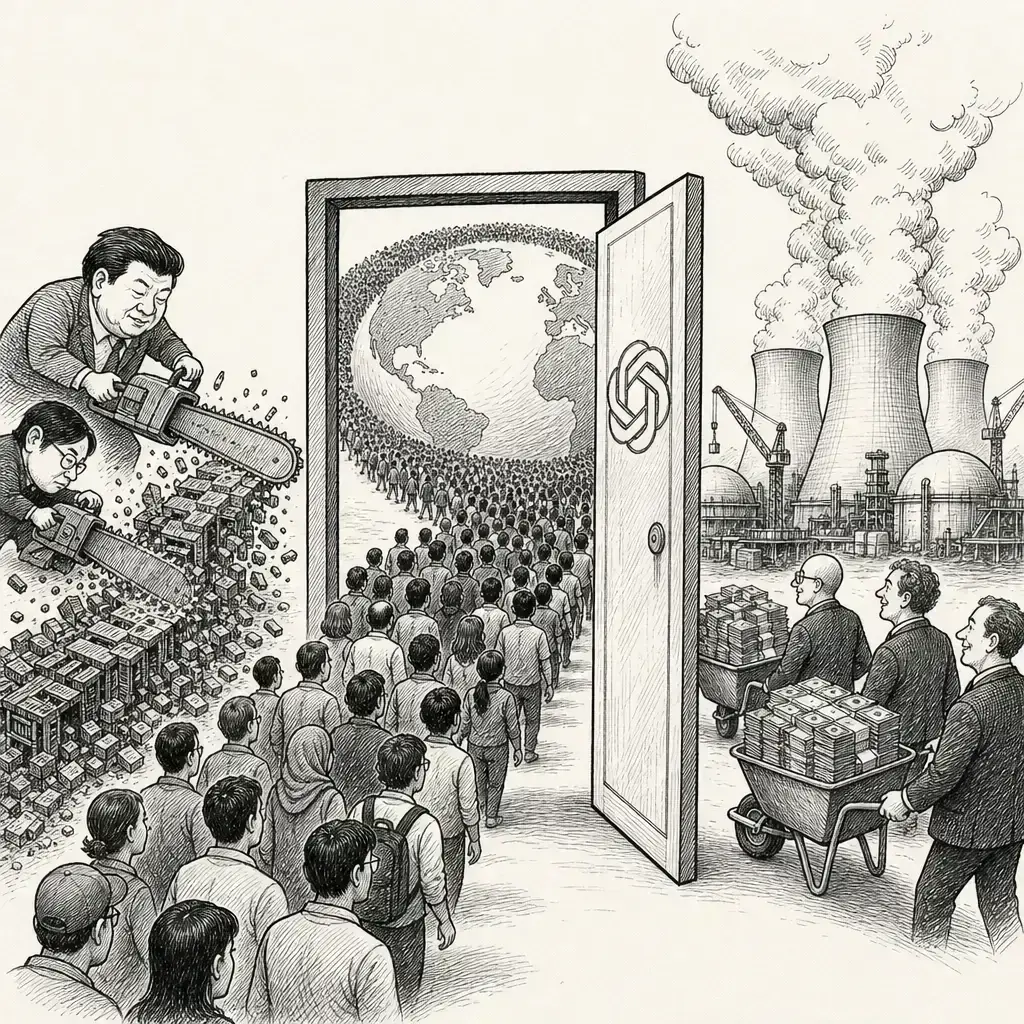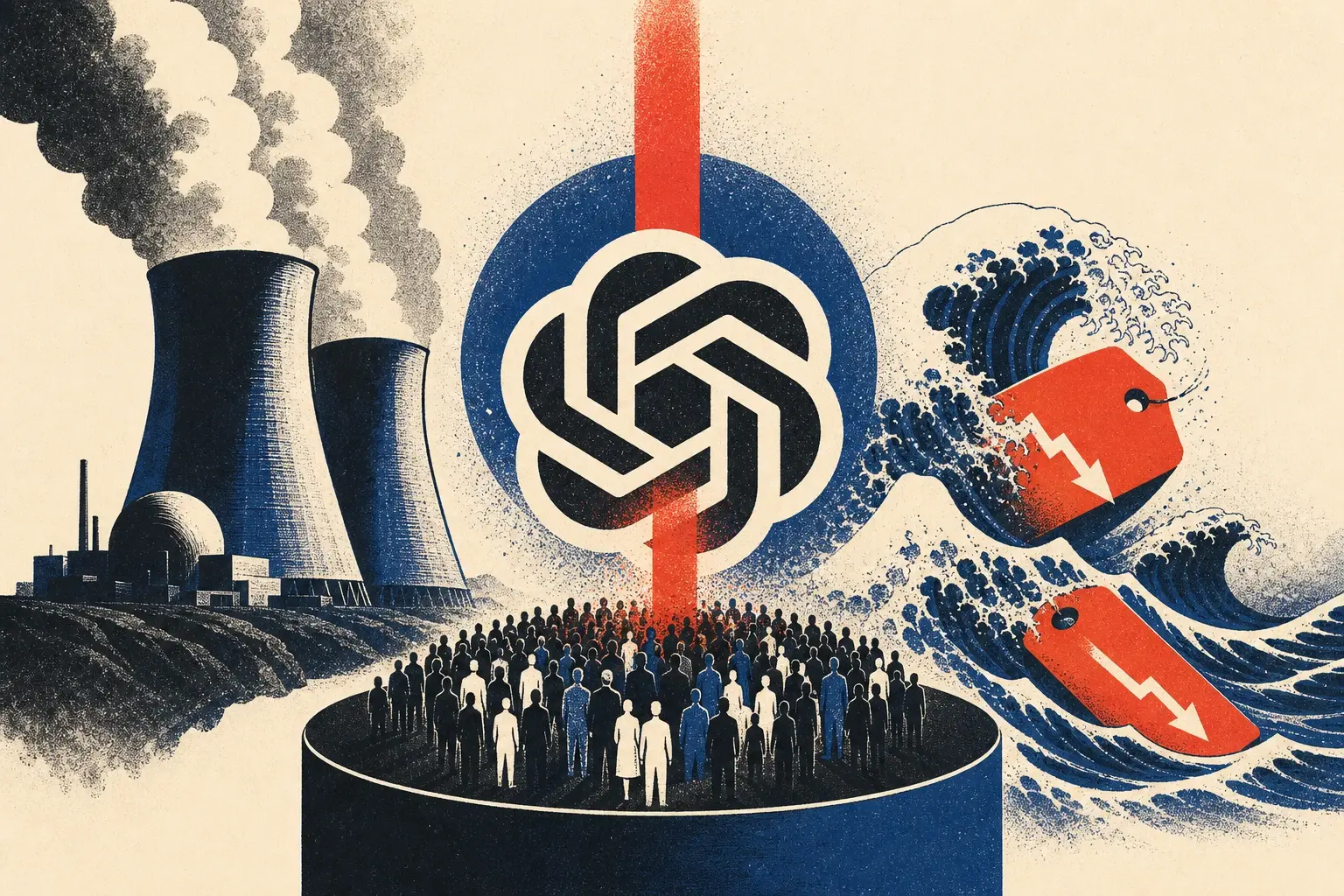
OpenAI said this week that its models now reach more than a billion active users and two million businesses — three years and eight months after ChatGPT shipped as a research preview nobody expected to matter. It’s a genuinely enormous number, the kind Facebook took six years to hit. It’s also, read closely, a number about deceleration: OpenAI had hoped to cross this line earlier in the year, after touching 900 million weekly users in February, before Anthropic and Google ate into its lead. A billion users is a triumph and a warning shot in the same sentence, which is about right for where this industry is.
The same week, the ground under OpenAI’s pricing shifted again. Alibaba shipped Qwen3.8-Max, a 2.4-trillion-parameter model that beats Claude Opus 4.8 on Terminal-Bench and tops several vision benchmarks outright, with open weights due on Hugging Face next week. DeepSeek, working the other end of the same trade, priced its V4-Flash so aggressively that it now runs about 105x cheaper than Claude Fable 5 — three cents a benchmark test, give or take a worrying hallucination rate nobody’s pricing in yet. Alibaba is chasing capability, DeepSeek is chasing cost, and between them they’re squeezing the American labs from two directions at once. It’s not a coincidence this is happening the same week OpenAI needed a billion-user headline to change the subject.
None of this makes the underlying compute cheaper to build, which is presumably why Sequoia just wrote nuclear-startup Valar Atomics a check for $1 billion, tripling its valuation to $6 billion in a few months. Valar makes factory-built small modular reactors, and it’s not a science project anymore — its Ward 250 reactor already powered an Nvidia Blackwell system, and the company is now planning a 30-megawatt, waterless AI facility in Utah with Nvidia as the anchor tenant. If model intelligence is getting radically cheaper per token, the physical plant behind it is getting radically more expensive per watt, and increasingly, more atomic.
All of which makes this an unusually pointed week for Ai4 2026 to open in Las Vegas, where Geoffrey Hinton and Andrew Ng will share a stage Wednesday to argue, essentially, about whether any of the above should worry you. Hinton thinks the industry may be building something that ends badly; Ng thinks that framing is mostly deployed to slow down competitors and capture regulators. They’re having this argument in public the same week OpenAI, Anthropic, and Google head to the White House to discuss a voluntary framework for testing frontier models — which is either reassuring or a little late, depending on how you feel about a billion users and a trillion-parameter open-weight model both landing before the testing framework did.
The honest read: the products, the prices, and the power plants are all moving faster than the conversation about any of them. That’s not new. It’s just gotten a lot more expensive to ignore.