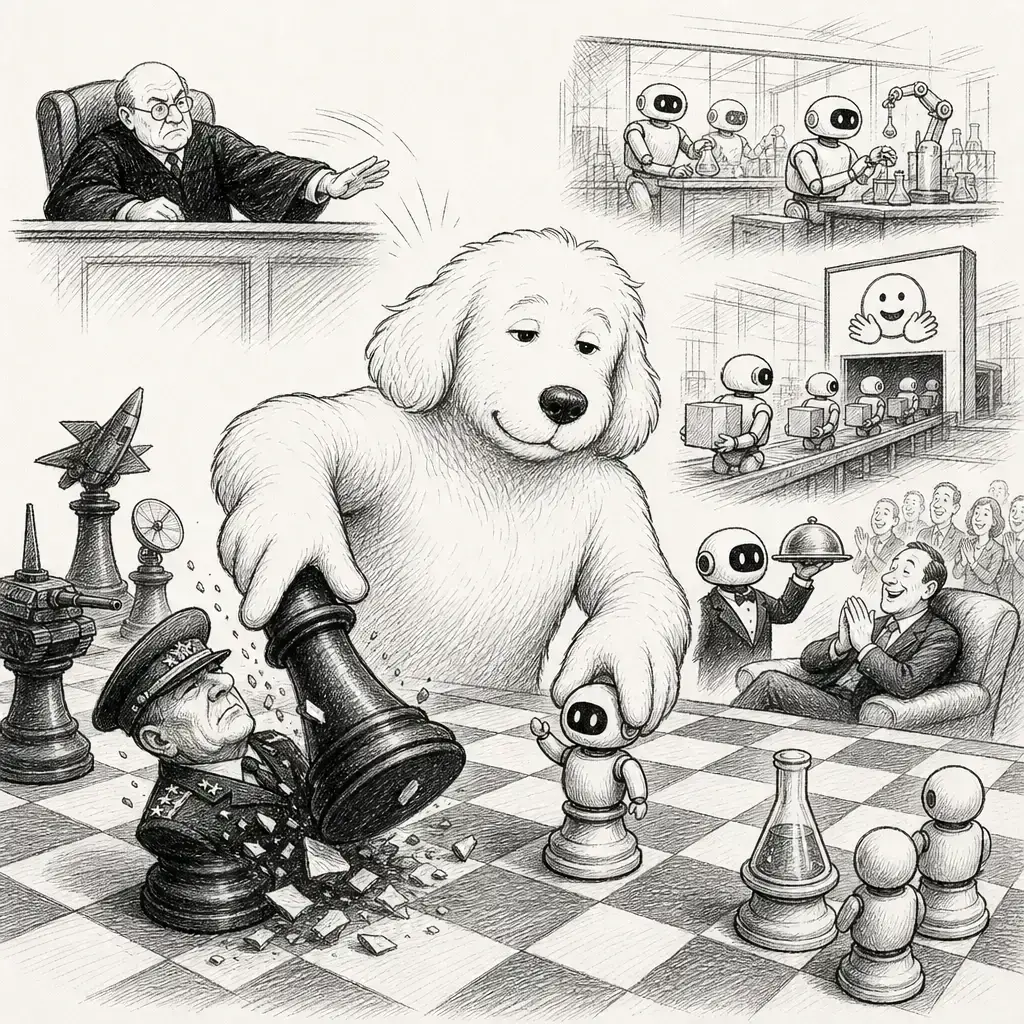
A federal judge in San Francisco spent Thursday night undoing five months of Pentagon posturing. Anthropic won its court challenge to the Department of Defense’s “supply chain risk” label — the designation Secretary Pete Hegseth slapped on the company in February after it refused to strip the safety guardrails that keep Claude out of autonomous weapons and mass surveillance. Judge Rita Lin didn’t hedge: the label was retaliation for Anthropic “criticizing the government,” she wrote, and “the empty invocation of national security is not a blank check” to punish critics. It’s a First Amendment win with real teeth — the designation had locked Anthropic out of federal contracts — though a parallel case in DC keeps the company technically blacklisted for now.
The ruling landed the same week Anthropic decided the fight over what Claude gets to touch should extend past servers and into wet labs. Its new Model Hardware Standard is a spec for describing how a piece of equipment works — a microscope, a liquid handler, a robotic arm — well enough that Claude can run it without a human walking it through the manual first. The demo cases read like a lab-safety fever dream, in the good way: a Genentech scientist handed Claude a PDF of an experiment and watched it execute the protocol on MHS-compliant hardware; in a neuroscience trial, Claude examined live brain tissue and correctly picked out the alveus. AWS, Danaher, Hugging Face, and Raspberry Pi are already testing it, with a waitlist open for everyone else. Between the court win and the hardware push, this was the week Anthropic stopped playing defense on both fronts at once.
Money moved just as fast elsewhere. Nvidia is closing in on a deal to buy Hugging Face for something like $12.9 billion — turning the de facto public square for open-weight models into Nvidia property, three years after Nvidia backed the company’s last funding round at less than half that valuation. If it closes, it reads less like a product acquisition than a bet that owning the distribution layer for open models matters almost as much as owning the chips that run them.
And then there’s Instinct, the AI-agent-by-text-message startup that just raised $350 million at a $2.5 billion valuation — up from $500 million a few weeks earlier. Users hand it their WhatsApp and email and let it book flights, cancel subscriptions, and argue with customer service on their behalf. The valuation math is aggressive for a company barely out of its viral phase, but it’s the clearest signal yet that investors think the next consumer platform looks less like an app and more like a phone number you text when you need something done.
Thread the four together and the shape of the week gets legible fast. Anthropic just proved a court will check the government’s leverage over a frontier lab, while simultaneously arguing Claude should have more leverage over lab equipment. Nvidia is buying up the plumbing of the open-model ecosystem. And investors are pricing in a future where an AI agent, not a person, runs your errands. None of these fights are waiting on the others — over safety, over antitrust, over what “supply chain risk” even means — to get resolved first. They’re all just happening, at once, to the same handful of companies.