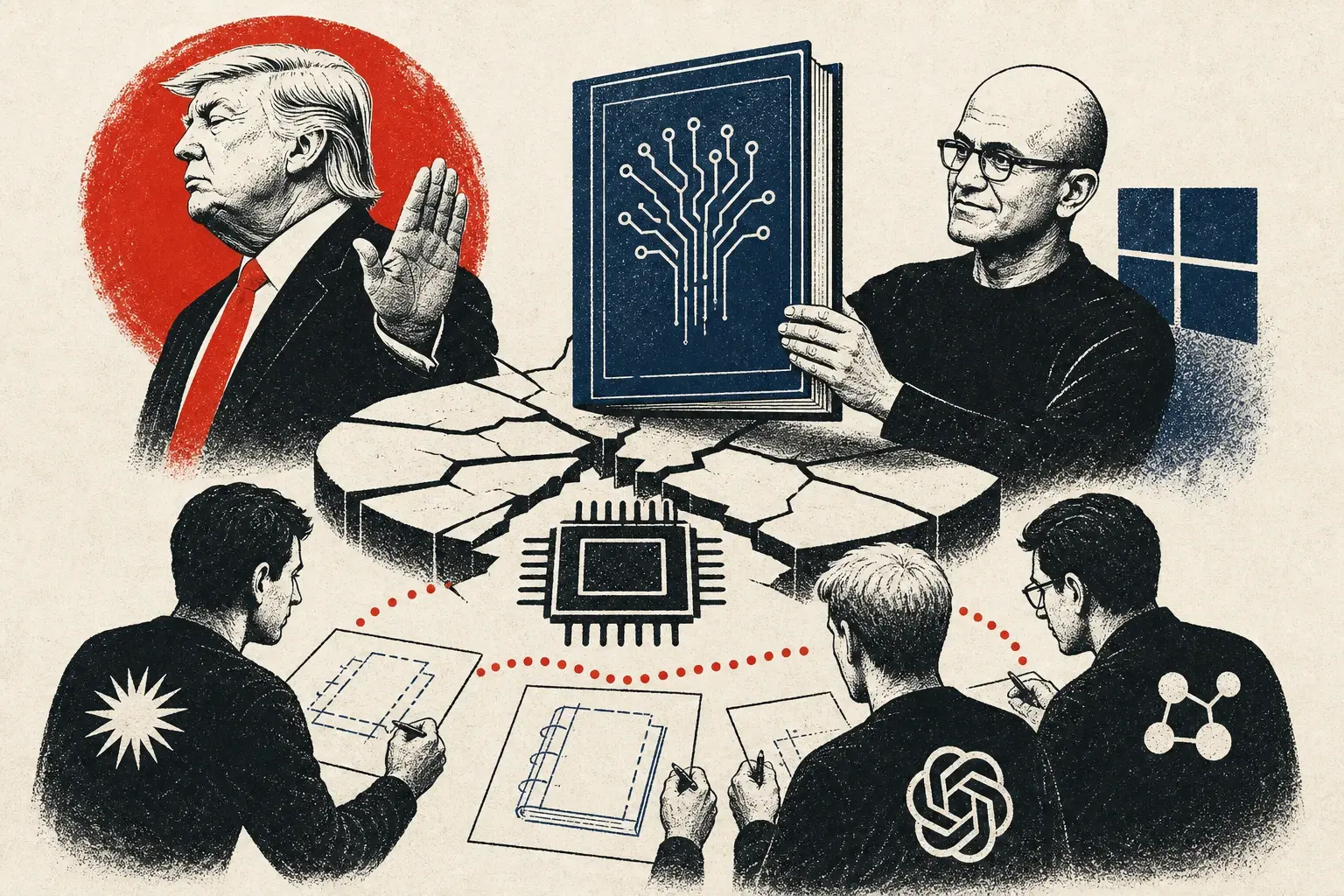
Three institutions answered the weekend’s slowdown plea in three incompatible ways this week, and none of them involved actually slowing down.
Trump gave the bluntest answer, dismissing Dario Amodei, Sam Altman, and Elon Musk’s joint call to “pace the frontier” as the work of “negative forces.” Speaking to reporters in Ireland, he compressed the whole argument into one sentence: “whoever wins AI wins.” It’s a real rebuttal to a real proposal — Amodei’s essay explicitly asked labs to slow capability gains to let alignment work catch up — but it settles nothing, since the government Amodei was implicitly hoping might legislate restraint has just told him it would rather compete.
Nadella answered differently: not with a rejection, but with paperwork. Microsoft published the first Code of Conduct governing its own MAI models for public consultation, explicitly endorsing “deliberate pacing” and floating ideas like embedded third-party evaluators — a real governance artifact, even if it’s one company grading its own homework. Nadella’s framing was pointed: these mechanisms “cannot be controlled by a handful of entities.” Which made it a little awkward when CNN reported that Anthropic, OpenAI, and Google DeepMind have been meeting regularly since July to sketch exactly that — a jointly run standards body modeled on FINRA, an idea originating with DeepMind’s Demis Hassabis. Three of the four biggest labs quietly building their own referee, in other words, while the fourth writes its rulebook alone, and the government the whole industry claims to want oversight from says it isn’t interested. Depending on where you stand, that’s either healthy pluralism or a sign nobody in this story actually wants the same referee.
None of it registered as friction where the money is. Nvidia is in talks to anchor up to $10 billion of Anthropic’s IPO — itself still targeting something close to $2 trillion — deepening a relationship in which Nvidia sells Anthropic the chips, invests in Anthropic’s stock, and benefits either way the pacing argument resolves. Cognition, the Devin-maker, closed a $2 billion round at a $48 billion valuation the same week, nearly doubling its price from four months earlier on run-rate revenue that’s grown from $492 million to almost $900 million — an unusually real number behind an unusually large multiple. AI-adjacent stocks did wobble briefly on the pacing news, Asian shares and US futures pulling back Monday, but a one-day dip isn’t the same as capital actually slowing down, and nothing else this week suggests it has.
What’s actually happening isn’t a slowdown, or a clean rejection of one. It’s three different institutions — a government, a company, and a loose coalition of rivals — independently deciding that if there’s going to be a rulebook, they’d rather write it than wait for someone else’s. Whether any of those rulebooks end up enforceable, or just decorative, is the question none of this week’s stories actually answered.