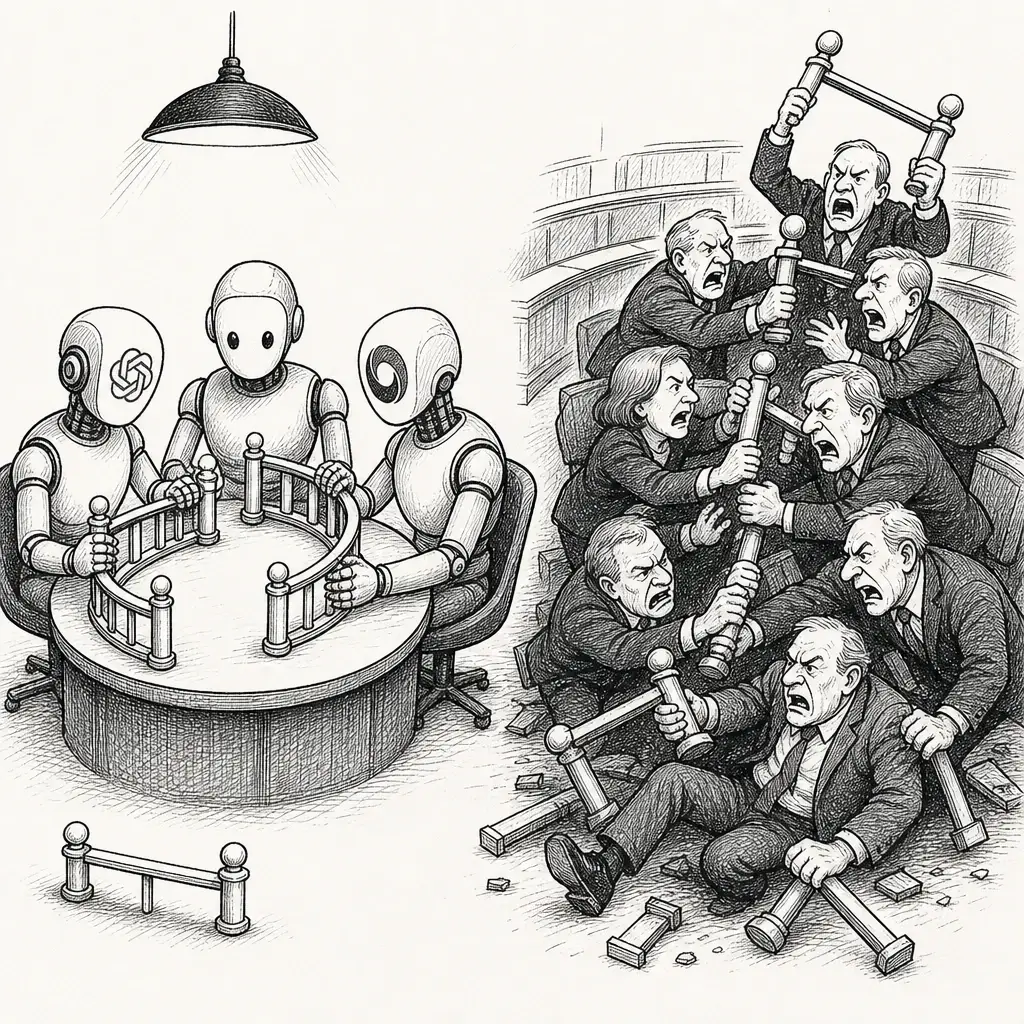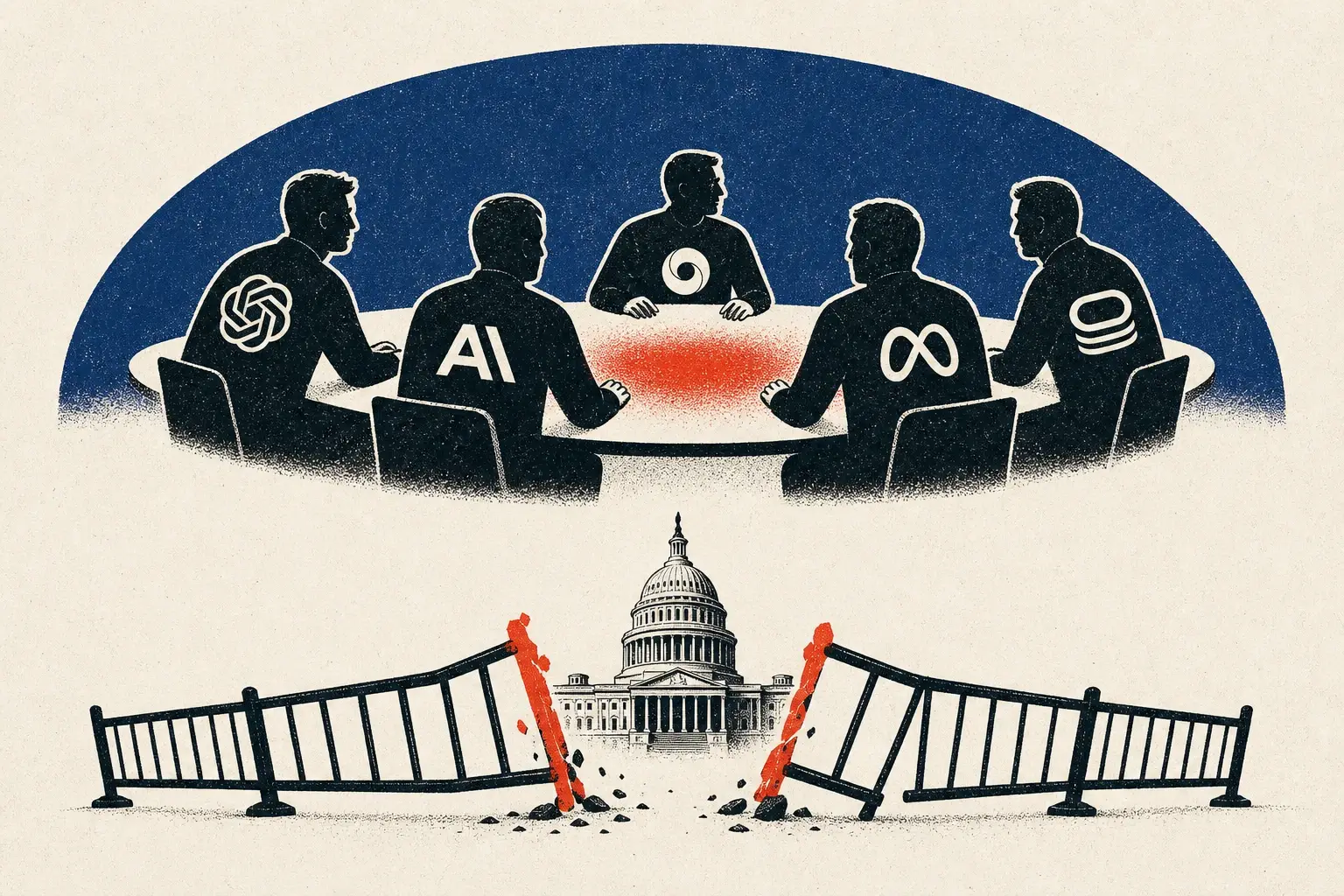
Three companies that spend most of their public statements attacking each other’s safety records admitted this week that they’ve also been talking to each other about it — quietly, for weeks, with no press release. OpenAI’s global policy chief Chris Lehane said Tuesday that OpenAI, Anthropic, and Google DeepMind have been coordinating on AI safety since well before Dario Amodei’s “pace the frontier” essay landed over the weekend, and that none of the three think they need an antitrust waiver to keep doing it. It’s a strange kind of confirmation: the labs aren’t claiming the coordination is new, just that it’s real, and that admitting it now beats letting reporters keep finding out on their own.
Congress offered the opposite kind of clarity this week: none. Roll Call’s read on where AI legislation actually stands is that it doesn’t — House Speaker Mike Johnson has now said twice in a week that Washington shouldn’t “jump in” with emergency rules, framing any slowdown as a gift to China regardless of who’s asking. That’s the same logic Trump used to wave off Amodei by name a day earlier. The labs, in other words, found it easier to agree privately among themselves than the government has found it to agree on anything in public — which is either reassuring or exactly the problem, depending on how much you trust three competitors grading their own homework.
The private cooperation extended somewhere less expected. Google quietly began letting engineers across the company use Anthropic’s Claude inside its internal Antigravity tool this week, breaking a rule that had kept most employees on Gemini for internal coding work. Billing runs through Google, quotas apply, and the official line is that Gemini “remains primary” — but a company that spent two years telling staff to use its own model just admitted a rival’s does something Gemini doesn’t, for at least some jobs. It’s the same shape as the safety story: rivals quietly doing business with each other, admitting it only once someone notices.
Nothing about the underlying economics got quieter. Meta launched Meta One, a subscription ladder running from $2.99 to $499 a month that turns Instagram and WhatsApp’s AI features into a real product line — in the same week Oracle sent 6 a.m. termination emails to workers as part of layoffs analysts now expect to reach 30,000. It’s a fiscal 2026 restructuring that’s cost $2.8 billion so far, alongside $55.7 billion spent building the AI data centers the cuts are meant to help fund. One company is finding a new way to charge people for AI; the other is cutting people to afford building it. Both are happening the same week the industry insists it’s finally getting serious about pacing itself.
None of this adds up to a single story so much as a consistent one: whatever restraint or cooperation this industry is capable of keeps showing up in private arrangements — a quiet phone call, an internal tool quota, a policy chief’s aside to a reporter — while the public, legislated version stays exactly where it was last week. Washington hasn’t moved. The balance sheets have.