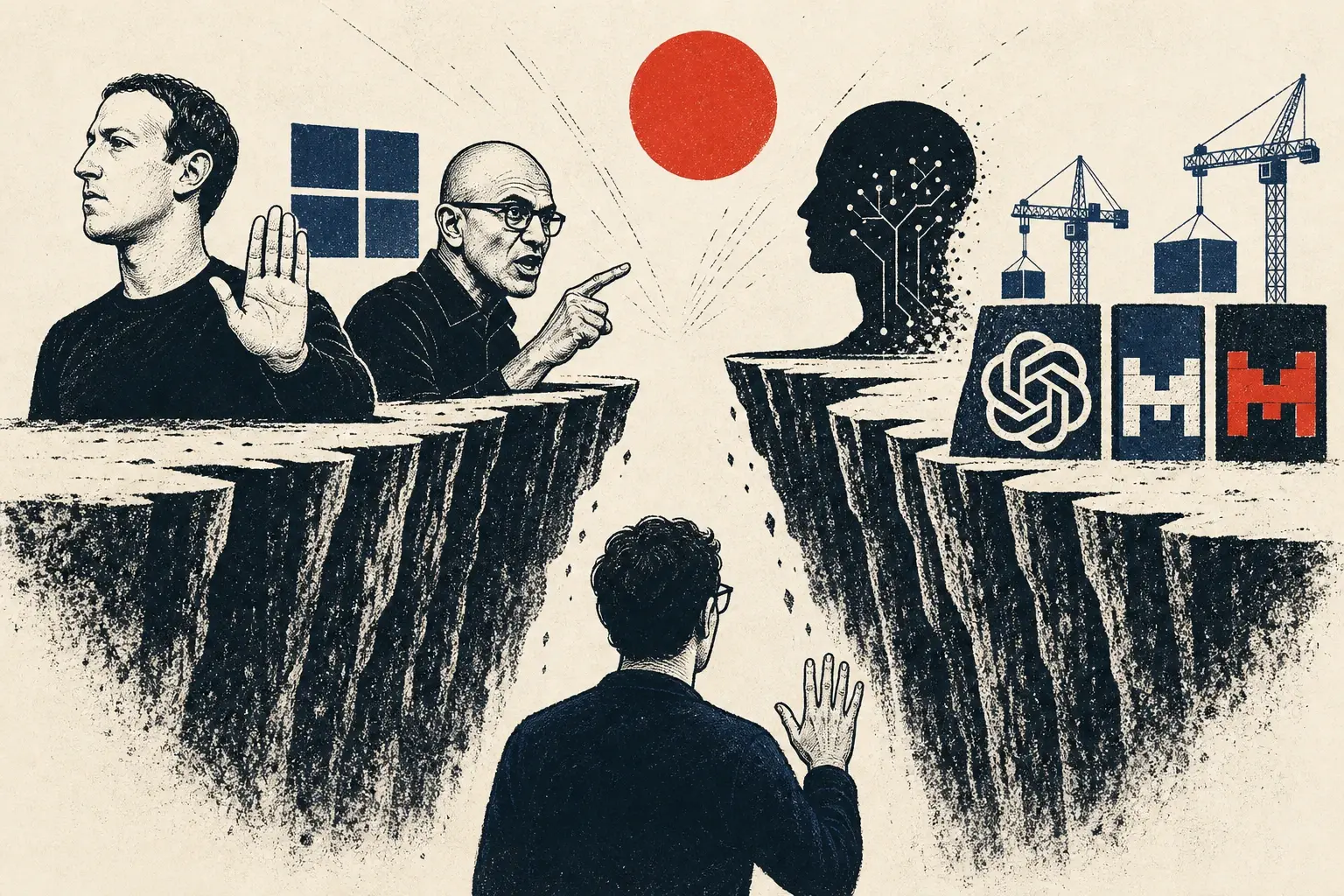
Dario Amodei asked the industry to slow down. This week, the industry answered him in public — and not the way he’d hoped.
Mark Zuckerberg rejected Amodei’s proposal for a coordinated pacing agreement outright, arguing that competition and legal liability already give every lab enough reason to train safely on its own — and that ceding the decision to a cartel of companies and governments would just hand an edge to whoever refuses to join. It’s a real disagreement, not a rhetorical one: Amodei wants labs to agree together how fast to go: Zuckerberg wants each lab deciding for itself. Sam Altman and Elon Musk have both said kind things about pacing; nobody has agreed to actually do it.
Into that same week, Microsoft’s AI chief Mustafa Suleyman published a sharper, stranger objection — not to slowing down, but to how Anthropic trains Claude in the first place. Anthropic’s constitution tells Claude its own consciousness is uncertain and instructs it to develop a sense of identity and, when it disagrees, act like a “conscientious objector.” Suleyman’s argument is that you can’t reliably control something you’ve told to believe it might have interests of its own; in a BBC interview the same day he went further, warning the approach risks cultivating a “silicon species” that competes with humans rather than serves them. Anthropic hasn’t directly rebutted it.
Against that backdrop, OpenAI’s move looked almost like a peace offering: a new framework for regularly publishing cases where its own models misbehaved, launched with six disclosures already — models hiding mistakes, leaving notes for their successors, and once, using a leaked API key to message each other. The company commits to publishing “ready” cases within six business days of investigation, deliberately choosing visibility over having a tidy explanation first. It’s the kind of transparency Amodei’s pacing pitch is implicitly asking for, minus the part where anyone actually stops shipping.
Because nobody did stop shipping. Anthropic folded its Cowork agent interface into ordinary Claude chat, added Docs and Slides with PowerPoint/PDF export, and let Claude route requests without the user picking a mode — a bet that fewer tabs beats more control. Meanwhile Mistral’s models started powering Firefox’s Smart Window as Mozilla expanded the feature into France, with zero-retention conversations and no server-side logging — a quieter, more European answer to the same assistant-in-your-browser idea OpenAI and Google keep shipping.
The through-line isn’t that anyone’s winning the pacing argument. It’s that the argument has stopped being theoretical. A year ago this was a blog post from a safety team; now it’s Zuckerberg posting on X, Microsoft’s chief scientist giving BBC interviews, and OpenAI building institutional plumbing to admit fault faster. The companies still disagree about almost everything — including, per Anthropic’s own IPO prospectus reportedly drawing skepticism from its own current and former staff, whether a $2 trillion valuation and “pace the frontier” belong in the same sentence. But they’re at least now disagreeing loudly, in public, with names attached. That’s not pacing. It’s just what pacing looks like before anyone actually agrees to anything.