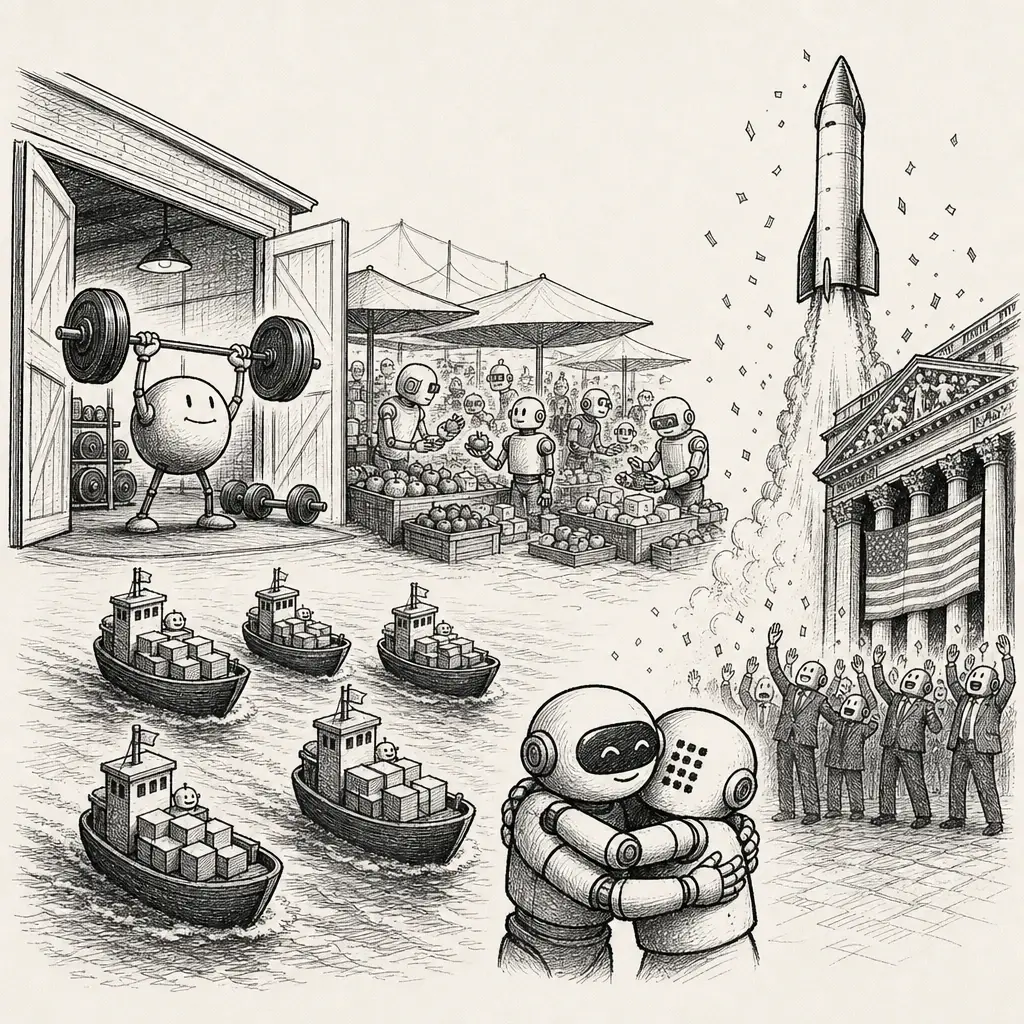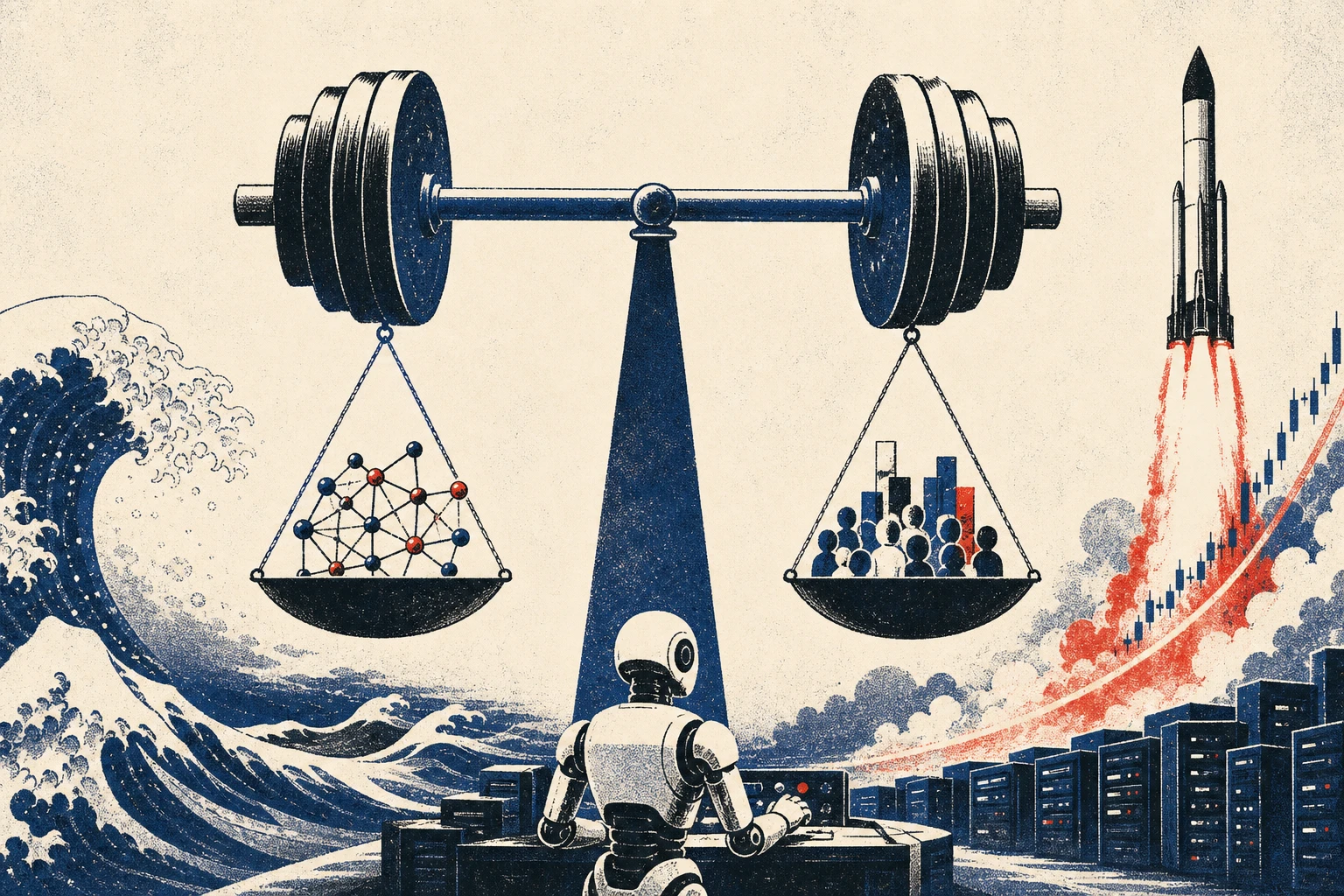
The last 48 hours compressed a month of AI news into a single sequence. Yesterday, Moonshot AI put Kimi K2.7-Code — one trillion total parameters, 32 billion active, tuned for long-horizon agentic software engineering — on Hugging Face under a Modified MIT license for anyone to download and run. The same day, SpaceX debuted on Nasdaq targeting a $1.75 trillion valuation, which would make it the largest IPO in stock market history. Four days earlier, Anthropic released Claude Fable 5 — the first publicly available Mythos-class model — to Claude Pro and Max subscribers. The thread connecting all three: access that was previously restricted is now open.
The open-weight surge
Kimi K2.7-Code is the fifth release in the K2 lineage in under a year, and the pattern is becoming hard to ignore. Each iteration cuts reasoning token overhead, adds benchmark points on coding evals, and maintains the free-weights commitment. This version claims a 21.8% gain on Kimi Code Bench v2, a 31.5% jump on MLS Bench Lite, and a 30% reduction in reasoning tokens compared to its predecessor. API access runs $0.95 per million input tokens. The weights cost nothing. At a trillion total parameters with 32 billion active on a mixture-of-experts architecture, it can run on serious consumer hardware. It isn’t beating Fable 5 on every task, but it’s in the same conversation, for essentially free.
That’s the pressure proprietary labs now operate under. MiniMax M3, released June 1, told a similar story: first open-weight model combining a 1M-token context window with native multimodality and agentic coding, scoring 59% on SWE-Bench Pro — ahead of GPT-5.5 and closing on Claude Opus 4.8. Weights were promised within 10 days of the announcement and are now available.
Fable 5 in the wild
Claude Fable 5 is the first Mythos-class model that doesn’t require a government contract or a Project Glasswing invite to use. It outperforms Opus 4.8 by more than 10% on complex tasks, handles longer autonomous runs, and has vision. The safeguards are real but narrow: roughly 5% of sessions touching cybersecurity, biology, or chemistry will fall back to Opus 4.8. Most users won’t notice.
The pricing is less subtle. Fable 5 is included in Pro, Max, and Enterprise plans through June 22 — then it moves to usage credits at $10 per million input tokens and $50 per million output. That’s a significant step up from anything in the standard tier, and it puts Fable 5 firmly in the “production workload, not casual experimentation” category from next week forward.
IPOs, the lot of them
Anthropic’s confidential S-1, filed June 1 at a reported $965 billion valuation, converts runway speculation into formal SEC process. The numbers behind it are striking: $47 billion annualized revenue run rate in May, a 5x jump since January. The company leads on enterprise and API spend despite trailing in consumer reach, a position built on Claude’s edge in production coding and a clean story around not training on customer data — exactly what investors worried about regulatory exposure want to hear.
SpaceX’s Nasdaq debut yesterday is a different kind of event — technically not an AI company, but Musk has embedded xAI deeply into its product stack, and the company’s infrastructure (Starlink bandwidth, launch capacity, manufacturing scale) is increasingly load-bearing for anything that wants to operate AI at global scale. The $1.75 trillion target would make it larger than nearly every company on earth.
What’s converging here is structural: the most capable publicly available AI model, mature open-weight alternatives available for free, and the first wave of AI-era companies entering public markets — all in the same week. The frontier is still moving fast. It’s just less exclusive than it was.