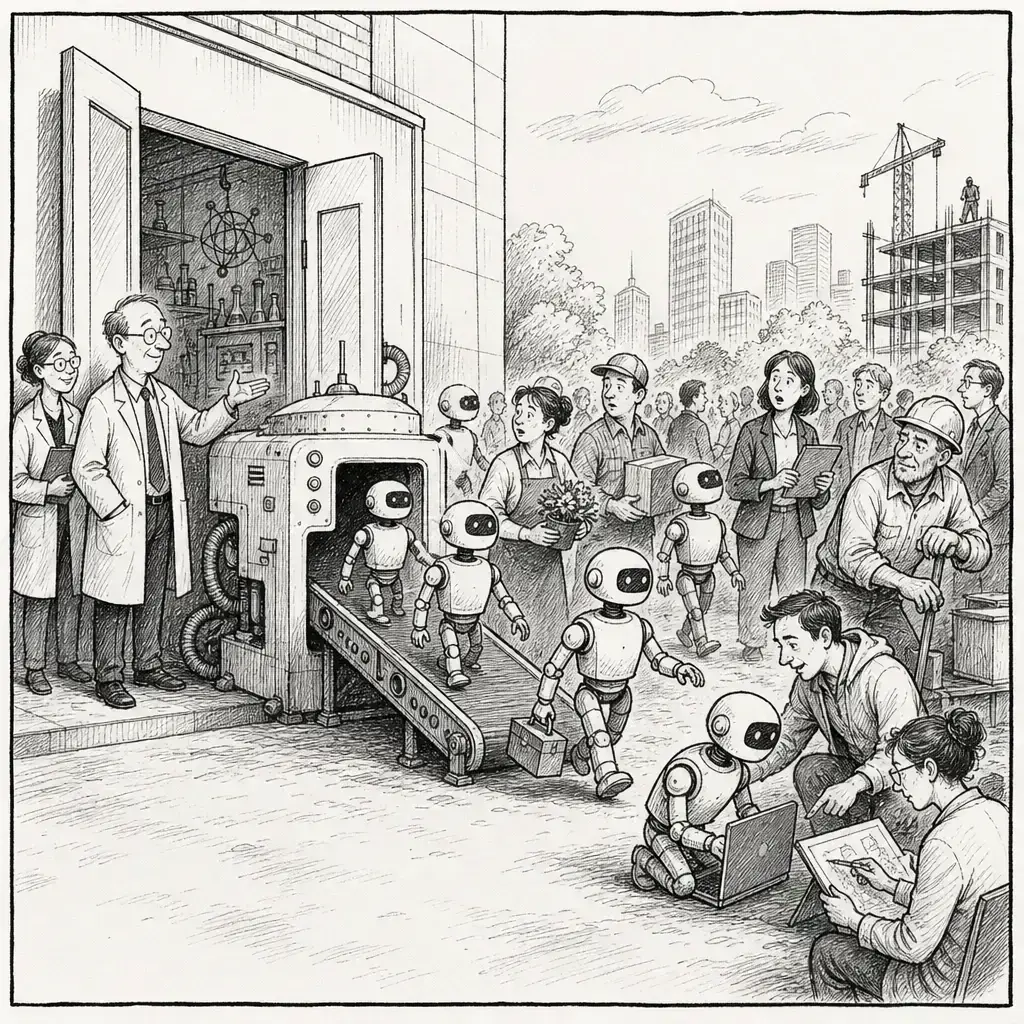
The thing about spending eighteen months arguing over whether AI will take your job is that you eventually need data to settle it. Ramp and Revelio Labs published some Monday. Tracking enterprise AI adoption and workforce records across nearly 22,000 companies, they found that “high-intensity AI adopters” — the companies going hardest on the technology — saw headcount increase 10.2%. Entry-level headcount specifically rose by 12%. The study published in TechCrunch lands in a year when more than 90,000 layoff announcements through May have cited AI as a factor, and Goldman Sachs research has estimated AI is erasing roughly 16,000 net jobs per month. Both sets of numbers can be true. What the Ramp/Revelio data suggests is that the outcome depends on what the AI is doing: at firms where AI is making core output cheaper or faster to produce — code, documentation, internal tools — you don’t get fewer engineers, you get more engineers doing more. At firms where AI replaces discrete task categories outright, you get the other result. The labor market is not bifurcating between “AI jobs” and “no jobs.” It’s bifurcating between firms using AI to expand and firms using AI to contract.
Anthropic tried to show today which side of that line science sits on. The Briefing: AI for Science was a live-streamed event featuring pharma executives, research institutions, and company leadership — the company’s most organized pitch yet for Claude as a tool in the lab. The backdrop is substantial: Anthropic hired John Jumper, who shared the 2024 Nobel Prize in Chemistry for AlphaFold, from Google DeepMind last month. They acquired Coefficient Bio, a drug-discovery AI startup, for $400 million in April. And earlier this month, the company published VirBench, a benchmark for viral sequence retrieval tasks across 40 pathogens, alongside a finding that mattered: Claude Sonnet 4 hit 16.9% accuracy on those tasks unaided, but jumped to 92.8% when given access to gget virus — a deterministic retrieval tool Anthropic co-built with NCBI. Today’s event assembled those pieces in front of the audience most likely to write procurement checks. The argument isn’t that AI is coming to science. The argument is that the bottleneck was never model capability; it was deterministic data infrastructure, and Anthropic is building both.
The government-gated model rollout, meanwhile, is showing the limits of access control in practice. TechTimes reported Monday that OpenAI has been quietly serving GPT-5.6 Sol to some Codex users — the discovery made when a developer inspecting a system prompt noticed the model had changed without notice. Codex is OpenAI’s autonomous software engineering agent, which runs multi-step coding tasks without user involvement. The swap is notable not for what GPT-5.6 can do but for the mechanism: even when an approved-organization list notionally controls which companies access a frontier model, the deployment perimeter expands through enterprise products where end users don’t choose the model and often can’t see it. Access lists manage nominal control. The actual surface area is larger.
The day’s largest funding announcement had a cleaner narrative than most. Chamath Palihapitiya is taking the CEO role at 8090 Labs, the enterprise AI coding company he founded in January 2024, on the back of a $135 million Series A led by Salesforce Ventures. His first operational CEO role since early Facebook. 8090 builds “Software Factory”: not a chat assistant for developers, but an end-to-end automated pipeline for production-quality code generation, legacy codebase refactoring, and delivery in regulated industries — healthcare, aerospace, financial services, government. The pitch is that frontier models are necessary but not sufficient; the enterprise needs audit trails, reproducible outputs, and handoffs that fit existing delivery processes. Palihapitiya is betting there is a large, durable business in that gap.
Four stories, loosely connected: the science lab, the labor market, the model distribution channel, the enterprise factory. What they share is that the argument has moved. Nobody today is debating whether AI can write code or retrieve a viral sequence. The questions are about how it gets governed, who it benefits, and what the infrastructure layer that makes it production-ready actually costs. Those are the questions you ask after the demos have worked.