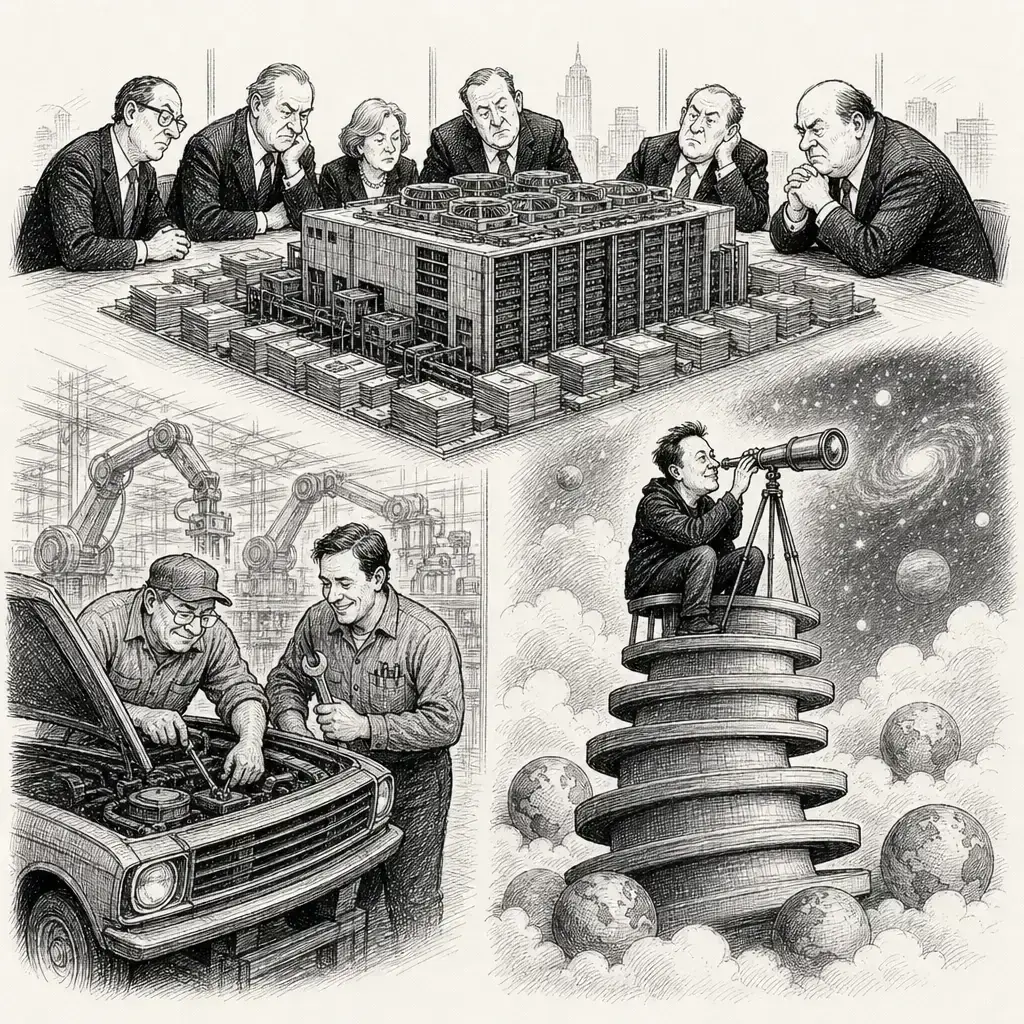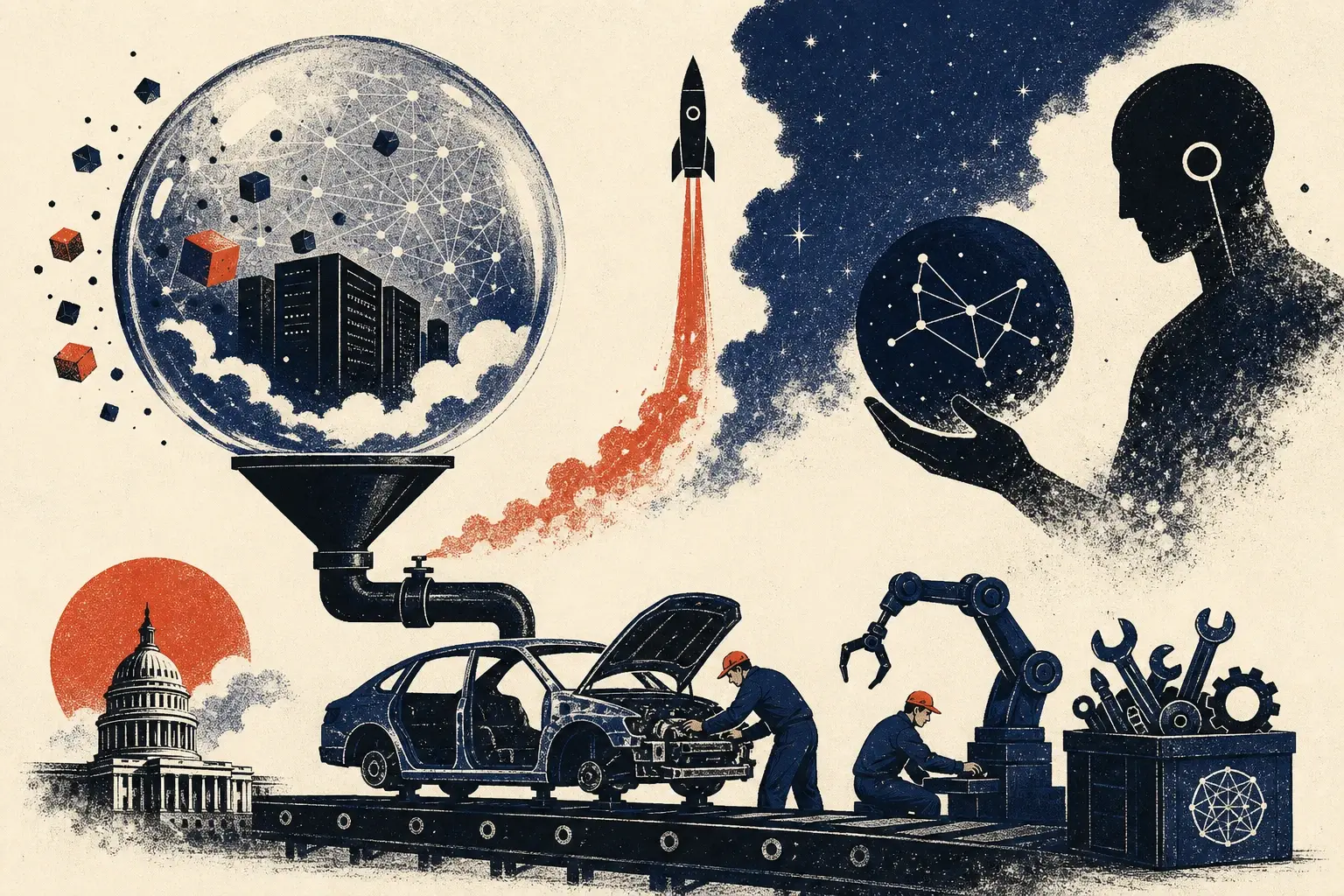
The reckoning on AI spending arrived, as these things tend to, without a press release. It came as five straight trading days in which chip stocks lost 9–12%, the Nasdaq fell more than 2%, and Alphabet’s free cash flow printed 47% below the same period a year ago. Combined capital expenditure across Microsoft, Alphabet, Amazon, and Meta has now exceeded $452 billion in 2026. Investors were willing to fund that number while AI revenue was growing fast enough to imagine the math working. This week, the imagining gave way to the asking.
This is a meaningful shift. The last two years were about building — infrastructure, models, GPUs, talent. The next phase is about showing what the infrastructure earns. The technology’s potential isn’t being questioned. The unit economics are. There is currently a large gap between “transformative technology” and “business that makes money,” and a material fraction of $452 billion is parked in that gap.
Ford gave the argument a face. The automaker has rehired 350 veteran engineers — internally called its “gray beards,” some retirees and some from suppliers — after AI-powered quality-control systems failed to deliver the results the company needed. The rehire is working: Ford’s COO cited “hundreds and hundreds of millions of dollars” in warranty and recall savings, and the company just claimed the top spot among mainstream brands in the JD Power Initial Quality Survey. The lesson isn’t “AI failed.” It’s more specific: AI that was stripped of the institutional knowledge it needed to function correctly failed. The returning engineers are now retraining both the systems and the junior staff who inherited them. Ford trimmed the human layer in anticipation of AI filling it, and the bet didn’t pay off on the timeline the factory needed.
The counterpoint came from xAI. On Saturday, Elon Musk announced that Grok 4.5 entered private beta at SpaceX and Tesla — built on a new 1.5-trillion-parameter V9 foundation model and augmented with data from the recently acquired Cursor coding assistant. Early internal evaluations, per Musk, put the model near or above Claude Opus. The claim is unverifiable outside the company; the roughly 200-250 SpaceX and Tesla engineers in the beta are the entire test pool. What’s notable is the accompanying commitment: Musk announced plans to release entirely new models, trained from scratch, on a monthly cadence for the rest of 2026. At a moment when the dominant frontier AI story is government-gated rollouts and access approval windows, xAI is betting that velocity itself is a strategy.
And from a stealth version of the same instinct: Mirendil closed a $200 million seed round at a $1 billion valuation — one of the largest seed financings on record. Founded by ex-Anthropic researchers, backed by Andreessen Horowitz, Kleiner Perkins, and Nvidia, the company’s pitch is that AI can automate most of the manual work of building frontier AI itself: running experiments, interpreting results, designing the next training run. Human researchers as curators of a self-improving loop. No product. No revenue. The $200M funds hiring, compute, and the first test of the hypothesis. That this shape of bet — $1B valuation, no deployed product — is now unremarkable tells you something about where the capital thinks the next unlock sits.
The four stories share a frame: they’re all about what happens when an abstraction meets a ledger. Investors looking at $452B in capex want the math to close. Ford’s quality auditors wanted the AI to catch defects; it didn’t; humans are back. xAI is measuring whether monthly training cycles can compound capability faster than governments can manage access. Mirendil is measuring whether AI can compress the training loop itself. The scrutiny phase and the acceleration phase are, for once, happening at the same time.