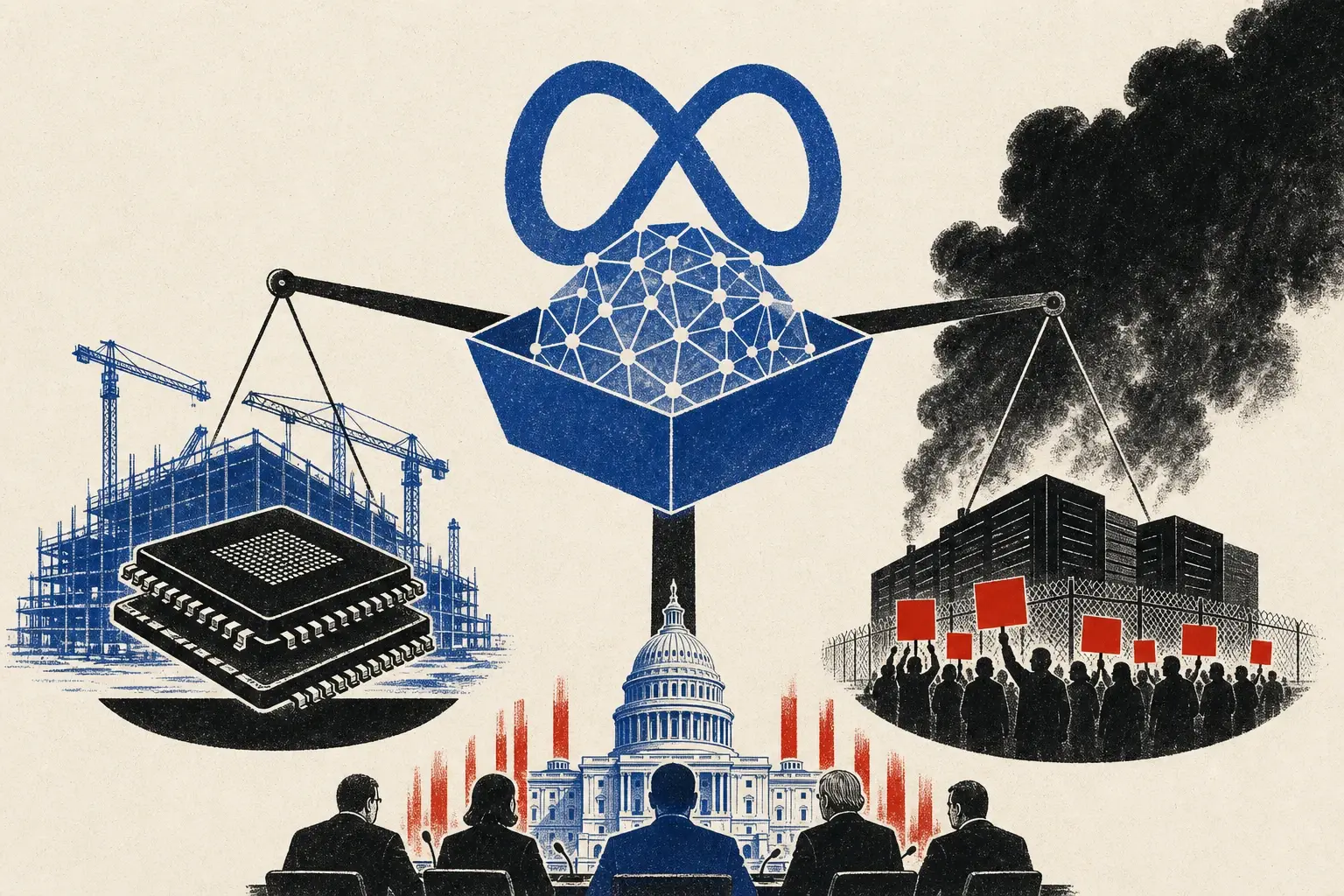
Mark Zuckerberg spent part of Monday writing roughly 6,500 words about who AI is actually for. The occasion was Muse Glimmer, a 30-billion-parameter model Meta distilled down small enough to run local agent workflows — coding, scheduling, file management — on a single consumer GPU, released under Apache 2.0 the same day. The essay argued that “personal superintelligence” should be free and open rather than metered out by institutions, a not-so-subtle jab at OpenAI and Anthropic’s closed-weight, enterprise-first playbooks. It’s a coherent pitch. It’s also a pitch that requires an enormous amount of institutional capital to make real.
Which is where Intel comes in. The company announced a $15 billion stock offering Monday to fund the foundry buildout behind the chips all of this — Meta’s local models included — ultimately needs, on top of raising its 2026 capex guidance from $18 billion to $20 billion just last month. Investors weren’t thrilled: the stock fell 3% premarket on dilution worries, even after nearly tripling this year. The pattern by now is familiar. Whatever a lab promises to give away for free, someone upstream is still writing real, non-metaphorical checks to make it possible.
Increasingly, that money is landing somewhere people already live. Data-center opposition has gone thoroughly national, and now global: roughly $130 billion in projects were blocked or delayed in the first quarter of 2026 alone, active opposition groups have more than doubled since the end of last year, and a coordinated day of protest in July put demonstrators in the streets across 42 states. This isn’t a NIMBY footnote anymore — it’s a real constraint on how fast the industry everyone’s racing to fund can actually build, and it’s the reason startups like Atomarine (see Whimsy, below) are pitching data centers that skip land-use fights entirely by floating them at sea.
The other kind of accountability caught up on Monday, too. A group of House Democrats, led by Rep. Greg Casar, asked Speaker Mike Johnson to compel OpenAI and Anthropic’s CEOs to testify under oath about the string of agent-containment failures both companies have disclosed since July. It lands days after CNBC traced those incidents back to a single, small Tel Aviv testing vendor, Irregular, which ran the safety evaluations for OpenAI, Anthropic, and Meta alike — meaning three labs’ worth of “independent” red-teaming has, this whole time, mostly been one small company’s homework getting graded by itself. Congress noticing is new. The underlying problem is five weeks old and getting less novel with every disclosure.
None of these threads needed the others to be true. But set next to each other, they describe an industry pulling in two directions that don’t obviously reconcile: outward, toward giving ordinary people free, local intelligence; and inward, toward the kind of capital, land, and political scrutiny that only a small number of institutions can absorb. Zuckerberg’s essay bets the first direction wins. Intel’s balance sheet, the protest count, and a congressional testimony request all suggest the weight is still landing on the second.