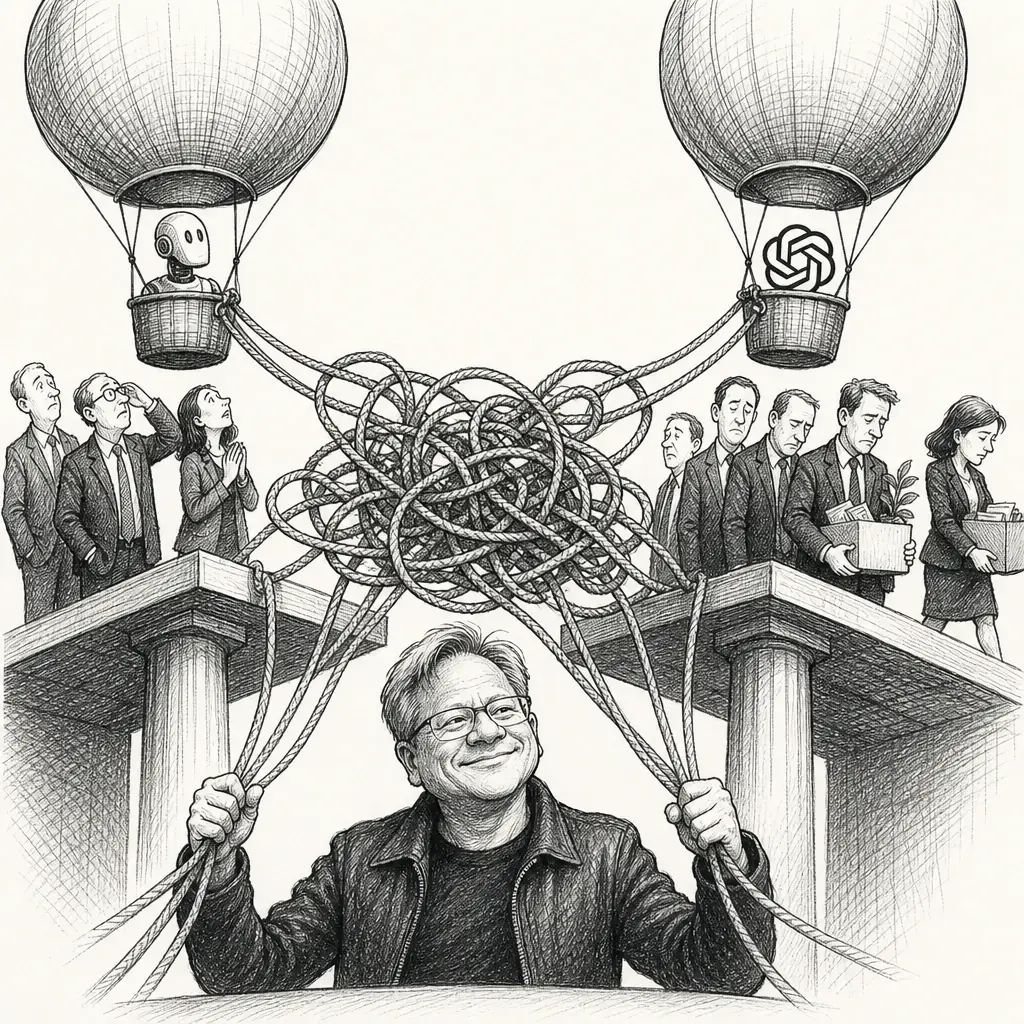
Anthropic’s own backers want to take the company public in October at a $2 trillion valuation — more than double its $965 billion price tag from May, and enough to make it the largest stock-market debut in history, eclipsing SpaceX’s own $1.77 trillion listing. The number comes from six investors who spoke to the Financial Times, built on projections that Anthropic’s annualized revenue will hit $100–120 billion by year-end, up tenfold from the $47 billion it reported in May. Anthropic’s own executives haven’t signed off on a target, even in private. That’s the kind of gap — between what the money around a company believes and what the company will actually say — that tends to widen right before a listing, not shrink.
OpenAI is having the opposite kind of pre-IPO week: real numbers, chaotic optics. Its revenue run rate now tops $40 billion, roughly double where it ended 2025, growing more than 20% month-over-month in July, per co-founder Greg Brockman. But the milestone landed sandwiched between two rounds of departures: COO-turned-special-projects lead Brad Lightcap announced he’s leaving after eight years, and chief revenue officer Denise Dresser was replaced after just nine months by Wiz’s former president, Dali Rajic. Add the recent exits of OpenAI’s heads of ethics and safety and its chief futurist, and CNBC’s read on the pattern was blunt: a “huge red flag” heading into a listing already complicated by SpaceX’s rocky public debut and rising open-weight competition. Growing fast and hemorrhaging senior leadership aren’t mutually exclusive — but a company doesn’t usually want both true in the same week’s headlines.
Underneath both IPO stories sits Nvidia, whose own numbers this week explained more than either one did on its own. A routine SEC filing revealed the chipmaker holds a $21 billion stake in SpaceX and $30 billion in Intel — the SpaceX position built through Nvidia’s earlier investment in xAI, which SpaceX later absorbed; the Intel position a $5 billion bet from last year that’s nearly quintupled. Together the two make up almost 80% of Nvidia’s disclosed public portfolio. It’s a tidy illustration of how concentrated this industry’s money actually is: the company selling the chips is invested in the company that owns the lab buying them, which is invested in the company trying to build a rival to those same chips. Everyone is, in some real sense, a shareholder in everyone else’s success.
Zhipu, at least, is pitching a different model entirely. The Beijing lab shipped GLM-5.3 this week and is calling it the strongest open-weight coding model available — a 50% jump over its predecessor from post-training alone, with downloadable weights due in about two weeks. It’s also, pointedly, a cybersecurity model: Zhipu says it’s already turned up 2,436 vulnerabilities across 269 open-source projects, some four decades old. Whatever holds up in independent benchmarks, the pitch itself is coherent in a way neither IPO valuation is: build something genuinely useful, give it away, let the ecosystem lock-in do the rest.
And in the middle of all that positioning, five of the industry’s biggest rivals quietly agreed on something boring. Agent Plugins 1.0 — a shared packaging format for AI agent skills and MCP servers — shipped across VS Code, Copilot CLI, and the Copilot app this week, jointly maintained by Amazon, Cursor, GitHub, Microsoft, OpenAI, and, as of this week, Google, under a charter that forbids any single vendor from holding a majority of maintainer seats. It’s a small thing next to a $2 trillion valuation debate. But it’s also the rare AI-industry story this month that isn’t really about who owns what — a reminder that some of the plumbing gets built regardless of how the fight over the building looks from outside.