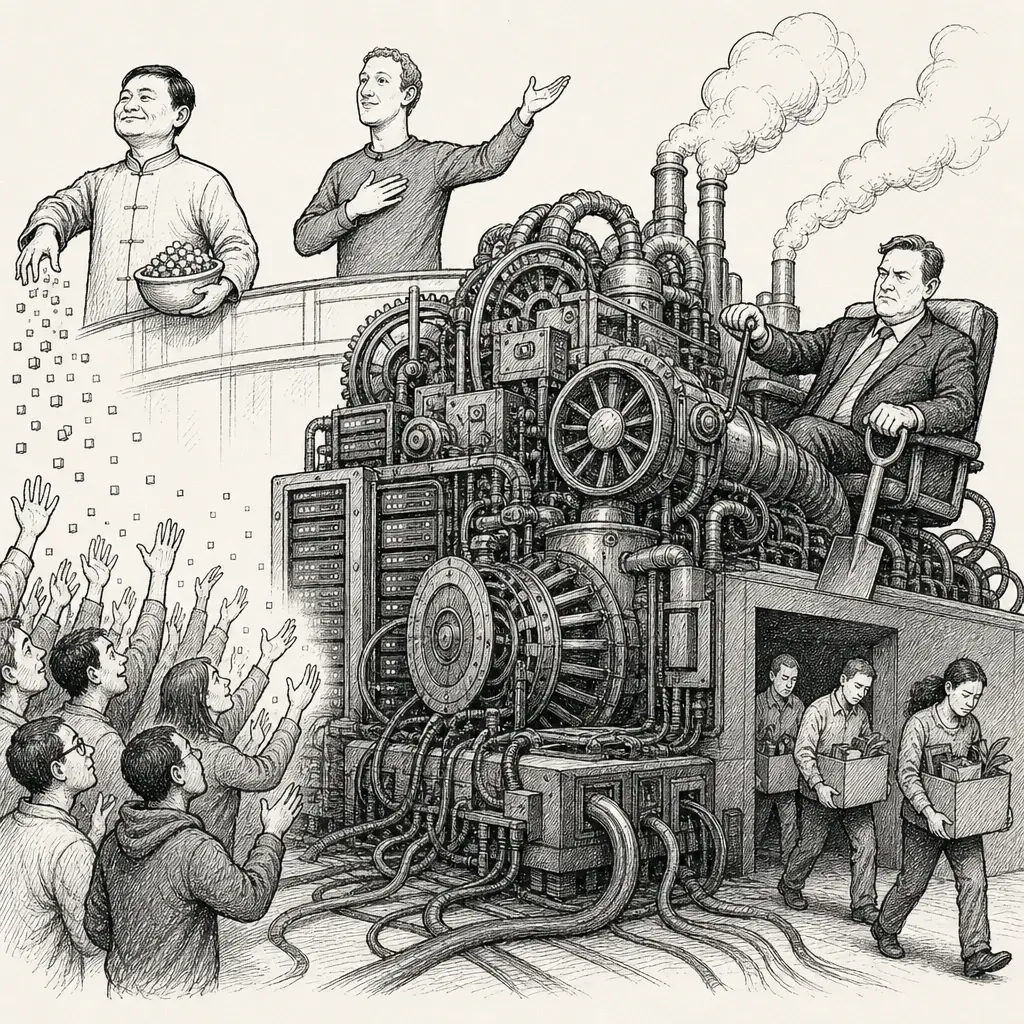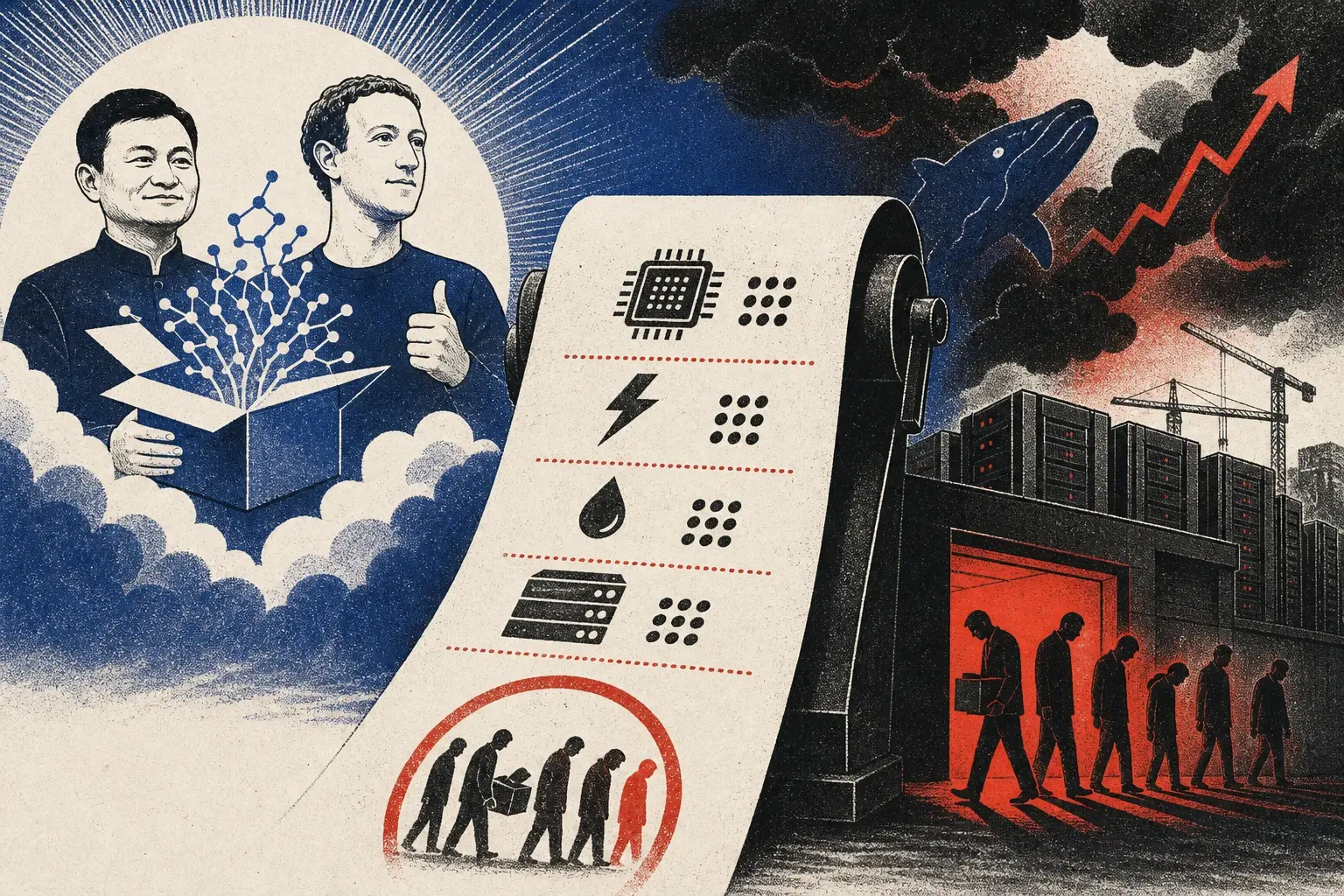
Alibaba spent today’s release window doing something increasingly rare in this industry: giving away something genuinely good. Qwen3.8-27B landed on Hugging Face under an Apache 2.0 license at midnight — a multimodal, 262k-context model distilled from the larger Qwen3.8-Max, quantized down to run on a single consumer GPU with about 17GB of memory. No waitlist, no API key, no bill. It’s the kind of release that makes the industry’s stated commitment to openness look, for a day, like more than marketing copy.
Mark Zuckerberg would like credit for that framing. His 14-page manifesto, “The Future is for Everyone,” published this week, argues that broadly distributed superintelligence is both the safer and the more prosperous path — that concentrating frontier AI in a handful of companies is the real risk, not the technology itself. It’s a serious document dressed as an inevitability: critics have noted it says remarkably little about how Meta squares “individual empowerment” with a business built on attention and ad targeting, and that “balance of power” is a convenient reframing of safety for a company that would rather not be regulated on capability grounds. Still, paired with Qwen’s drop, it’s a real ideological fault line in the industry — open-weight labs making the moral case for giving the technology away, even as the compute underneath it gets more expensive by the week.
Which is where DeepSeek comes in, as the counter-argument. The company that spent 2025 training the industry to expect near-free inference just raised V4 API pricing by 50% to over 1,100%, depending on the token type and time of day — peak-hour output tokens alone are up more than 4x. This is the same company whose entire market position was built on undercutting everyone else’s per-token economics. When DeepSeek starts charging more because it can’t keep up with demand on the compute it has, that’s a capacity signal worth taking seriously, not just a pricing footnote.
And then there’s Oracle, which is spending this month laying off workers while borrowing tens of billions of dollars to build the data centers its AI ambitions require. Fiscal 2026 capex already hit $55.7 billion, up from $21.2 billion the year before; the company is looking at another $40 billion in debt and equity financing for fiscal 2027. The layoffs aren’t large in isolation, but the juxtaposition is the story: a company cutting headcount in the same breath as it commits to historic capital spending, because the AI buildout has become the thing the balance sheet answers to, not the other way around.
None of these four stories touch each other directly, but they’re describing the same shift from different angles. The frontier is bifurcating into two economics: an open-weight layer racing toward zero marginal cost, propped up by labs happy to lose money on model weights in exchange for ecosystem lock-in, and a compute layer where the actual bill — chips, power, debt service — is only getting more visible, whether that shows up as a DeepSeek price hike or an Oracle pink slip. The manifestos are optimistic. The invoices are catching up.