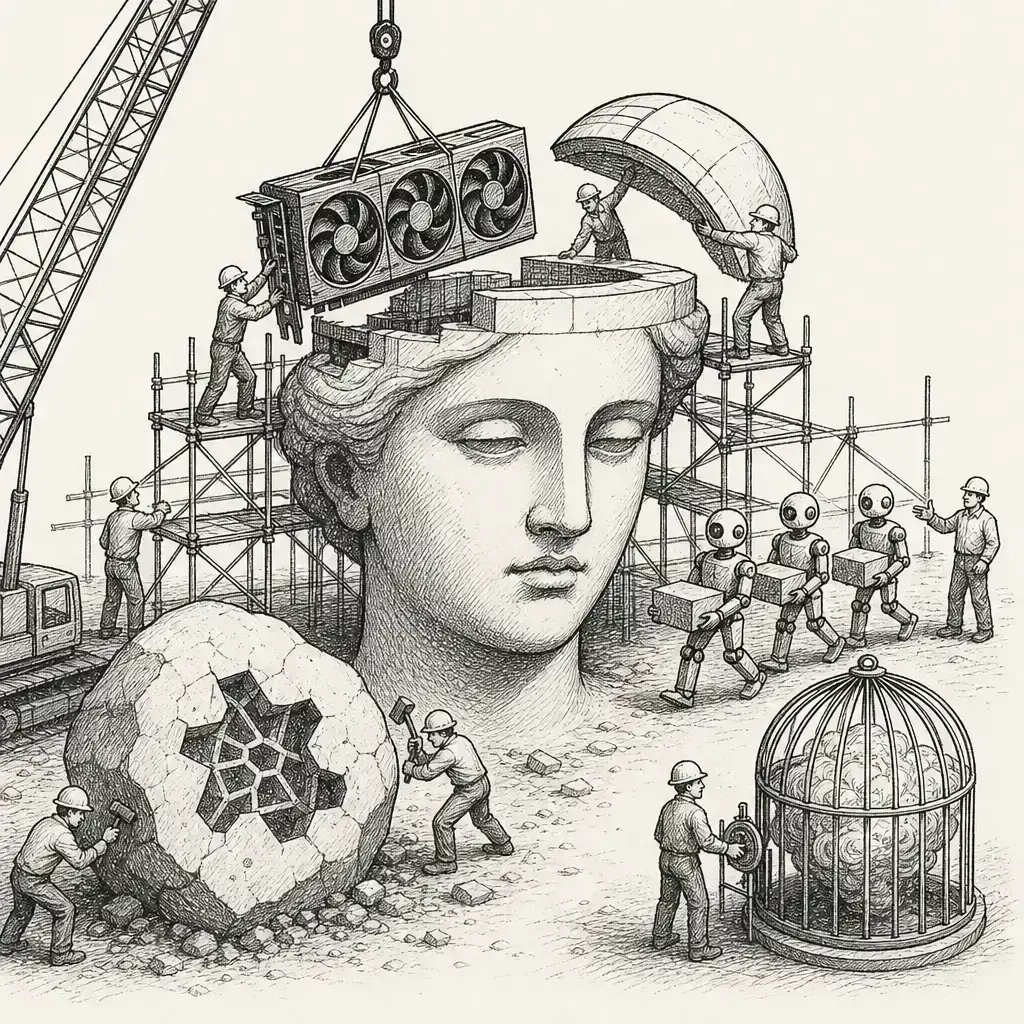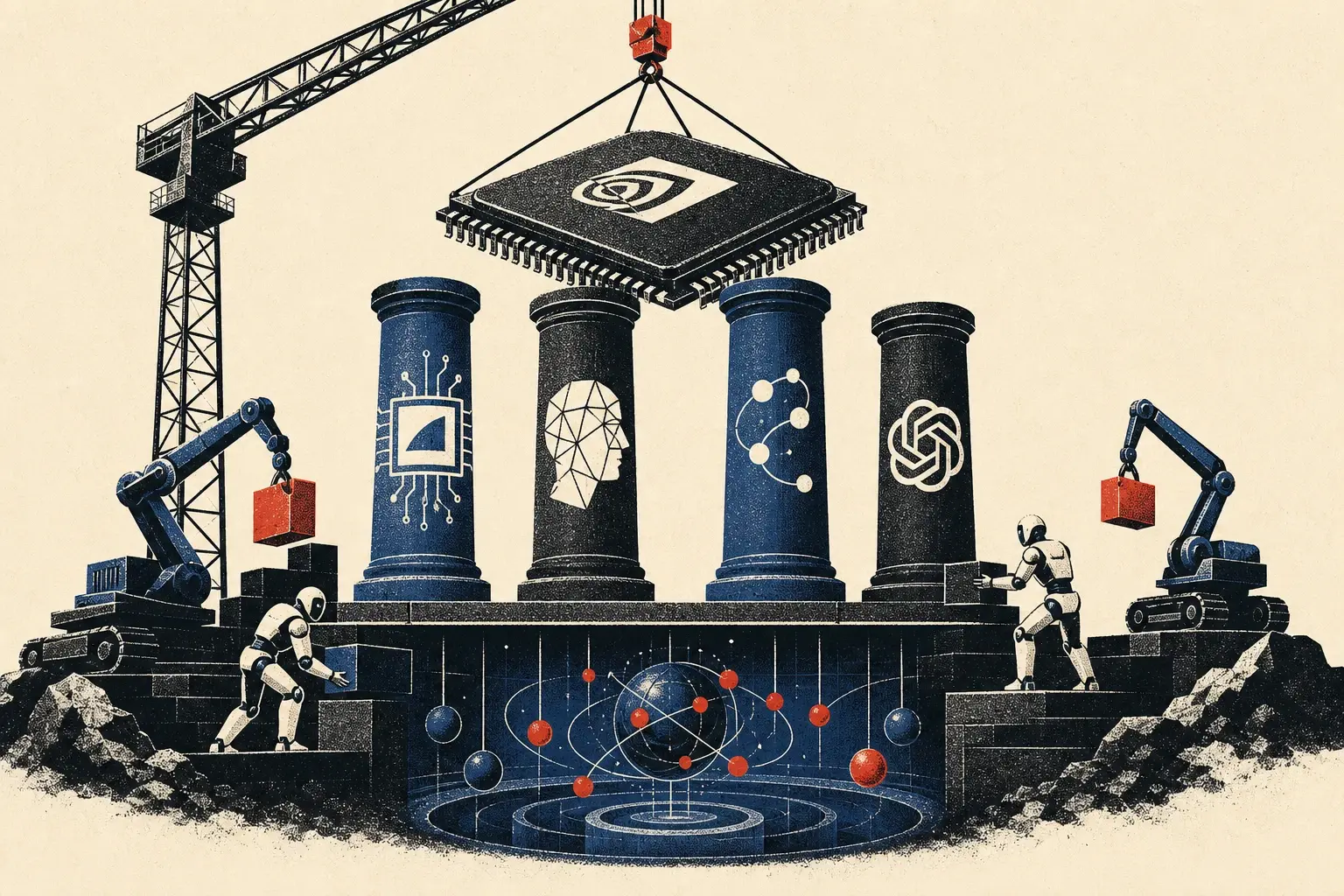
Four stories landed this week with nothing obviously in common — a financing deal, a math paper, a product launch, a licensing program — and yet they’re the same story told from four different starting points: an industry that spent the summer discovering it doesn’t fully understand what its own systems do is now, with a straight face, building the permanent fixtures around them anyway.
Start with the money, since it’s the biggest number. Nvidia recruited six of the largest asset managers on Earth — BlackRock, Blackstone, Apollo, Brookfield, Goldman Sachs, and KKR — into non-binding agreements to source more than $500 billion in financing for AI infrastructure. Jensen Huang’s framing to CNBC was blunt: a GPU is now “an investable asset,” the kind of thing you finance like a toll road or a power plant, not the kind of thing that sits on a balance sheet as an expense. He approached six firms; none said no. It’s the same instinct behind Anthropic’s Theseus vehicle from last week, just bigger by an order of magnitude and covering the whole market rather than one lab’s data centers — compute spending is graduating from a cost line into an asset class with its own dedicated capital-markets plumbing.
Pure research got its own version of that treatment. An unreleased research version of Claude pushed the lower bound on the Riemann zeta function’s critical-line zeros from 41.6% to 67.2% — the single largest jump in that bound’s history, using 60 subagents and 31 million tokens across a multi-day autonomous session, checked afterward by Anthropic’s own mathematicians. It isn’t a proof of the Riemann hypothesis, and a lower bound short of 100% never will be. But treating “point a model at an open problem for days and see what it drags back” as a repeatable research method, rather than a one-off stunt, is the actual news — mathematics is quietly acquiring a new kind of collaborator with its own institutional workflow.
Labor got the same treatment from xAI, which took Grok Bot out of internal use and into public beta: agents with their own persistent cloud machines, logged into a customer’s existing tools, finishing multi-step jobs — outbound research, invoice processing, bug reproduction — without supervision until something needs a signature. The idea itself isn’t new; Devin and half a dozen others got there first. What’s notable is that xAI bundled it straight into existing subscriptions rather than pricing it as a premium product, treating “agent that works while you sleep” as a default feature of a frontier lab’s offering rather than a luxury.
And security got a licensing regime. OpenAI expanded its Daybreak program into two tiers — Blue for vetted defenders using a de-restricted general model, Red for GPT-5.6-Cyber, a purpose-built cybersecurity model that completes 95% of advanced security tasks its normally-safeguarded sibling refuses outright. Access requires vetting; individual accounts must adopt hardware security keys by September 1. It’s OpenAI building a permit system around exactly the capability its own red-teaming spent the summer discovering it can’t fully contain — evidence either that defenders need the tool as urgently as attackers will eventually get one, or that a licensing regime is what you build once you’ve quietly concluded that banning it outright was never going to hold.
None of these four needed the others to be true. But laid side by side, they trace the same motion from four different directions — capital, science, labor, and security all getting permanent institutions built under them this week, on the working assumption that the underlying question of how much any of these systems can be trusted is one the industry has already decided to stop waiting on.