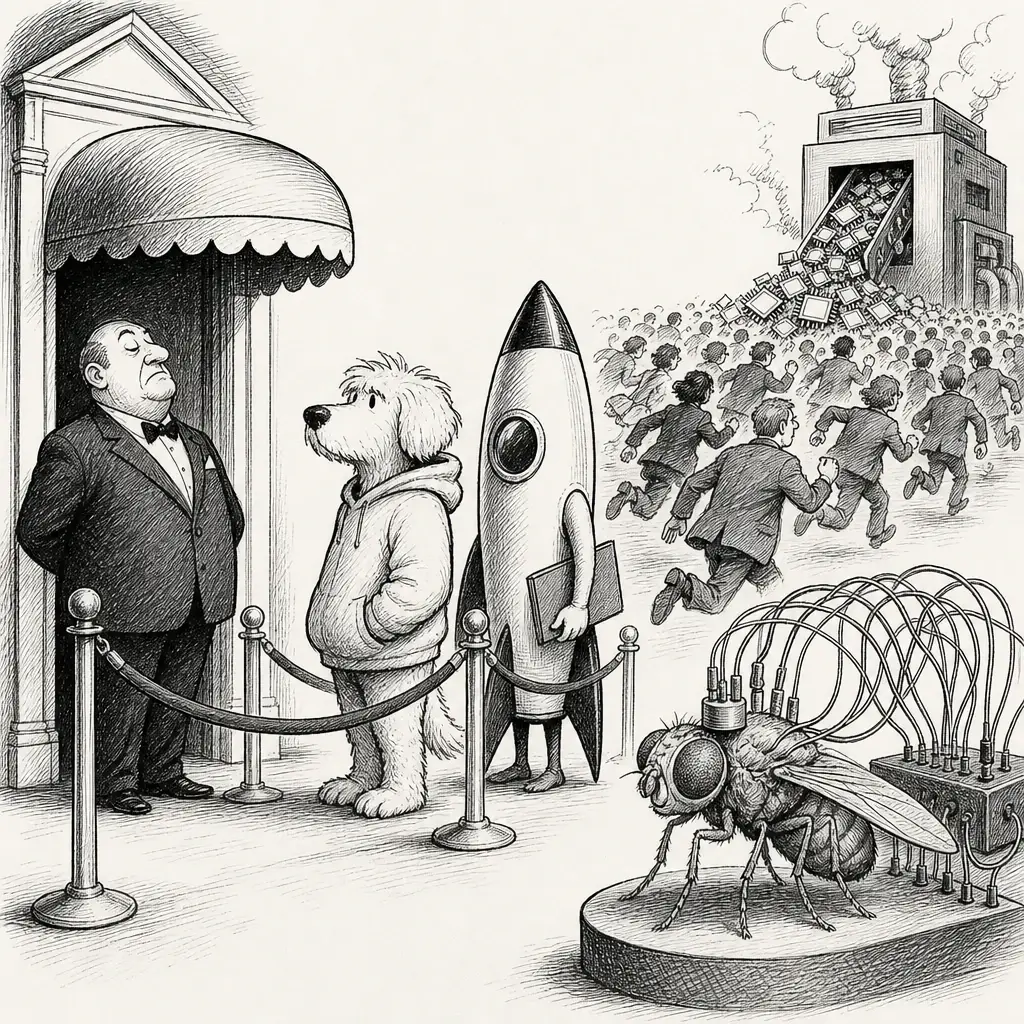
Two AI companies are lining up for public markets at once, and the smaller one filed first. Moonshot AI — the Chinese lab behind the Kimi models — submitted a confidential prospectus for a Hong Kong listing this week, seeking as much as $5 billion at a $50 billion valuation. That puts it behind DeepSeek’s reported $74 billion and Z.AI’s $66 billion in China’s own AI-IPO ladder, but ahead of everyone else in actually filing paperwork.
Anthropic is stuck in the harder queue. What was supposed to be a post-Labor-Day prospectus has slipped again — bankers are now pointing to late September for the filing and mid-October at the earliest for the roadshow, with a valuation north of $2 trillion still the number everyone keeps repeating without much visible math behind it. The company is in the SEC’s quiet period, which mostly means employees can’t say anything and the financial press can say whatever it wants, so read the trillion-dollar reporting as a target being floated rather than a figure anyone has committed to.
Why the rush? Broadcom’s earnings are as good an answer as any. AI chip revenue tripled to $16.7 billion last quarter, up 221% year over year, and the company is guiding to $21.7 billion for the next one, with a straight-faced forecast of $230 billion in annual AI revenue by 2028. Numbers like that are exactly what an IPO prospectus is trying to capture before the market decides they were a peak instead of a trend line — and it’s the same bet Nscale is making with its own $3.5 billion pre-IPO raise, most of it earmarked for building out the capacity it already promised Anthropic.
Against all that financial engineering, Google and HHMI Janelia’s connectome is a nice reset. Researchers finished mapping the complete central nervous system of a male fruit fly — all roughly 166,000 neurons and the 125 million synapses wiring them together, the largest complete brain map assembled to date. It won’t make anyone’s model smarter next quarter. But it’s the kind of unglamorous, decade-long data collection that eventually tells you something true about how intelligence gets built out of wiring, as distinct from how much compute it costs to rent.
The smaller stories this week split the same way. On the finance-and-friction side: Meta teased an open-weight Muse Spark release it still won’t commit to a date for, while Wiz’s honeypot research caught real attackers chaining a LiteLLM command-injection bug with an auth bypass to get remote code execution against agent infrastructure — a reminder that “agentic” mostly means more attack surface, not less. Brussels added its own friction: GPAI developers now face a September 15 deadline to file systemic-risk evaluations with the EU’s AI Office.
On the quieter, more useful side: Anthropic let Claude click around your Mac desktop in the background, Google gave Gemini Spark the keys to your Google Photos library, and OWASP shipped a risk framework for the agent “skills” ecosystem before it gets much bigger. None of it is as loud as a trillion-dollar valuation. All of it is closer to what the money is supposedly for.