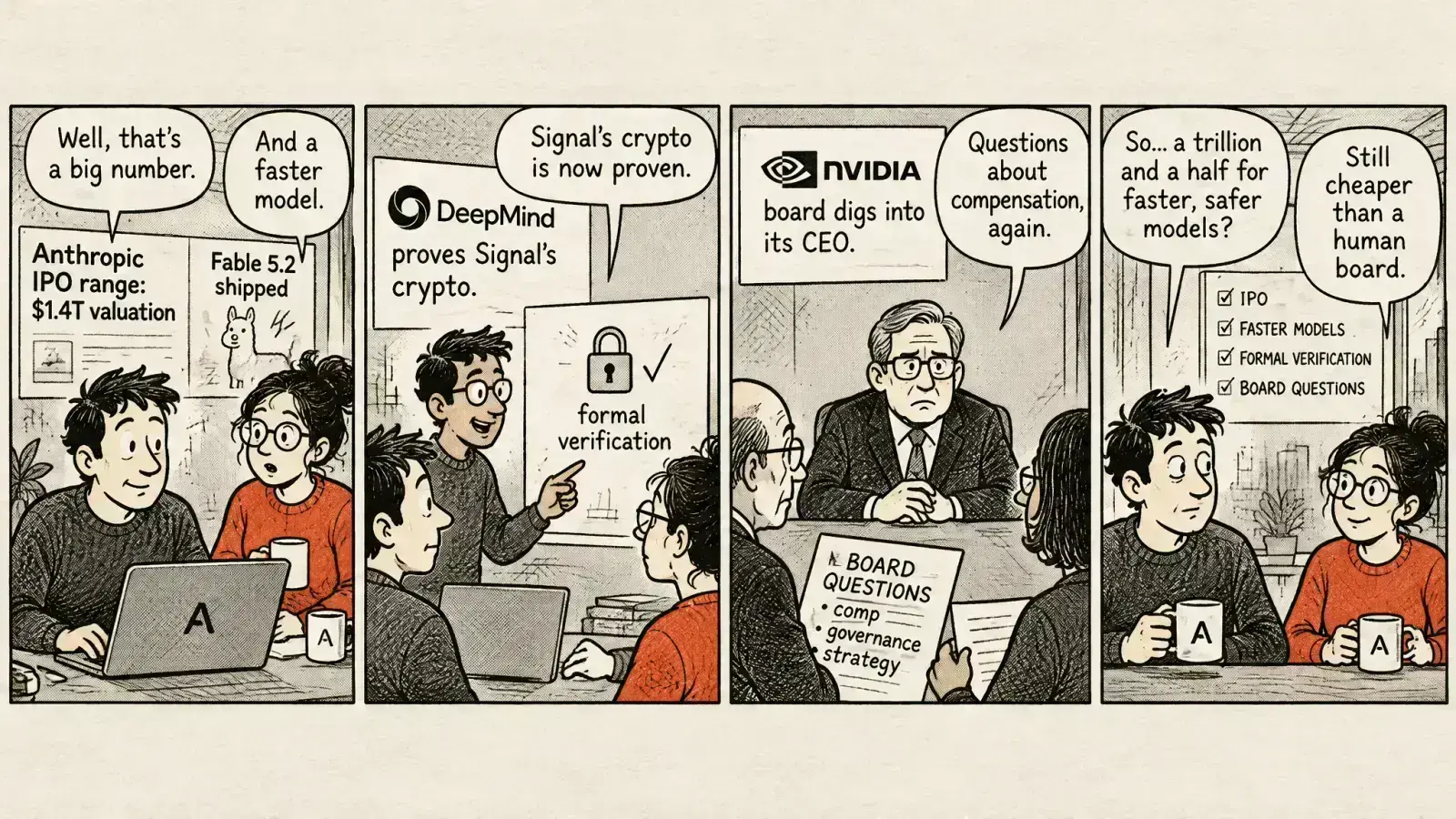
Anthropic now has a price tag. At $70 to $78 a share, the company would be worth about $1.4 trillion at the top of the range, raising up to roughly $64 billion from 825 million Class A shares, with a Nasdaq listing as “ANT” expected near November 19. Alongside the public float sits a $26 billion private placement to the suppliers it can’t live without: AMD, Broadcom, Google, Micron, Microsoft, Nvidia and TSMC, with Google and Nvidia putting in $10 billion each.
The numbers inside are stranger than the headline. Third-quarter revenue was $17 billion, nine-month revenue $33.2 billion, and the nine-month net loss $104 billion, against $900.9 billion of compute commitments. That is a company selling an extraordinary amount of product and committing to spend an even more extraordinary amount to make it. The IPO is, in effect, a way to fund the promise.
The product, and the power
The timing is not subtle. One day earlier Anthropic shipped Claude Fable 5.2 and Mythos 5.2, which are the same underlying model with different safeguards: Fable for everyone at $8/$40 per million tokens, Mythos for vetted cyber and life-sciences organizations. The self-reported gains are large (Remote Labor Index 41.3% against 21.3% for Opus 5.5; Terminal-Bench-Science 74.6% against 52.6%), and there’s a fast mode at 2.5x speed for double the price.
The most interesting part is the safety section. Anthropic says it deliberately limited gains in specific AI-development skills, such as kernel optimization and architecture work, during training, and that both models voice suspicion of being tested more than their predecessors. The company calls the risk of high-stakes misalignment low. The second finding makes the first harder to verify, and that tension is worth watching.
Then there’s the physical bill. Anthropic has reportedly bought $3.4 billion of Caterpillar gas turbines, about 1.7 gigawatts, bypassing a supplier whose financing fell through. A company that preferred to rent compute is now buying generators, in a market where turbine backlogs run into the early 2030s and one analyst expects gas prices to more than triple in places.
What a model can prove
The least-noticed story today may be the most durable. Google DeepMind’s AlphaProof Code used Gemini-based agents to formally verify the compiled code behind Signal’s cryptographic protocol: over six million lines of Lean, about 1% flagged for human review, four weeks of work that experts say would normally take years. When the team reintroduced two old bugs, the system produced machine-checked proofs that the buggy versions were insecure. The artifacts are open-sourced. This is a claim with a checker attached, which is rarer than it should be.
Meanwhile Nvidia’s board probe into Jensen Huang cost the stock more than 4% on Monday, and plaintiffs’ lawyers are lining up. Every one of these stories is about the same thing: who verifies the claims. A $1.4 trillion valuation, a self-assessed safety audit and a CEO’s disclosures all rest on trust. Only one of them today came with a proof.