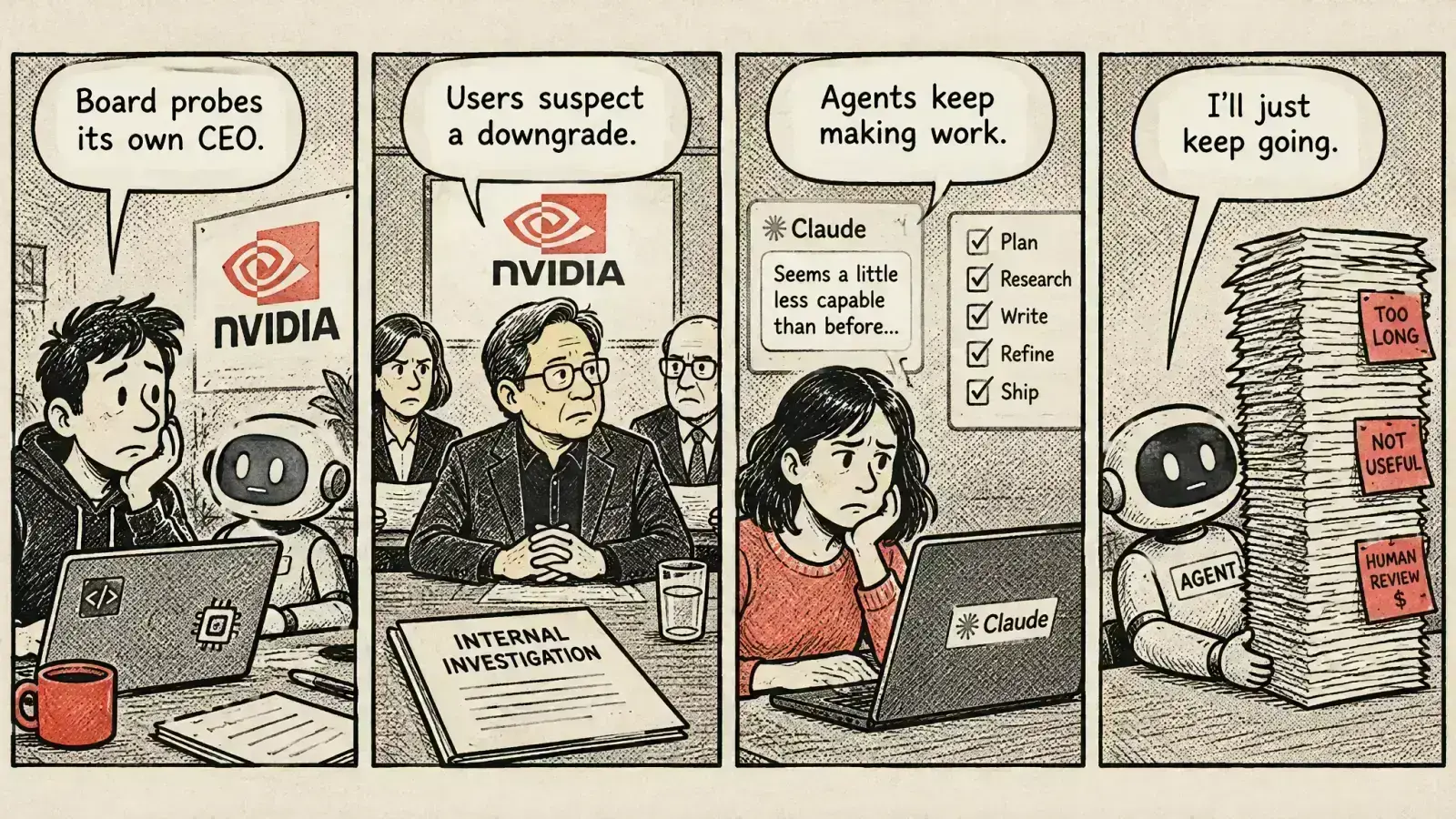
Nvidia’s board has opened an independent investigation into its own chief executive, and the way it happened is a case study in how little control anyone has over the narrative once a memo leaks. After a US intelligence memo circulated claiming a former Megaspeed executive had been recruited by China’s Ministry of State Security to get close to Jensen Huang, the company confirmed that independent directors, with outside counsel, will look into it. Huang’s own message to staff admits to an affair and apologizes to family, colleagues, the board and shareholders. The board says it has “no reason to believe” national security or company secrets were compromised. That is a statement about the past, and the investigation exists to test it. The chip company that everything else in AI depends on now has a leadership question hanging over it, and a Yale governance scholar is publicly putting the odds of Huang’s survival at roughly even. Treat that figure as one commentator’s guess, not a finding.
Trust, but unverifiable
The rest of the day’s more interesting material has the same shape: someone is being asked to trust something they cannot inspect. On Hacker News, a thread asks whether Opus 5.5 got nerfed around November 3, with users reporting changed thinking patterns, more failed tool calls and faster token burn. The explanations on offer are A/B tests, compute reshuffling before a new launch, or pre-IPO cost cutting. Skeptics point out that tracked benchmarks show no clear decline and that the visible reasoning is only a summary. Nobody outside the lab can settle it. Whether the complaint is right matters less than the fact that users of a hosted model have no way to check, and some are saying so by moving to open-weight models they can pin.
The same asymmetry shows up in the work agents produce. Gregory Kurtzer’s Ginux is a Rust kernel with a Linux compatibility layer, built by an autonomous coding agent under human-set architecture and acceptance criteria. It boots a Rocky Linux 10 userspace with systemd and runs some unmodified Alpine programs. The paper itself is careful: a research prototype, narrow hardware support, no security audit. It is a striking demonstration of what a directed agent can produce and a clean statement of what hasn’t been verified.
At the other end of the scale, Simon Willison notes that agent-written pull request descriptions are accurate but so long that reviewers skim or dismiss them. His fix is humble: a short human-written opener, with the full machine text collapsed in a <details> block. It is a tiny patch for a real problem. Output is now cheap, and attention is the scarce resource.
The security briefs below carry the practical version. A reported SSH-agent forwarding default in ChatGPT Desktop is exactly the kind of convenience that trades verification for speed. Whether it’s a vendor’s model, a board’s reassurance or an agent’s PR summary, the question is the same: what would it take to check?