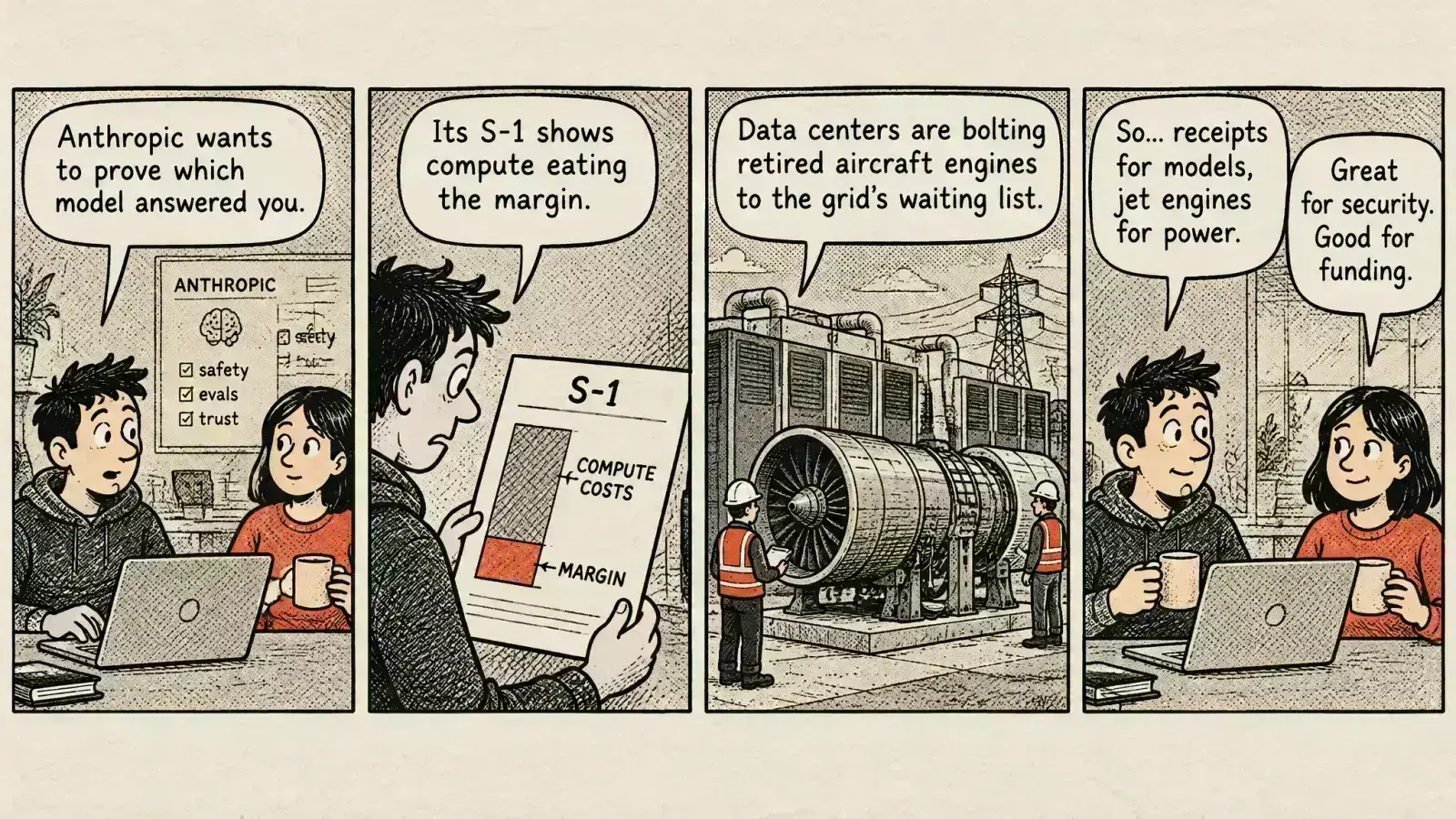
Anthropic had two kinds of news on Tuesday, and they pull in opposite directions. One is about trust: how do you know the model answering you is the model you paid for? The other is about money: what it costs to keep any model answering at all.
The trust piece is FlashProve, an open-source system for “provable inference.” The idea is a cryptographic proof that an output came from a specific model. Labs would publish a fingerprint per model, which doesn’t reveal weights, so closed models can take part, and verification is light enough to run on a local device. The use cases are unglamorous and real: catching a provider quietly swapping in a cheaper model, or confirming that a claimed result came from the frontier model it was credited to. The caveat is large. Anthropic calls this “intermediate progress,” and there are no plans to deploy it anywhere, including at Anthropic. Still, a market full of resold and routed inference needs receipts, and it’s telling that the people selling the inference are the ones drafting them.
The money piece comes from the amended S-1 and is the more sobering read. TechCrunch’s reading of the filing: Q3 revenue was $17 billion, up from $11.5 billion, but compute swallowed 58% of it, up from 48% the quarter before. Revenue per compute dollar peaked just above 2x and slid to 1.72x. Part of the culprit is $5 billion of short-term compute, which costs more than multi-year commitments, including a reported $1.25 billion a month to SpaceX. Growth near 50% a quarter keeps investors calm for now. Note the direction of travel, though: scale was supposed to make this ratio better, not worse.
Where the electrons come from
The ceiling on all of this is physical. Data centers are buying retired jet engines, rebuilt to burn natural gas, because a 100 MW grid connection in Northern Virginia takes about seven years, per the IEA. Converted units can have a site running in about 24 months, according to Rystad. xAI has eight in Mississippi for Colossus 2; Crusoe ordered 13. They’re less efficient and dirtier, and experts mostly call them a stopgap. Microsoft walked away as anchor tenant of Nscale’s UK site over a utility that couldn’t deliver power until the 2030s. When Anthropic’s bill says “short-term compute at a premium,” this is the world behind the footnote.
The bill for old code
Finally, a reminder that AI is a cost to defenders too. IEEE Spectrum’s piece on PHP2Shell tells how an out-of-memory bug reported in 2024 and filed as a minor crash was turned into a working exploit within two weeks by a Calif researcher using AI tools in an OpenAI-sponsored audit. A patch shipped before any known abuse, but it took four engineers two months. Finding bugs is getting cheap; fixing them is not. Matthew Green’s prediction in the piece is bleak: serious action will probably wait for a serious incident.
Put the four together and the week’s shape is plain. Proving what ran, paying for where it ran, powering it, and patching what it uncovers are all the same bill, arriving from different directions.