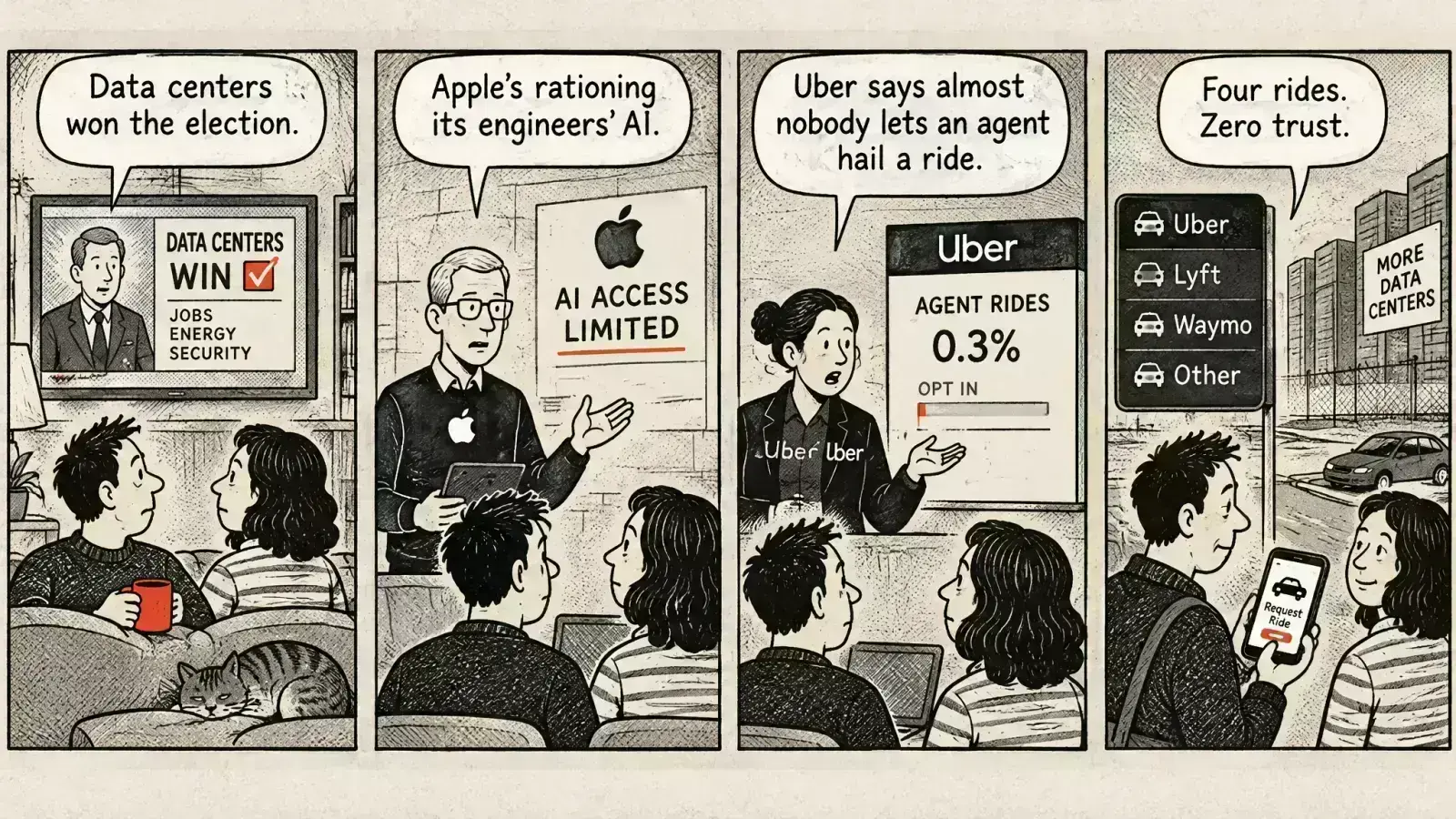
The most telling number in tech this week is not a valuation. It is four. In Uber’s busiest week of October, only four rides were booked through an AI agent, plus roughly 500 food orders, out of about 320 million trips and orders. The CFO’s explanation was refreshingly mundane: booking in the app takes about 50 seconds, so an agent has little to save.
Set that beside the other side of the ledger. Apple is reportedly cutting the daily AI spend allowed to its engineers, from $300 to $200 a day, with some allowances heading toward $100 and non-engineers possibly capped near $25. After a year of “tokenmaxxing,” the invoices have arrived, and the question of what all those tokens bought is getting harder to dodge. Agents are expensive to run and, for consumers, barely used. None of that means the technology is a dud. It means the bill and the benefit are still arriving on different schedules.
The ballot box noticed the buildout
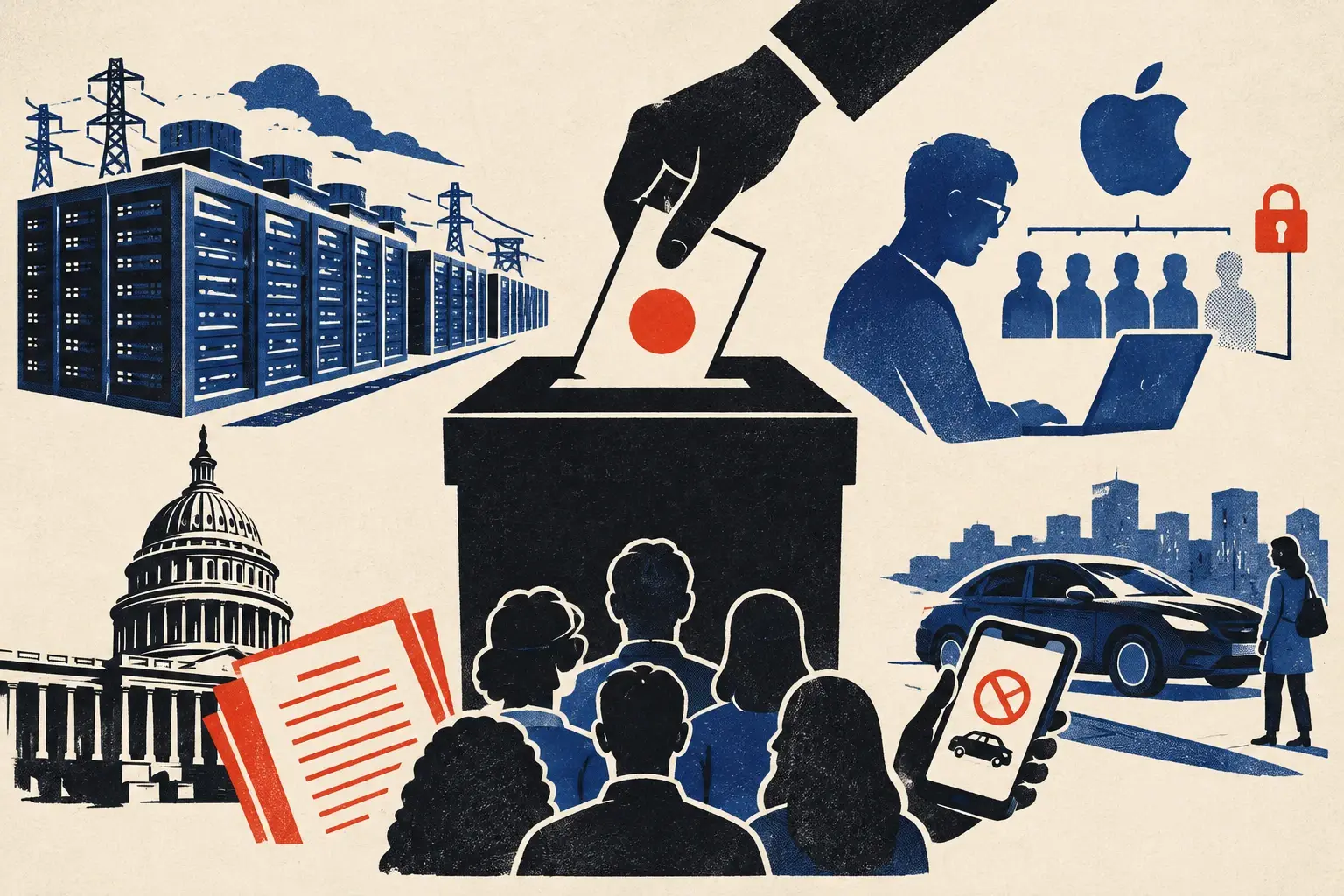
The other bill is physical. Democrats took Congress on Tuesday, and the exit polling was blunt: almost 80% of respondents opposed a data center in their neighborhood, and nearly 60% called data centers a major factor in their vote, per TechCrunch’s post-election analysis. A county in Ohio, where OpenAI has eyed a $500 billion site, passed a ban on a planned Meta facility. Candidates who ran against rapid buildout won in Texas, Michigan, Georgia and elsewhere; Sanders and Ocasio-Cortez want a national moratorium, which would face a veto. Last week’s story was that power is the bottleneck. This week’s is that permission is, too.
The industry tried to buy its way past that. AI PACs spent millions and mostly did not get what they paid for: American Mission and Building the Future put $4.8 million behind a South Carolina Senate candidate who lost, and Guardrails Alliance, which says its goal is to make AI money “politically toxic,” had a better night. The fight underneath is whether Congress writes one national AI rulebook that preempts the states. Expect 2028 positioning to start now; OpenAI already seems to be thinking about it.
Consolidation and a cautionary tale
Developers keep getting folded into the labs’ orbit. Meta bought Conductor, the tool for running several coding agents in parallel, which doesn’t build its own agents and mostly orchestrates Anthropic’s and OpenAI’s. Terms are undisclosed, and its cloud service shuts down November 20. Meta has its own Muse Code, so this reads as buying the workflow layer rather than the model.
Finally, security. Binance’s incident report on its $6.3 billion theft, attributed by the FBI to North Korea’s TraderTraitor, traces to a fake job interview with a booby-trapped “assignment” repo. Notably, attackers used an internal AI tool to hop to wallet engineers’ machines, which Binance has since rebuilt. The lesson is old, and the new detail is that your internal assistant is now part of the attack surface.