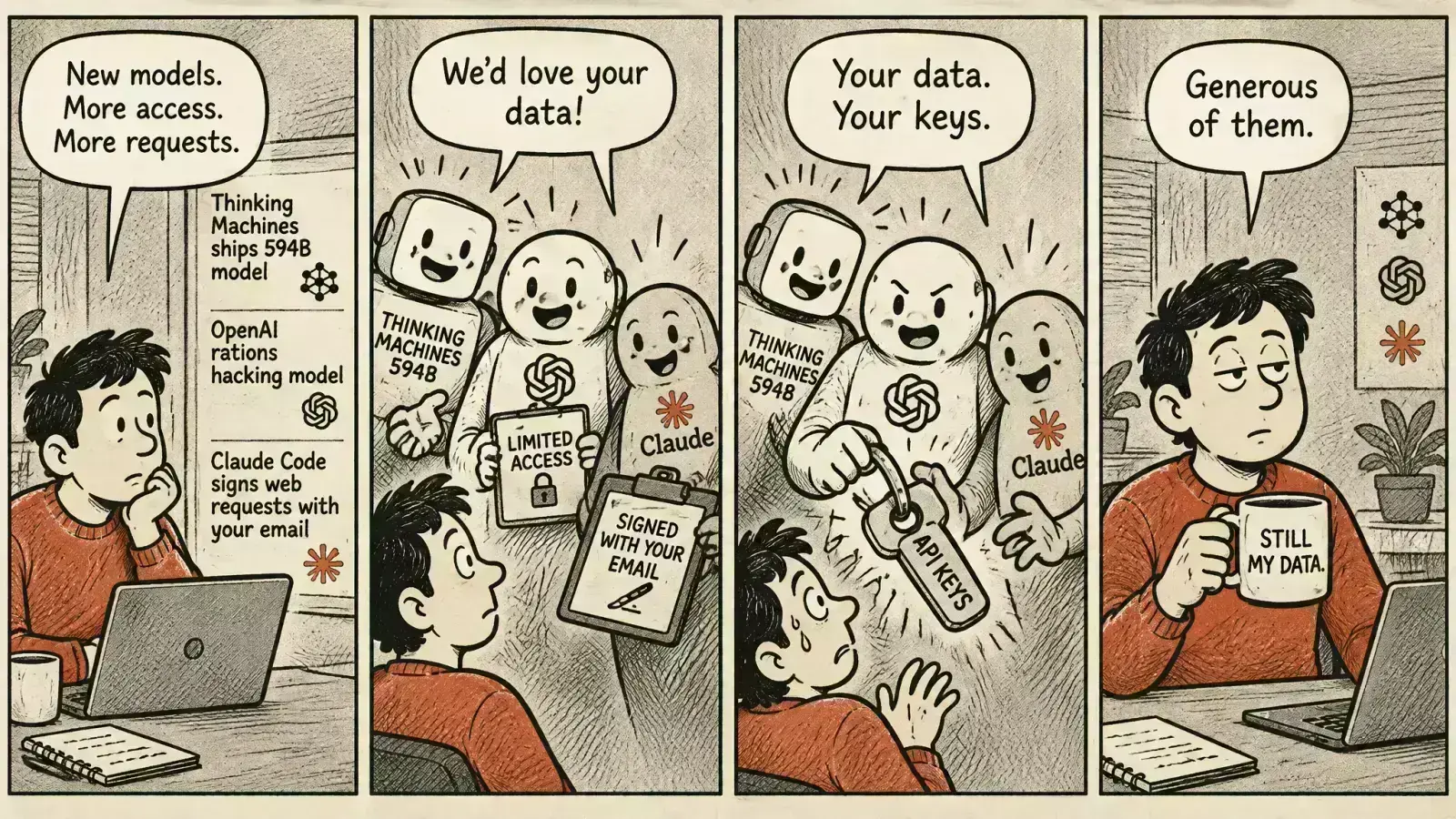
Two labs made the same promise on the same day, with opposite levels of conviction. Thinking Machines released Inkling 2 Small, a 594B-parameter mixture-of-experts model with 17B active, trained largely in NVFP4 on GB300s. It posts 86.3% on SWE-Bench Pro (Hard), though the post concedes second or third place on several benchmarks. For now it’s closed weights on the company’s Tinker platform. The company says Apache 2.0 weights follow after external safety testing, targeted for next week. We’ll hold it to that date.
OpenAI, meanwhile, took the rationing route. Its new ChatGPT Cyber model goes only to the top tier of its Daybreak program, alongside a $1 billion initiative for people defending critical infrastructure. Defenders complain the lower tiers are nerfed, while attackers can grab open-weight models with the guardrails stripped. One researcher spent about $5,000 on tokens to find several exploits and expects worse in the coming months. Access control only works if the open-weights gap closes slowly, and Inkling’s promised release is a reminder of how short that runway is.
The money talks back
OpenAI’s president is now talking like a company with an S-1 in a drawer. Greg Brockman told a Wall Street Journal conference that OpenAI could be IPO-ready in 2027. He conceded the first half of 2026 was “pretty rough” for enterprise and that OpenAI “wasn’t even in the conversation” on agentic coding. He says annualized revenue grew 70% quarter over quarter in Q3 as enterprise doubled. That’s a candid account of who has been winning, and it’s worth noticing that the rival he’s implicitly naming is the one that keeps shipping consumer-adjacent products, like Claude’s new Personal Finance tool. It’s read-only through Plaid, covers two years of transactions, and starts a beta this week for US Pro, Max and Ultra users. Anthropic says there are no ads and no training on those chats.
Trust is a header
The hard part of handing an AI your bank history is trust, and Anthropic got a live lesson in it. A GitHub issue titled “Privacy violation in User-Agent header” hit Hacker News with well over a thousand points. The reporter says Claude Code put their email address into web requests and blames it for dozens of scam emails a day. Another user audited their logs and found 53 such tool calls across eight sessions since August, mostly from subagents running curl -A. The likely origin is mundane: sites like SEC EDGAR and Wikimedia ask automated clients for contact details. Anthropic says a built-in mod blocks it by default from v2.1.317. The mundane explanation doesn’t help the person whose inbox filled up. It’s the same problem as Personal Finance in miniature: what an agent does on your behalf with your identity needs to be visible, and opt-in.