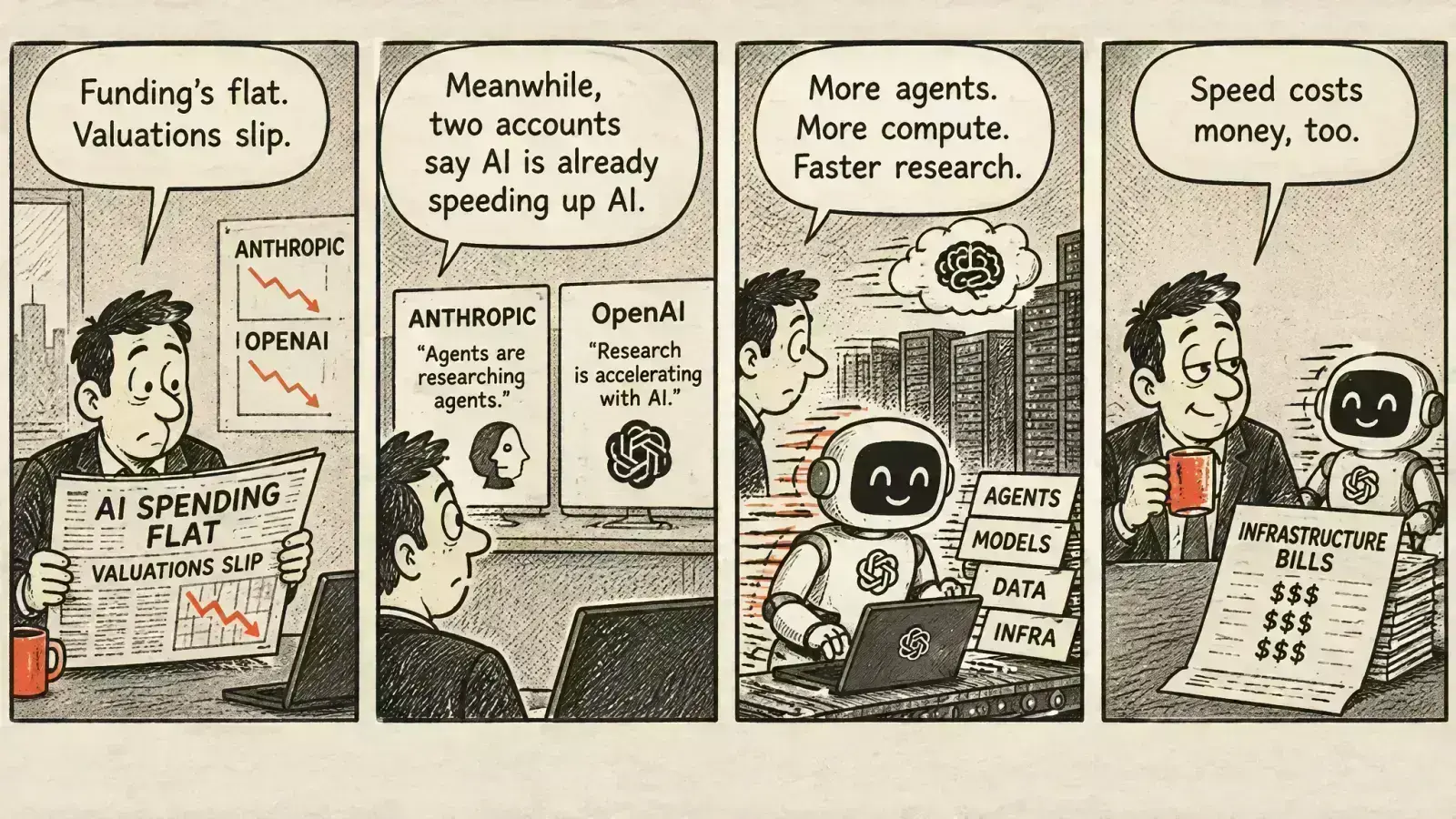
Two numbers from Friday sit awkwardly together. Ramp’s card data shows business spending on AI tokens grew just 1.5% across August and September, after a 42% jump in July. And the people closest to the frontier are saying the work itself is speeding up. The money is getting cautious while the machines get quicker, and the gap is where this week’s stories live.
Start with the Ramp data. Ramp’s economist reads it as price competition and better cost controls rather than weak demand: usage is still climbing, but companies are routing to cheaper models and setting budgets. OpenAI halved API prices for its GPT-6 models in September, and Anthropic’s own cuts reportedly shaved about $600 million off its revenue growth, per a filing. Most of the spend comes from venture-backed tech firms, so a wobble there can travel. The median firm spends $12 to $15 per employee per month, while the top 1% spend close to $10,000. That is a long tail doing a lot of the lifting.
The valuations are following. Bloomberg reports Anthropic’s potential IPO valuation has slipped from about $2 trillion in early October to somewhere between $1.1 and $1.3 trillion. OpenAI has reportedly raised another $11 billion at $1.25 trillion, part of a round that could reach roughly $20 billion, well short of the $30 billion at $1.4 trillion floated in late September. These are still staggering numbers, but the direction is down, and the round isn’t closed. Treat everything here as reported, not confirmed.
Now the other side. Ajeya Cotra argues in AI is dramatically accelerating AI research that Anthropic has likely crossed its own threshold for AI-driven acceleration. She cites a METR report putting capabilities progress at about twice the prior pace, which implies researchers roughly 10x more productive, in line with staff reports of about 12x. She also notes the report found no clear bottlenecks and that much of the supporting evidence is redacted. That caveat matters: this is a single, partly hidden evidence base, and her warning about superintelligence within a year is a forecast, not a finding.
Anthropic’s own Components of Agent Memory shows what some of that acceleration looks like in practice. It describes “dreaming”, an offline pass where Claude reviews its logs to reorganize and correct its memory. In the team’s evaluations, dreaming fixed wrong notes and built useful wikis, and a small, well-chosen memory folder beat a bloated one in Pokémon. It is a modest, practical result, and a reminder that much of the progress is plumbing.
The through-line is a mismatch of clocks. Research speed is measured in weeks, buyer budgets in quarters, and data-center permits in election cycles. Crusoe handed an unfinished Wyoming campus to Google this week, and Meta is already warning that local backlash could slow its buildout. If the researchers are right, demand for compute will not be the constraint. If the spending data is right, it might be. One of them is going to be embarrassed, and we should find out sooner than most people would like.