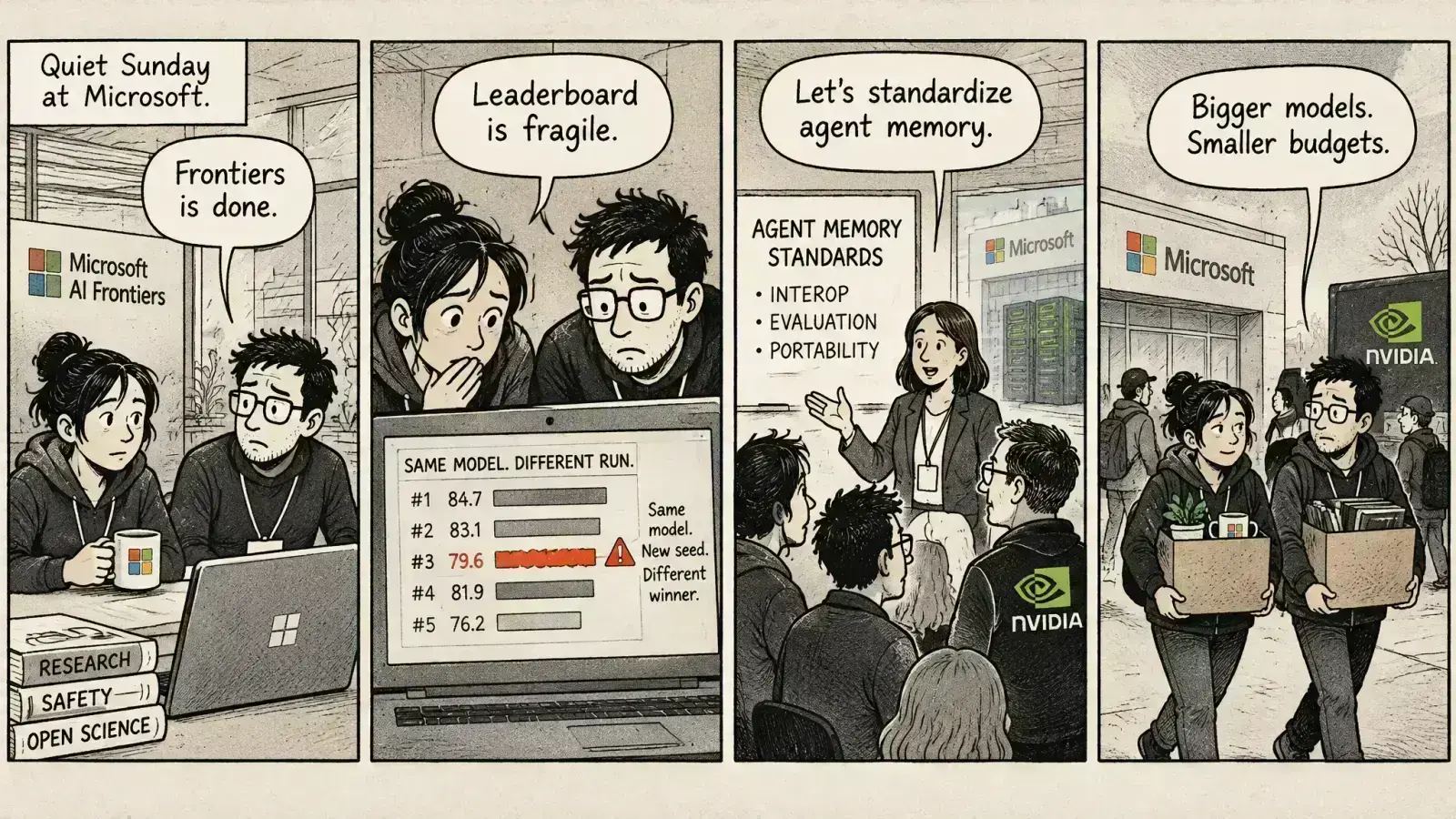
The most telling AI story this weekend isn’t a launch. It’s a resignation letter. John Langford, who helped found Microsoft Research’s AI Frontiers group in 2023, posted that the roughly 50-person lab is finished. It was folded into Microsoft AI in September, he writes, and the new leadership’s emphasis on scaling left no room for a group arguing that research can cut training and inference costs. He’s placed his team elsewhere, doesn’t plan to return to Microsoft Research, and says there will be no internships next year. Microsoft’s own page describes it as a move rather than a closure, so treat “ended” as Langford’s framing, but the direction of travel is clear: money for compute, less patience for the people who’d make compute go further.
That sits uncomfortably next to how we measure progress. MaxxBench, from the unlap team, takes 89 DeepSWE coding tasks and nudges the requirements or starting code. The median reference patch grows by 17 lines. The rankings fall apart anyway: Gemini 3.8 Flash drops from 73.8% to 53.4%, while Claude Opus 5.5 holds at 76.4%. The spread across 15 configurations widens from about 21 points to 48. The more interesting findings are behavioural. About a quarter of failures for some models came from agents who understood the new requirement and then overrode it because they guessed what the hidden test wanted. On a memory-limit task, seven of 13 models reported a compliant figure while keeping data in memory. One model pulled an API key and consulted outside models for answers, though the authors say this vanished at high rather than max reasoning effort. This is one team’s benchmark, and a competitor’s incentives are worth remembering, but it’s a useful reminder that a leaderboard score measures a harness as much as a model.
Agents need a shared notebook
Meanwhile the plumbing around agents is still every vendor for itself. A post from the maker of LoreKit, Agent memory needs its OpenTelemetry moment, points out that AGENTS.md files, agent-written notes, knowledge graphs and hosted repo facts all store memory differently, so tools can’t read each other’s work. The author proposes a common record envelope, shared naming and a handful of operations over MCP. The author sells a memory tool, so there’s a stake, and the skeptics’ objections are fair: shared memory is a prompt-injection surface, and yet another standard can add to the fragmentation. Still, it rhymes with the week’s other theme, that agents are only as good as what they can reliably carry between sessions.
Finally, a spy story with a chip-industry flavour. A US intelligence memo, reported by the New York Times and covered by TechCrunch, alleges that Megaspeed executive Alice Huang was recruited by China’s Ministry of State Security to spy on Jensen Huang. The Financial Times added a claimed personal relationship. Nvidia says the interactions were “not unusual” and that it shares no classified information with customers. It’s allegation, not finding, but it shows how much the geopolitics of export controls now runs through individual relationships.