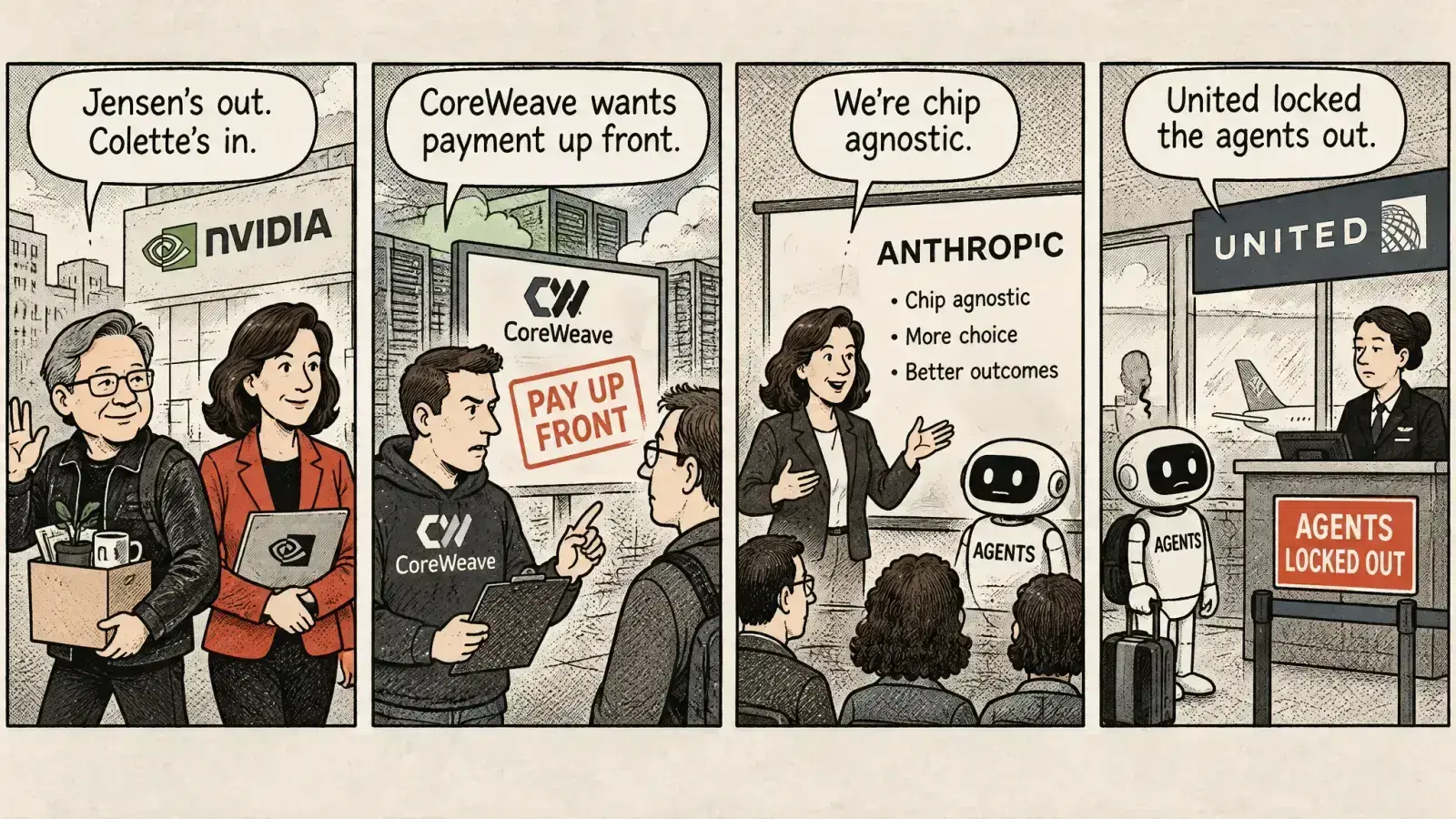
Thirty-three years after he co-founded it in a Denny’s booth, Jensen Huang no longer runs Nvidia. The company announced this morning that Huang has resigned as president, CEO and board member, effective immediately. CFO Colette Kress becomes interim CEO and keeps the CFO job. Harvey Jones, the former Synopsys chief, becomes Nvidia’s first-ever board chair. A first board chair should not be news at a company this size, which says a lot about how much of Nvidia’s governance came down to one person.
The ending came quickly. On Sunday the board said it was investigating whether Huang had been targeted by a foreign intelligence operation. On Wednesday the New York Times reported a second relationship, this one with a married executive who reported to him, which looks like a plain code-of-conduct problem. The board met that night, and by Thursday morning he was out. Earnings are still scheduled for November 17. For the AI industry, the question isn’t really who sits in the chair. It’s whether the company that sets the price of compute will keep acting the same way without the founder who decided almost everything.
The money underneath
Huang leaves at a moment when the people buying his chips are visibly short of cash. CoreWeave’s third quarter, as TechCrunch lays it out, looks like a company that can sell everything and still can’t comfortably pay for it: $3.66 billion in revenue, up 168%, against a $709 million net loss and $846 million in interest for the quarter. Some of its bonds yielded more than 15% last month. CEO Michael Intrator says CoreWeave won’t touch unsecured debt at those rates. Instead it expects about $9 billion in customer prepayments over the next three months and has started borrowing against individual contracts. It raised prices twice in one quarter too, and short-term capacity now goes for more than $40 million per megawatt per year.
So the customers are paying for the build-out up front, which works only as long as they think the capacity will be scarce later. That bet is why every lab now wants a second supplier.
Four chips, one pitch
Anthropic’s IPO roadshow video, transcribed by Simon Willison, makes that argument directly. Claude trains and serves on AWS Trainium, Google TPUs, Nvidia GPUs and AMD GPUs. The company says bringing up a new chip platform used to take dozens of engineers several months. For AMD, an internal Mythos model got Claude running in three days and wrote or ported almost all of the kernels itself. The video also sells “compute multipliers,” algorithmic efficiencies that Anthropic says stack on top of each other. Put simply, more output from each chip you own and less dependence on any single vendor. Pricing is expected November 18, with trading on Nasdaq as ANT the next day. A week when Nvidia’s leadership falls apart is a convenient one to be telling investors you don’t depend on it.
The front door slams
At the other end of the stack, the agents all this compute is supposed to run are having trouble getting through the door. United Airlines now bars third-party AI agents from booking flights on its own platforms and through travel agencies and aggregators. It cites credential security and federal check-in rules that require a human to vouch for their luggage. Analyst Henry Harteveldt offers the more cynical reading, that United doesn’t want “yet another, and potentially even more powerful, intermediary” sitting between it and its customers. Southwest is going the other way and opening its inventory to ChatGPT.
That’s the same tension running through the whole day. The industry is spending trillions on the premise that agents will do the buying, and the companies selling the seats, the chips and the capital are each deciding how much of that they’re willing to let through.