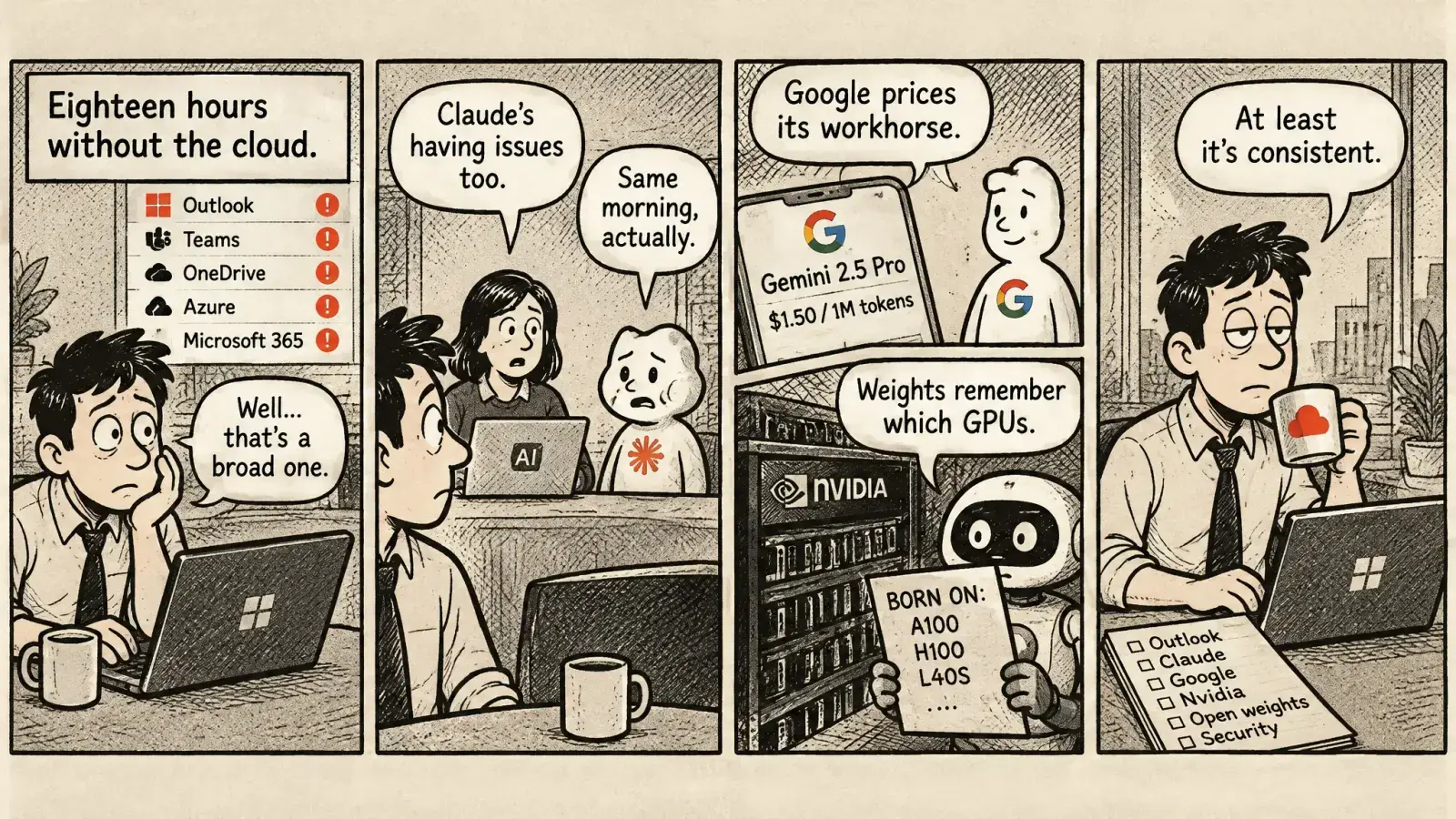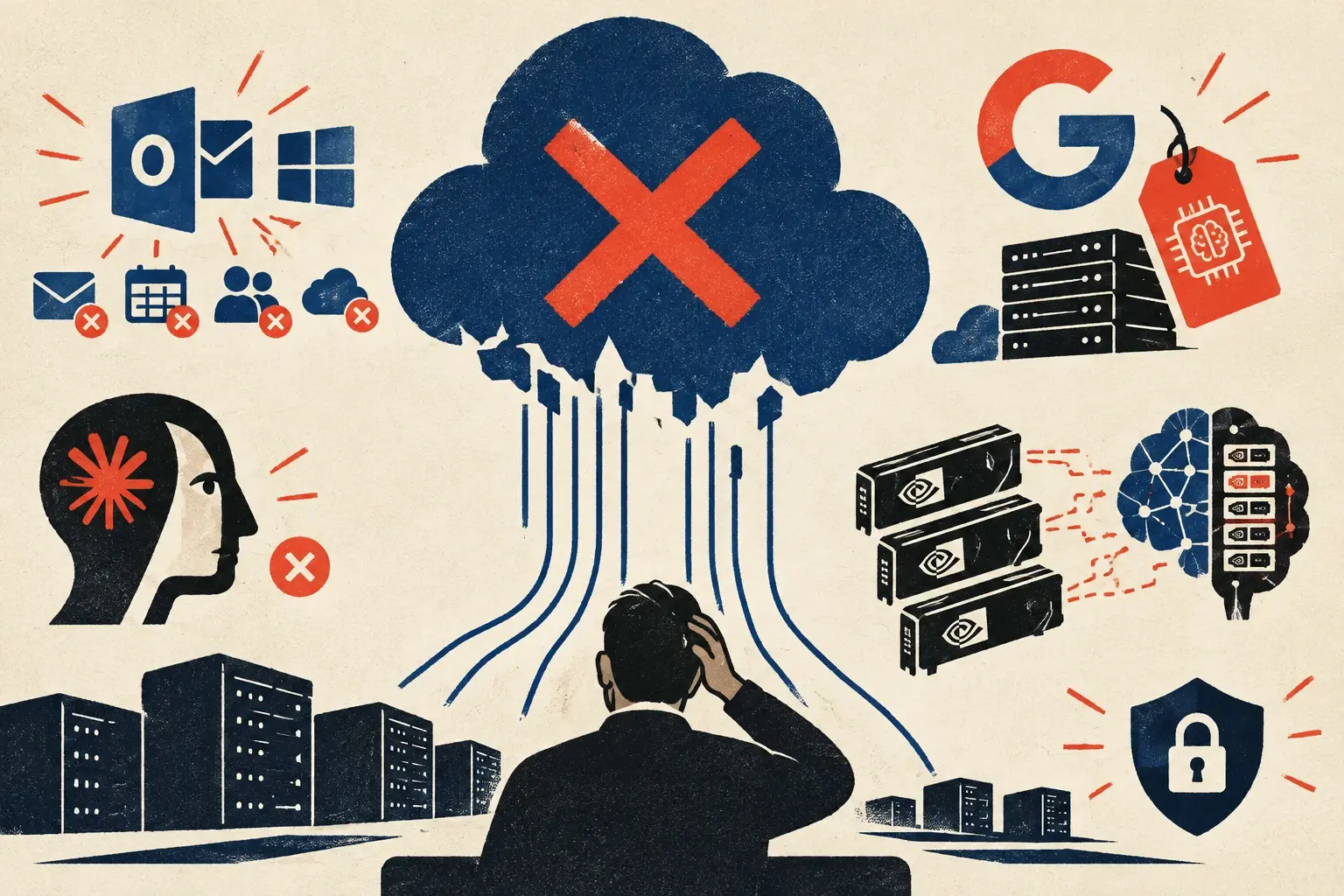
Some time Thursday, Outlook stopped delivering mail. Then Teams went. Then, according to TechCrunch, the failure spread across much of Microsoft’s cloud: files and documents, Copilot, Defender’s security screening, Intune admin consoles, even some customers’ cloud-hosted Windows PCs. Kentik’s Doug Madory put the downtime at about 18 hours. Microsoft’s explanation so far is “a large number of servers being unexpectedly unavailable,” which is a description, not a cause. It says there is “no evidence of malicious activity,” without saying how it would know. This comes about two months after a days-long outage blamed on a “core authentication configuration.”
Friday morning brought a smaller echo. Claude’s apps, Console and Code couldn’t authenticate users for roughly two hours before a fix went out. The same day, Uber confirmed that drivers’ license records were stolen through Fireworks AI, the inference vendor whose breach had already exposed Notion’s customers. None of these incidents is connected, but they share a lesson. Agents are only as dependable as the stack under them, and that stack now runs through a handful of vendors most users have never heard of.
The workhorse gets cheaper
Google, meanwhile, spent the week making that dependency more tempting. Gemini 4 Hydrogen replaces the Flash line and costs $1.50 per million input tokens and $7.50 per million output, a flat rate across the whole 1M-token window. Google says it scores 51 on the Artificial Analysis index at default settings, one point above its own pricier Argon, and 57% on Terminal-Bench, up from 18.2% for 3.8 Flash. The more interesting part is Antigravity’s new Orchestrator mode. It lets Carbon plan and inspect while Hydrogen does the edits and runs the tests, and Google claims it gets close to Carbon’s success rate with 24% less quota. That is a real product idea: stop picking one model and start assigning them roles. Hydrogen is also now the default in Search’s AI Mode, so it becomes one of the most widely used models in the world overnight.
Weights that remember where they were made
The most original work of the day came from one person and some PyTorch arithmetic. In a forensic report, Will DePue argues that a model’s random initial weights carry the thread layout of the GPU that generated them, and that weights barely touched by training still hold that signature. Working only from published checkpoints, he finds Blackwell-class signatures in six recent Chinese models, including DeepSeek-V4, Kimi K3 and MiniMax-M3. Blackwell is export-controlled for China. The method matched all 24 models whose developers had disclosed their hardware. DePue is careful to say what it doesn’t show: where the chips physically sat, or whether any export rule was broken. Still, it is a striking reminder that open weights reveal more than their authors may intend.
That lands awkwardly for Nvidia, whose leadership is now in question. With Jensen Huang gone, TechCrunch asks whether the company’s open-source push survives him. That push includes the Nemotron line, the unfinished Hugging Face acquisition and Huang’s lobbying against limits on open-weight models. Nathan Lambert called his exit “very very bad for the open model cause in the US.” An insider says Nemotron work continues. But interim CEO Colette Kress is the executive who cut Nvidia’s credit to OpenAI’s Ohio data center from $250 billion to $105 billion. She looks like someone who reads the bill before signing it, and open models are one more bill.