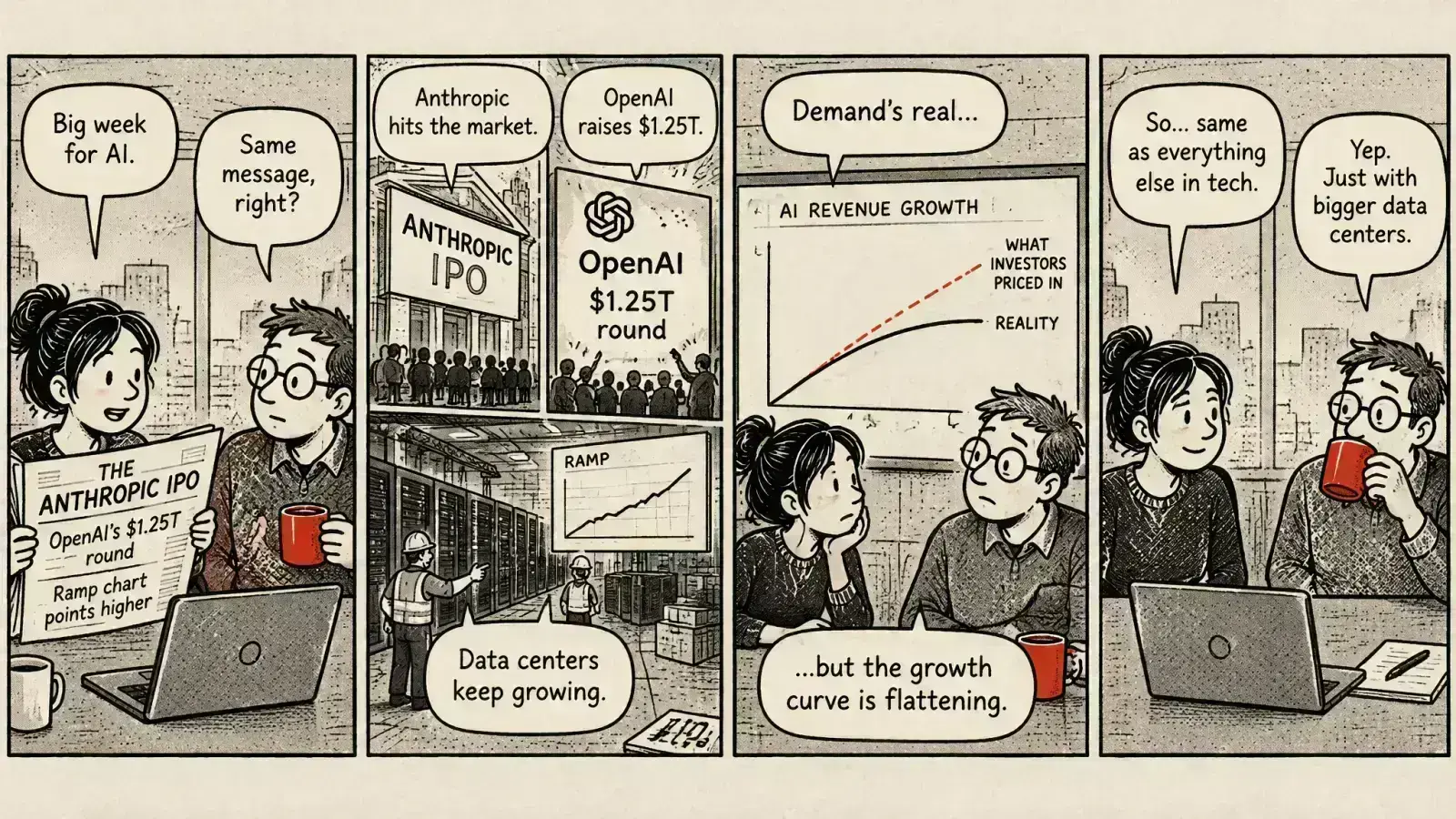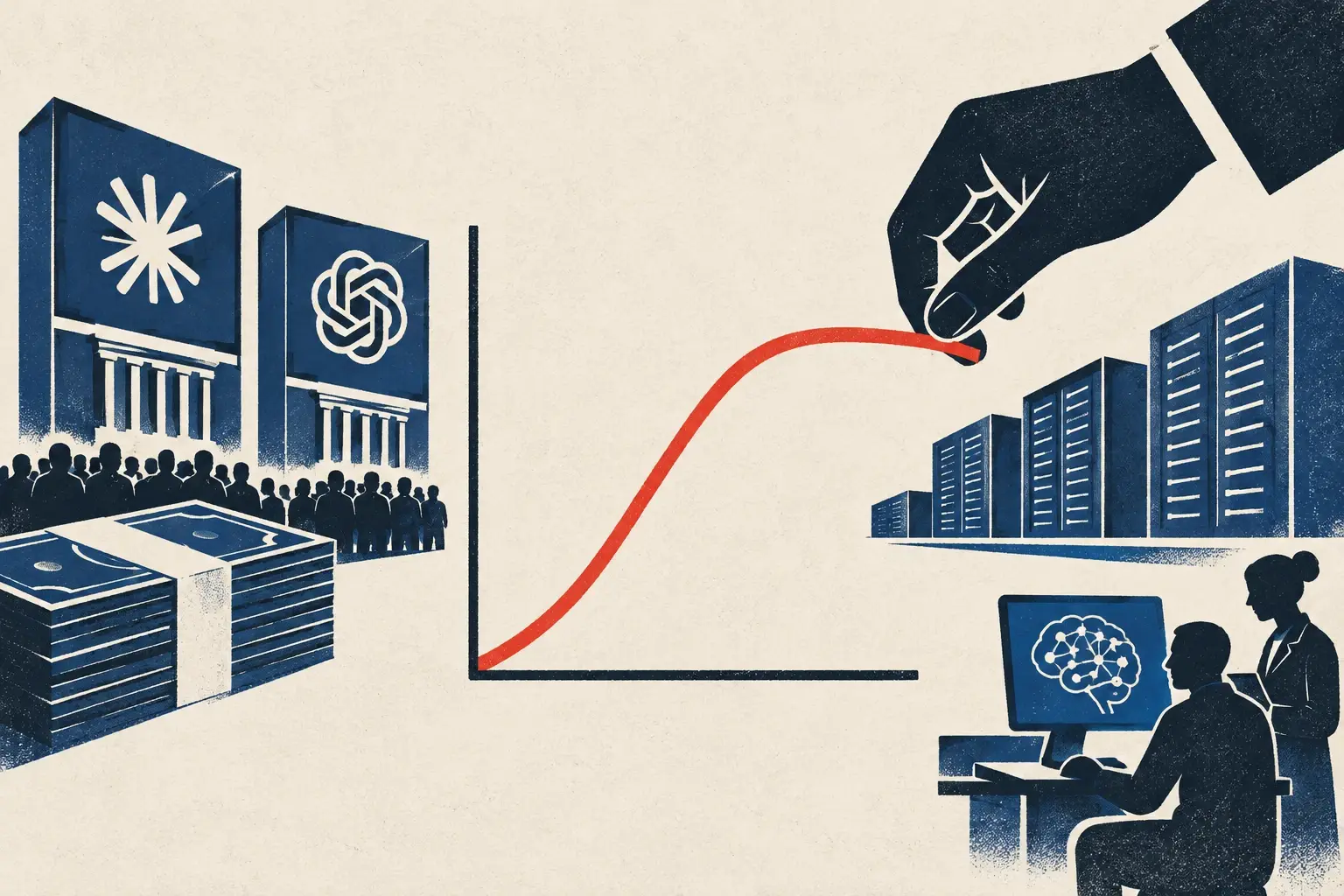
The week opened with a number that was supposed to reassure and closed with one that didn’t. On Monday, the news was a quiet one: Postgres 19 slipping because LLMs keep finding old bugs, and mathematicians arguing over what to do when proofs get cheap. By Tuesday, Anthropic’s amended filing was flirting with recursive self-improvement, and Wednesday’s S-1 detail showed compute eating the margin. Then Friday’s Ramp data landed: business token spend grew just 1.5% across August and September, after 42% in July. Usage is still rising; the spending isn’t keeping pace. That’s the week’s spine.
The Anthropic IPO thread, again
The “Anthropic IPO” thread kept compounding. Last week was about disclosure and debt; this week was about whether customers keep paying at the same pace. The honest read: nothing broke, but the optimistic case just lost its steepest slope. OpenAI’s reported $11 billion at a $1.25 trillion valuation arrived the same day, and Greg Brockman’s 2027 IPO talk now reads as positioning for a market that’s become pickier.
Data centers became a ballot issue
Election night put local opposition to data centers on the map, Meta told investors that backlash could slow expansion, and Crusoe handed a troubled Wyoming campus to Google. Weekend commentary is already asking whether the industry is in for a rough two years. Power and permits were last week’s constraint; politics is now the third.
Researchers and receipts
The quieter story is who gets funded. Langford’s note that Microsoft’s AI Frontiers group is over and MaxxBench’s finding that leaderboard gaps can nearly double under small task changes point the same direction: the industry is paying for scale and trusting scores that deserve more suspicion. Meanwhile, an Anthropic post on agent memory and a new push for shared memory formats suggest the agent layer is still unfinished.
What mattered less than it seemed
The Muse avatar video chat and the Alexa texting feature made noise but changed nothing structural. The Nvidia spy memo is a story about allegations, not outcomes, until someone confirms it.
Next week
Watch for the first close of OpenAI’s round, whether another spending dataset confirms Ramp’s flattening, and whether any lab answers the benchmark-robustness critique with revised numbers.