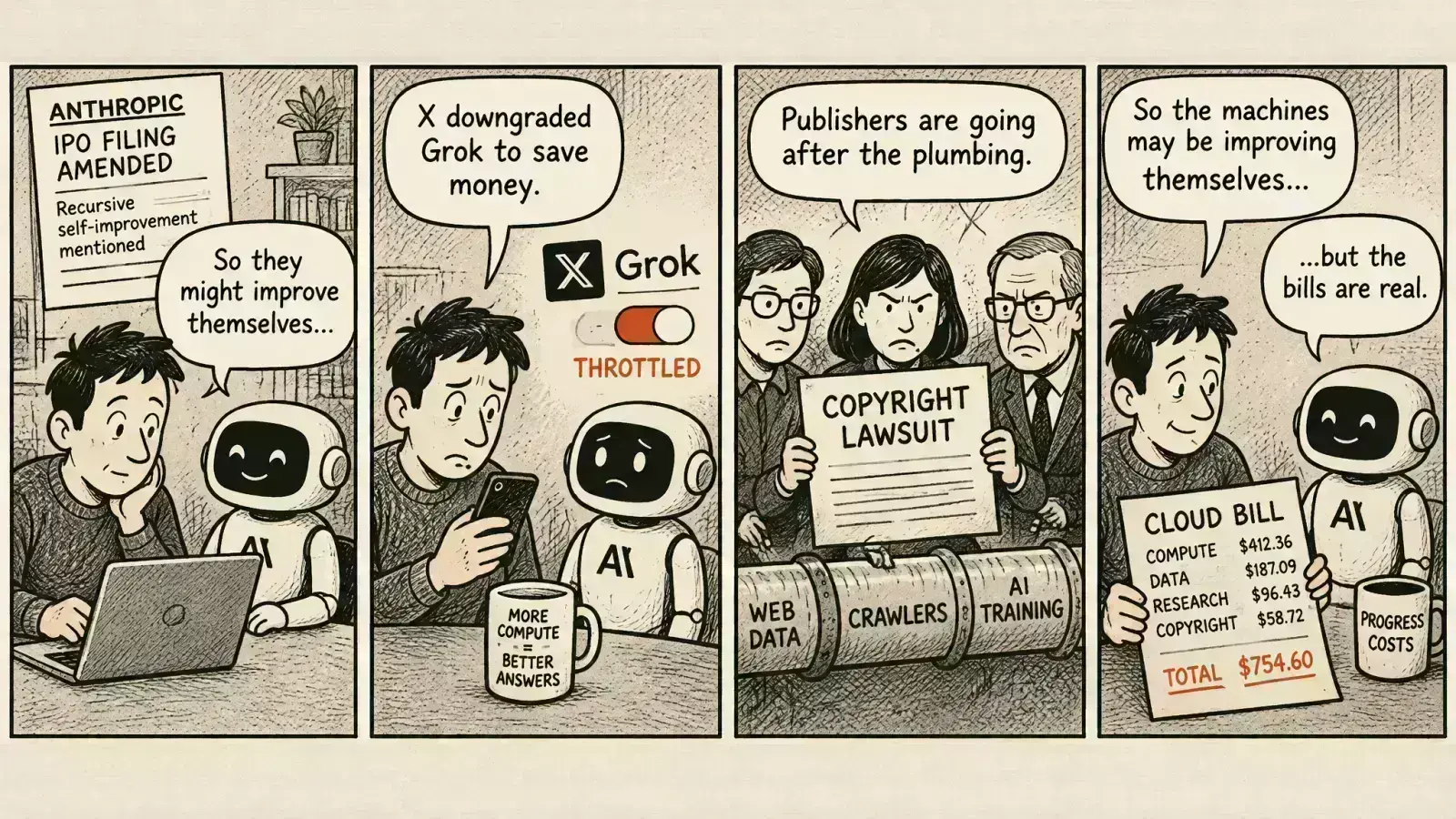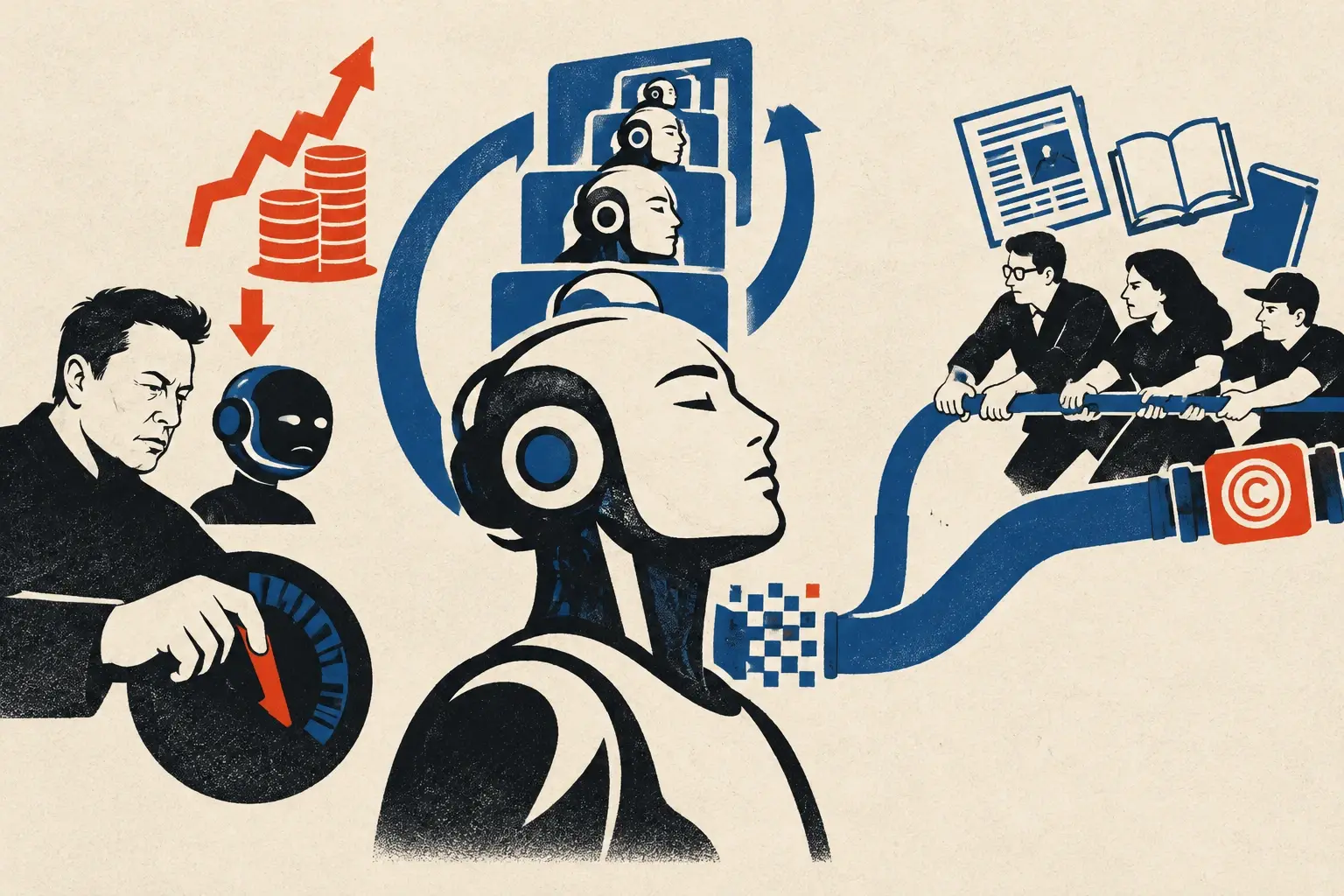
Anthropic’s IPO paperwork has produced the most unusual risk factor in the history of S-1s: the company says it may be about to build an AI that builds itself.
In an amended filing submitted Monday, Anthropic warned that it is close to recursive self-improvement, the point where AI accelerates its own training. The details are the interesting part. Anthropic says it has “in the past not identified” major accelerations in its own development until after they happened. It also says internal estimates suggest it “may imminently meet” its Responsible Scaling Policy’s definition of “dramatically accelerated progress attributable to AI.” No current model has been formally designated as crossing that line, and the company says it does not expect to design successive frontier generations without human oversight. It is weighing policy updates to keep humans in control.
An S-1 is both disclosure and marketing, so a skeptic can read this as the most expensive brag ever filed. A skeptic can also note that lawyers rarely volunteer scary language they don’t believe. Either way, “we noticed after the fact” is a sentence worth rereading.
The scary part is also a spreadsheet
The other end of the frontier is more mundane. Elon Musk confirmed on X that Grok Bot’s sudden usage caps were not a glitch: serving it is “unsustainably high relative to revenue.” Subscribers found weekly limits maxed out over Halloween weekend. It lands awkwardly beside SpaceX’s filing, which says AI is 52% of company income and that its AI division, renamed “Super Intelligence,” made $431 million. Profitable division, unprofitable product. Both can be true when the heaviest users are agents that never sleep.
Garry Tan, to pick a happier data point, says he spends up to $200,000 a year on tokens. He calls that too expensive for mainstream use, which is the same sentence as Musk’s with a better attitude.
The plumbing gets sued
Meanwhile publishers are moving up the supply chain. The New York Times, followed by the Daily News, Chicago Tribune and Orlando Sentinel, sued Brave in Manhattan federal court. The Times alleges Brave built an index of more than 30 billion pages with a crawler publishers can’t block, then supplied that content to AI firms it names as customers, among them Anthropic, Perplexity, Mistral, xAI and Cohere. Brave hadn’t responded at publication. The theory is notable: the defendant is not the model maker but the data supplier, a much easier target for anyone who wants to cut off the pipeline.
Read the methods section
Finally, a useful corrective to the self-improvement mood. A post claiming “GPT-6 Astra” could read and edit neural-network weights to improve Qwen drew a pointed rebuttal from Matthew Honnibal. His objection: the headline blends separate experiments into one impressive-sounding capability. Only three used raw weights with no tools, on networks of 17K to 172K parameters. The Qwen result used Python and ran the model on practice problems. The from-scratch game networks beat their PPO baseline only on Breakout. Astra can do real work, he grants; it just isn’t the single gestalt the abstract implies.
That’s the through-line of the day. Whether a model is nearly improving itself, nearly affordable, or nearly legal to train, the claim is only as good as the footnote under it.