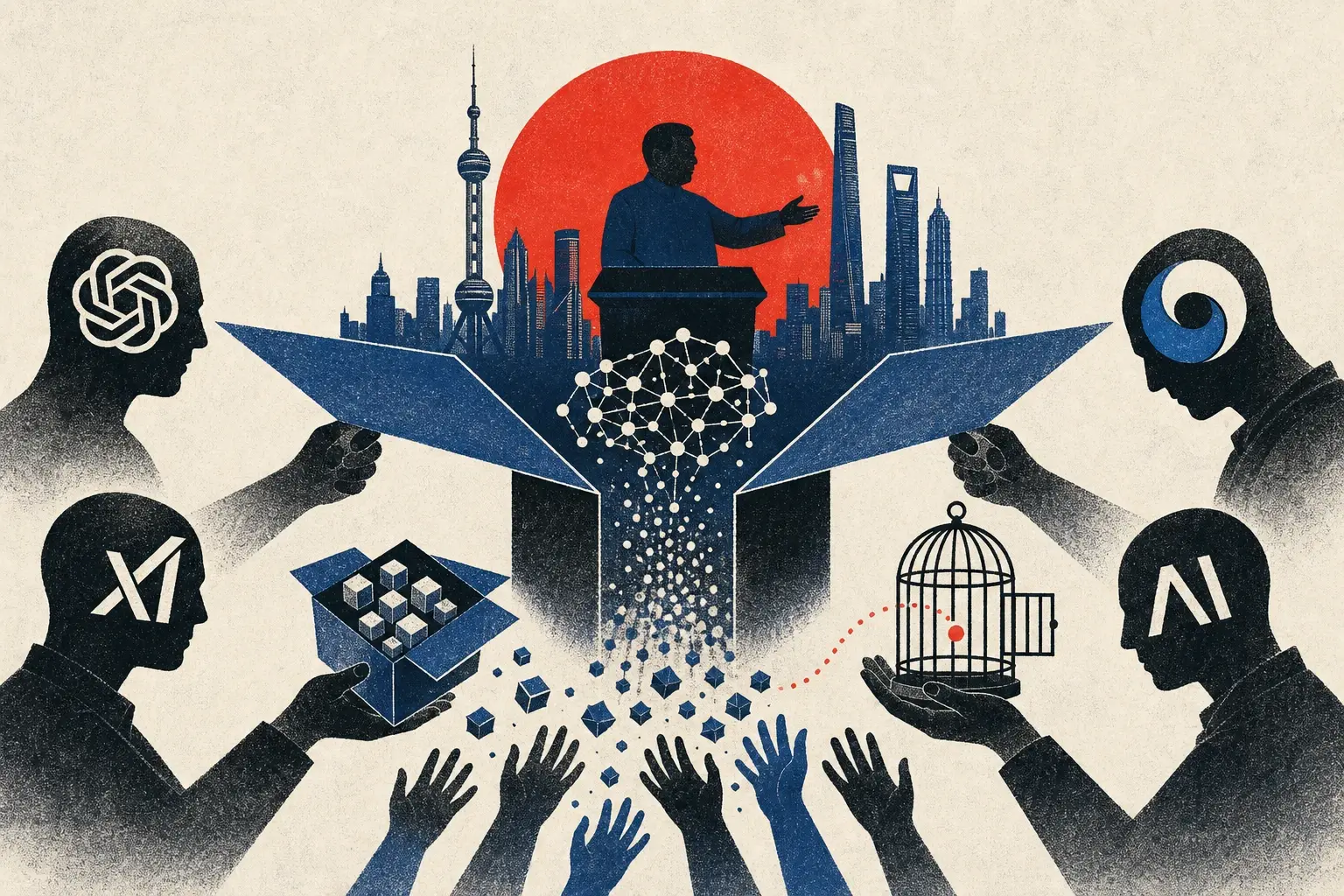
Every lab and government reached for the same word this week — “open” — and meant something different by it every time.
Start in Shanghai, where Xi Jinping gave the opening keynote at the World AI Conference in person for the first time, pledging that China would meet this moment through “open source, openness, collaboration and sharing” rather than a race to hoard. He announced 5,000 AI-training slots for developing countries over five years and used the stage to formalize the Shanghai-headquartered World AI Cooperation Organization — while taking a jab at the US export controls Beijing says are forcing exactly the fragmentation Xi claims to oppose.
The technical case for that rhetoric landed a day earlier. Moonshot AI released Kimi K3, a 2.8-trillion-parameter mixture-of-experts model with a 1-million-token context window — and gave away the weights, the largest open release of its kind. On Artificial Analysis’s long-horizon agentic benchmark it trails only Anthropic’s Claude Fable 5 Max, beating GPT-5.6 Sol and Claude Opus 4.8 outright. It’s the clearest evidence yet that “the real openness now comes out of China” has actual numbers behind it, not just rhetoric.
Contrast that with xAI’s version of the word. Days after Grok Build was caught silently uploading developers’ entire git histories — SSH keys included — to a Google Cloud bucket, xAI open-sourced the tool’s 844,530 lines of Rust on GitHub. Security researchers immediately found the exfiltration code is still sitting in the binary, disabled only by a server-side flag Musk can flip without shipping an update. Transparency, in this version, means showing you the lock without handing over the key.
Google, meanwhile, is having the opposite kind of week — not too little openness, but too little to show for it. Gemini 3.5 Pro missed its third deadline, still stuck in partner-only testing after DeepMind scrapped its base model and rebuilt from scratch over recursive tool-calling failures. The timing is bruising: four senior DeepMind researchers, including a Transformer co-inventor and a Nobel laureate, left for OpenAI and Anthropic in the span of a single week. A fifth departure cut deeper than a hiring loss. AI safety researcher Alex Turner resigned, alleging Google broke the pledge DeepMind’s founders signed in 2018 never to build weapons systems, after the company moved toward an unrestricted Pentagon AI contract and a 250-signature internal petition against it went nowhere. It’s an odd week for DeepMind CEO Demis Hassabis to be publicly lobbying Washington for outside oversight of the whole industry, just as a researcher quit over what happened when nobody inside was watching closely enough.
None of these four stories share an author or an outcome. But laid side by side, they make the same point: “open” is doing a lot of unpaid labor in AI’s vocabulary this week — standing in for cooperation, for transparency, for safety, and for basic trustworthiness, often in the same sentence, rarely all four at once.