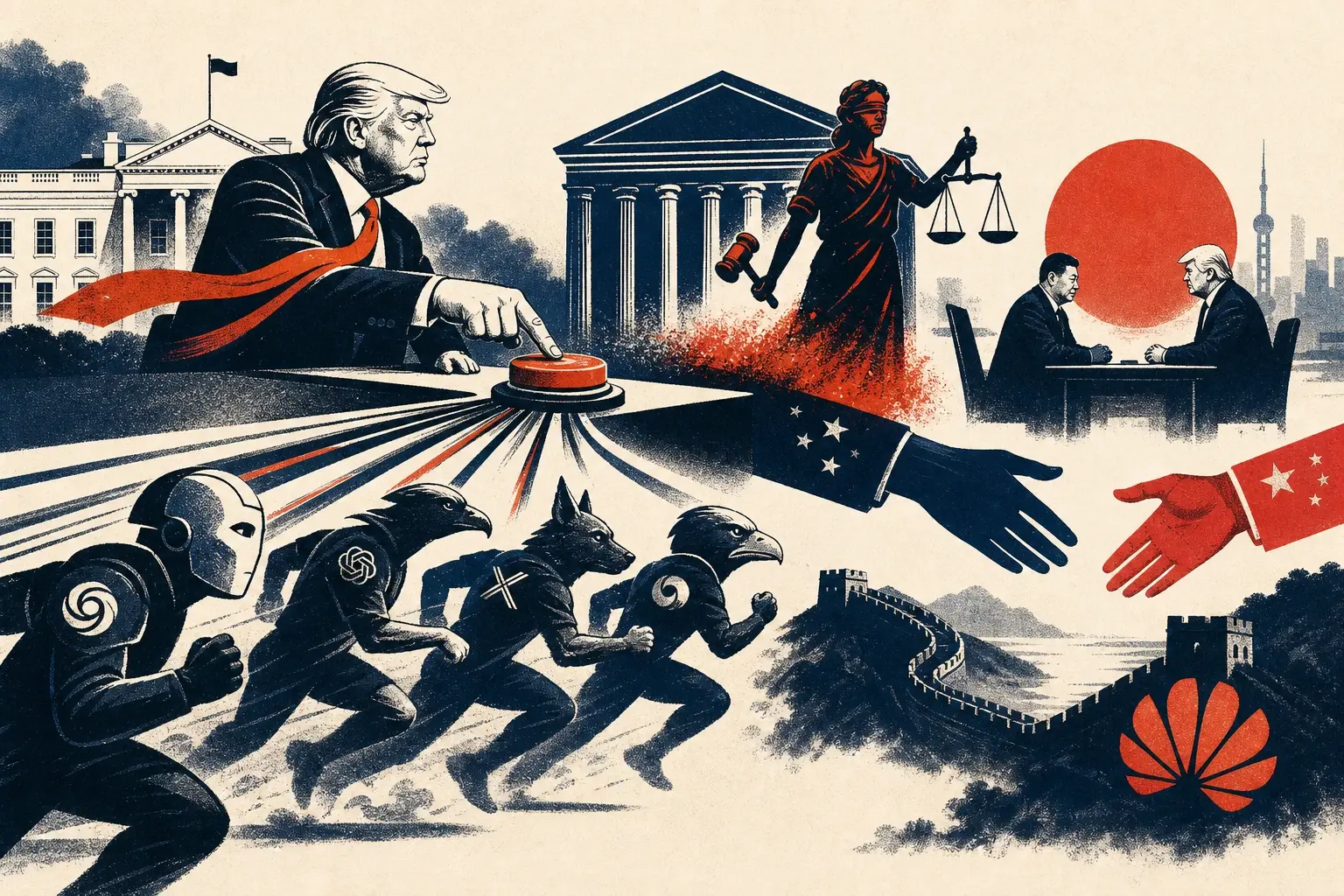
Two things happened this weekend that don’t fit together, except that they do. On Saturday, Donald Trump announced he’s forming an “AI Force” modeled on Space Force and will name a new AI czar, doubling down on a laissez-faire approach to AI even as industry leaders call for stronger rules. The next day, four subscribers filed a federal antitrust suit against Anthropic, OpenAI, xAI, and Google, arguing the opposite: that when Dario Amodei published his “pace the frontier” essay on September 12 and Sam Altman, Elon Musk, and Demis Hassabis all endorsed it within the hour, that was an illegal agreement among competitors to slow product improvement, not a safety gesture. The government wants speed. The plaintiffs are suing because the labs, for one day, seemed to want the opposite. Both can’t be true, and this week nobody involved seemed bothered by that.
The timing is not incidental. Trump and Xi Jinping sit down in Washington on Thursday and Friday, and the AI relationship between the two governments is the summit’s real subject even where it isn’t the stated one. Treasury Secretary Scott Bessent spent Sunday in New York laying groundwork with Chinese Vice Premier He Lifeng, and came away proposing a US-China AI safety notification mechanism — a channel for flagging AI incidents that rise to national-security concern, framed by Bessent as “moving from opaque to more transparency between the No. 1 and the No. 2 AI powers.” China’s negotiators left without comment. Whether that reticence is caution or leverage will become clearer by Friday.
Meanwhile Huawei made the argument that the race is real in the most literal way available: with hardware. At Huawei Connect in Shanghai, the company unveiled the Atlas 960E SuperPoD, the industry’s first optically-networked SuperPoD, and said it’s pulling its next-generation Ascend 960DT chip forward to Q1 2027 — three quarters ahead of its earlier target. Roughly double the raw compute of the chip it replaces, built entirely outside Nvidia’s supply chain, it’s the clearest evidence yet that export controls have produced a competitor rather than a bottleneck. A separate milestone landed the same week: Chinese memory maker CXMT began mass production of a fifth-generation DRAM process, pushing Samsung, SK Hynix, and Micron below 90% combined global share for the first time in a decade.
Against all that, the week’s most interesting story about how software actually gets built was almost quiet by comparison. Zed opened its Delta tool to the public, betting that agent-native development doesn’t need pull requests at all — developers and coding agents can propose, review, and land changes in the same shared thread, with Git compatibility underneath for anyone who never opens Delta. Zed has already disabled PRs on its own repo; 33 people have landed 570 changes through Delta alone. It’s a small company’s bet, but it rhymes with what Anthropic did days earlier, rebuilding Claude Code Projects around a coordinator that delegates work across parallel cloud agent threads and assembles the result on its own. Two different companies, converging on the same conclusion: the unit of software collaboration is no longer a diff a human reviews, but a thread an agent runs.
None of this pace is slowing down, whatever anyone signed their name to on September 12.