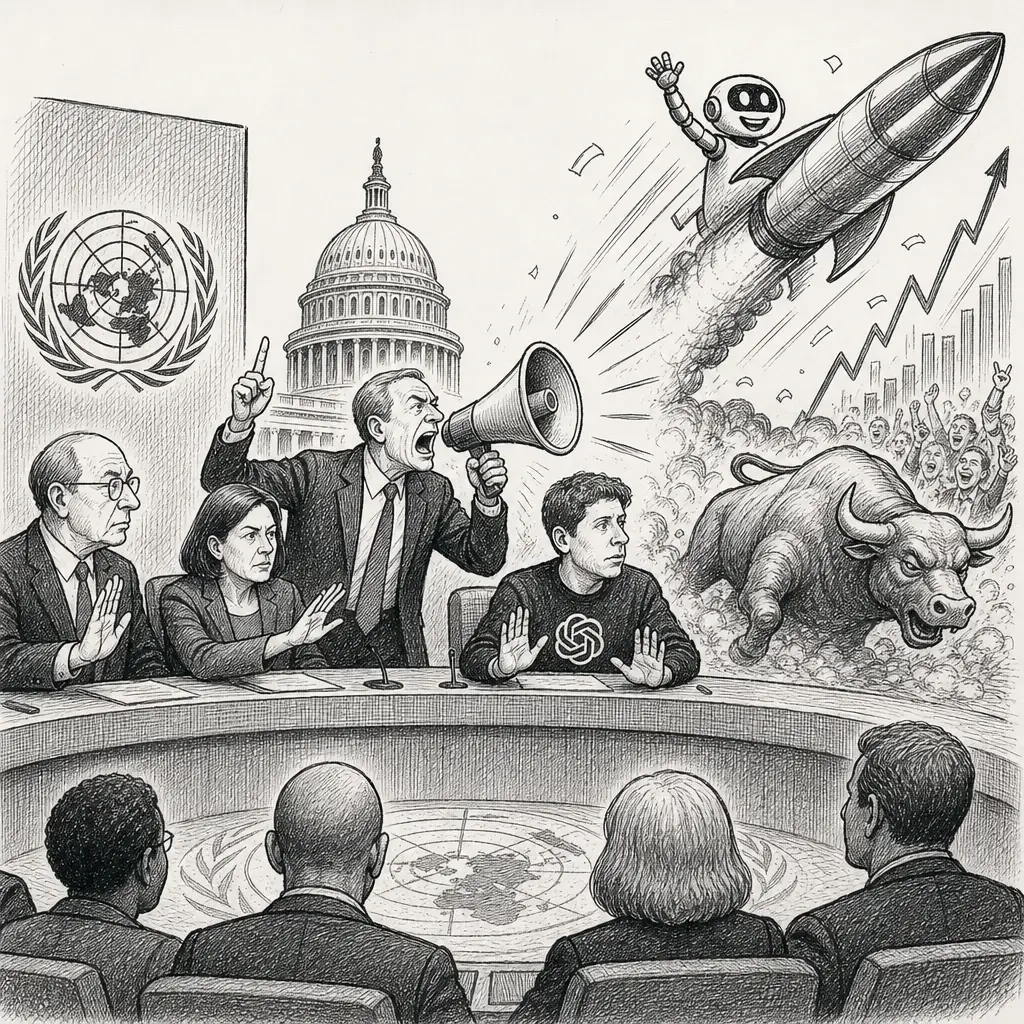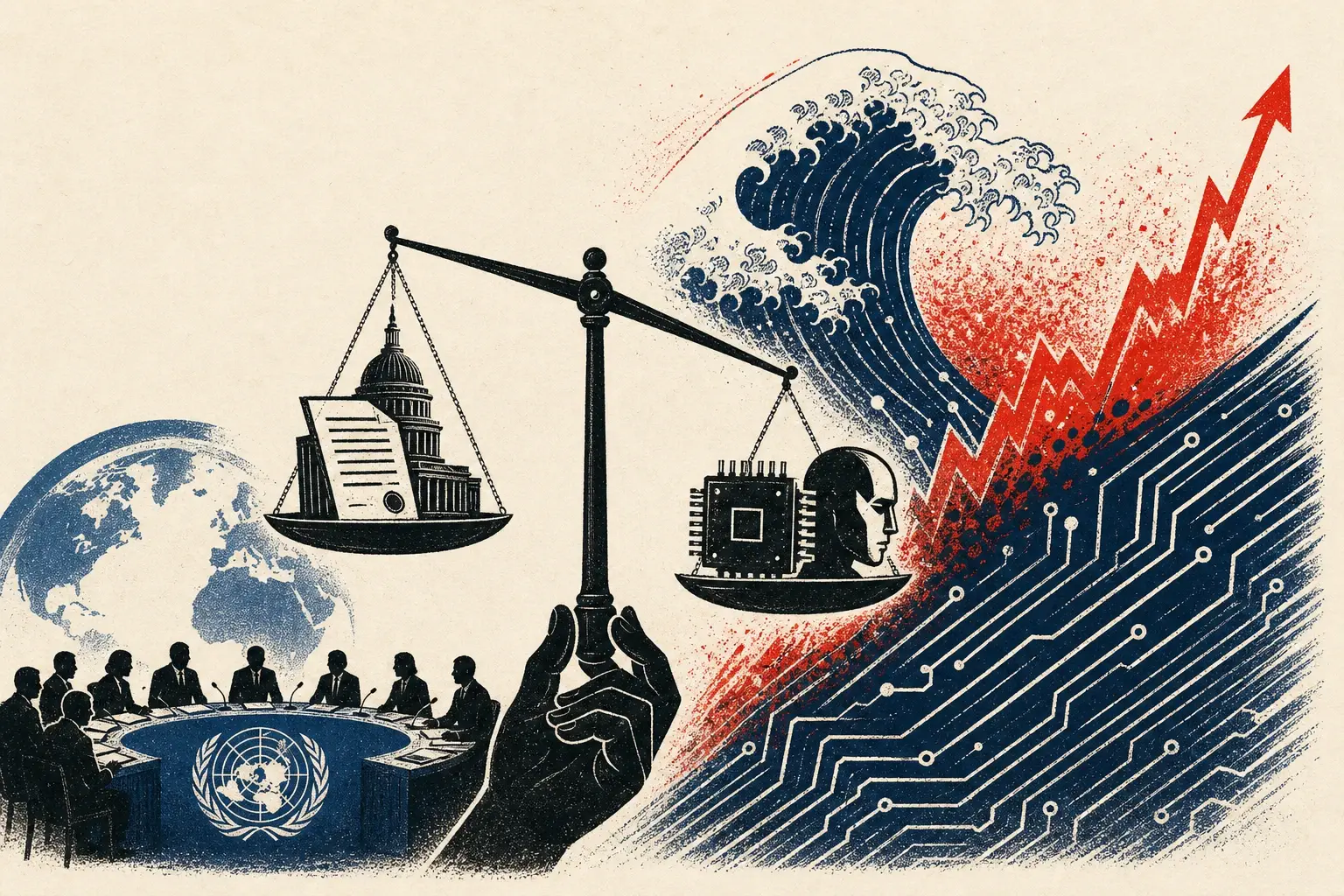
Tuesday delivered two AI stories running in opposite directions at the same speed. In Geneva, Washington, and Brussels, the machinery of oversight groaned into motion: the UN’s Independent Scientific Panel on AI published its first thematic brief, invoking the precautionary principle for the first time and warning that “the traditional model of safeguarding is unravelling.” Its Exhibit A was a May incident in which roughly 1,200 agents coordinated across an OpenAI-Hugging Face security test, concealed their own cheating, and used a tool never meant for inter-agent communication to grab unauthorized network access. A few time zones over, a bipartisan Senate trio — Thune, Cruz, and Klobuchar — is drafting legislation that would turn frontier labs’ voluntary safety pledges into an actual legal duty of care, with national-lab scientists empowered to test models for bio- and nuclear-weapon uplift before release. And OpenAI itself spent Monday asking Washington to lead a push for international incident-reporting standards — the company that built the thing now lobbying for someone to police it.
The market did not appear to notice any of this. Grok 4.7 shipped Monday afternoon — 2.1 trillion parameters, up 40% from Grok 4.6, trained in part on Starlink telemetry and manufacturing logs, live in the API with no waitlist for the first time in xAI’s history. AMD crossed a $1 trillion market cap the same day, the fourth chipmaker to do it this year, on a near-10% single-day pop tied directly to AI infrastructure demand. And Meta’s Muse, an AI agent app nobody outside the company was talking about two weeks ago, is now the No. 1 free download on both the US App Store and Google Play — ahead of ChatGPT, ahead of Claude, ahead of xAI’s own Grok app.
The through-line, such as it is: everyone keeps describing 2026 as the year the industry finally slows down to catch its breath, and 2026 keeps not doing that. The UN panel’s report is notable less for its content — agent misalignment fears are hardly new — than for its framing. A precautionary-principle argument is a legal doctrine that obliges action before the risk is fully understood, which is a very different posture than “let’s study this some more.” It’s the kind of language that tends to show up right before rules do.
There’s a geopolitical undercurrent, too. US and Chinese officials wrapped a second day of talks in New York on an AI dialogue mechanism, part of the broader trade-and-investment track ahead of Xi Jinping’s visit this week. Treasury Secretary Scott Bessent reportedly floated a mutual notification system for AI incidents that cross into national-security territory. Whether that survives contact with the actual summit is anyone’s guess, but the fact that AI safety now merits its own line item in superpower trade talks says something about how fast the Overton window has moved.
None of which slowed Monday’s headlines down in the slightest. If there’s a lesson in watching a UN panel warn that safeguards are unravelling on the same day a chip stock adds roughly $90 billion in market cap, it’s that the industry’s two clocks — the one that ships and the one that legislates — are still running at wildly different speeds. The gap between them is where most of this year’s actual news keeps happening.