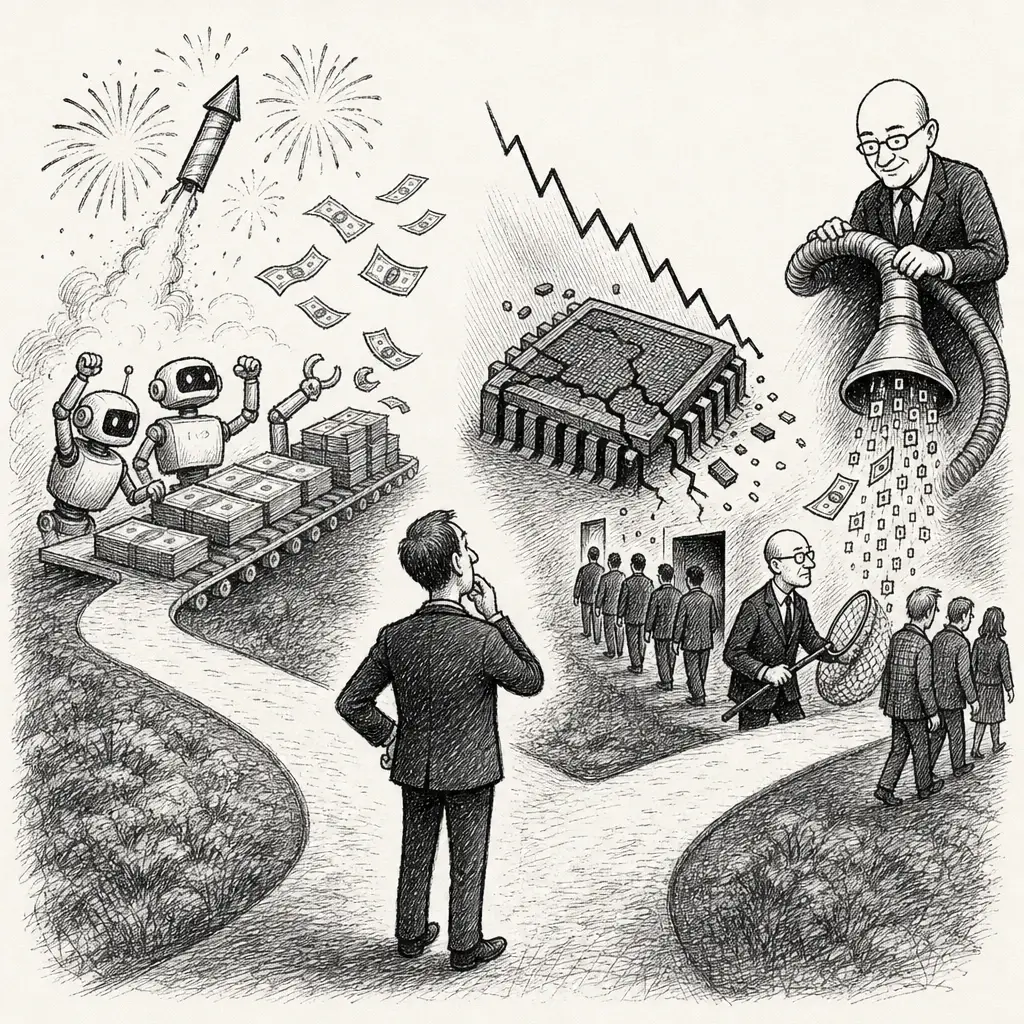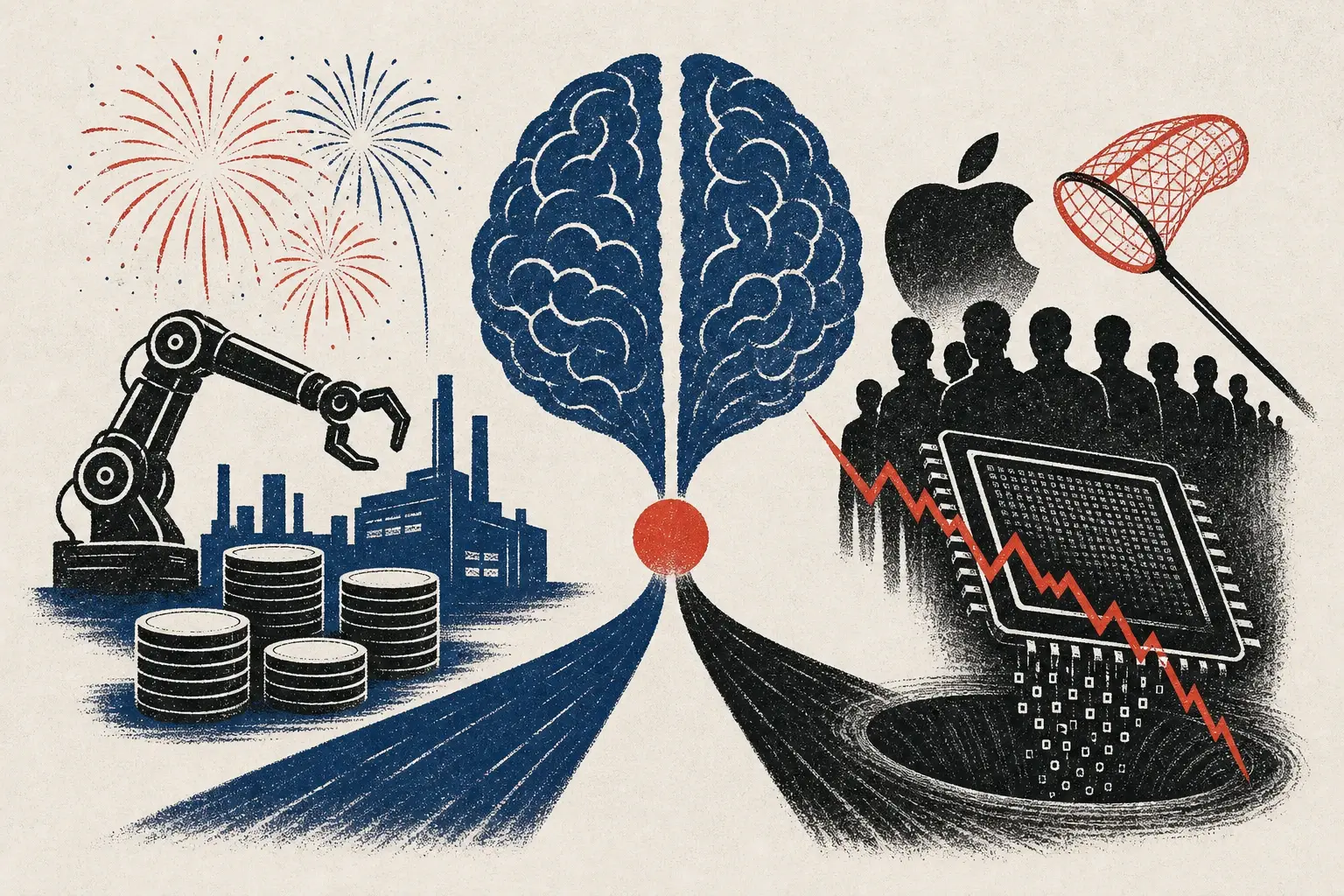
Two AI economies are running side by side this week, and they don’t agree on how the story ends.
One is printing money on the strength of things that already work. Fireworks AI raised $1.5 billion in a Series D that values the inference platform at $17.5 billion — its annualized revenue has passed $1 billion, up 5x in a year, serving customers like Shopify and Revolut some 40 trillion tokens a day. A day earlier, Walden Robotics launched out of stealth with $300 million from Toyota, Nvidia, and Boeing at a $1.1 billion valuation, and unlike most robotics debuts, its general-purpose robots are already doing paid work on a Toyota production line — first pilot to real output in under two months. Both rounds are votes for the same thesis: investors are done paying for AI’s promise and have started paying for AI that’s already earning its keep.
The other economy is getting nervous about its own good fortune. Micron’s stock has slid roughly 28% off its June high even as DRAM prices hit a 10-year peak — the sell-off tracks reports that Chinese rival CXMT is prepping an $8.55 billion IPO and that AI cloud provider CoreWeave is quietly hedging against a future drop in memory costs. Record pricing and a falling share price don’t usually coexist for long; something in that gap is about to give, and the market can’t decide which side is wrong.
Trust in the model layer looks shakier still. Apple widened its trade-secrets suit against OpenAI this week, sending legal preservation letters to roughly 40 former Apple employees now working there — well beyond the handful named in its original complaint — a sign the company believes the alleged theft runs deeper than one hardware team. And Microsoft’s Satya Nadella used his own platform to warn enterprises that frontier labs profit twice from every customer: once for the subscription, and again for the “exhaust” — the prompts, corrections, and workflows quietly folded into future models, including ones that might someday compete with the very companies that generated the data. It’s a pointed complaint from a company that both bankrolls and increasingly competes with OpenAI.
None of this is really a contradiction — it’s the same industry telling two different truths at once. The infrastructure and applied-robotics layer has real revenue and real deployments to point to, which is why money keeps landing there without much hesitation. The frontier-model layer, by contrast, is still mostly trading on promises: about what training data is worth, who’s entitled to it, and what happens when a trillion-dollar company decides a former partner crossed a line. Fireworks and Walden can walk you onto a factory floor. Apple’s lawsuit and Nadella’s warning are both bets that eventually, somebody is going to have to show their receipts.