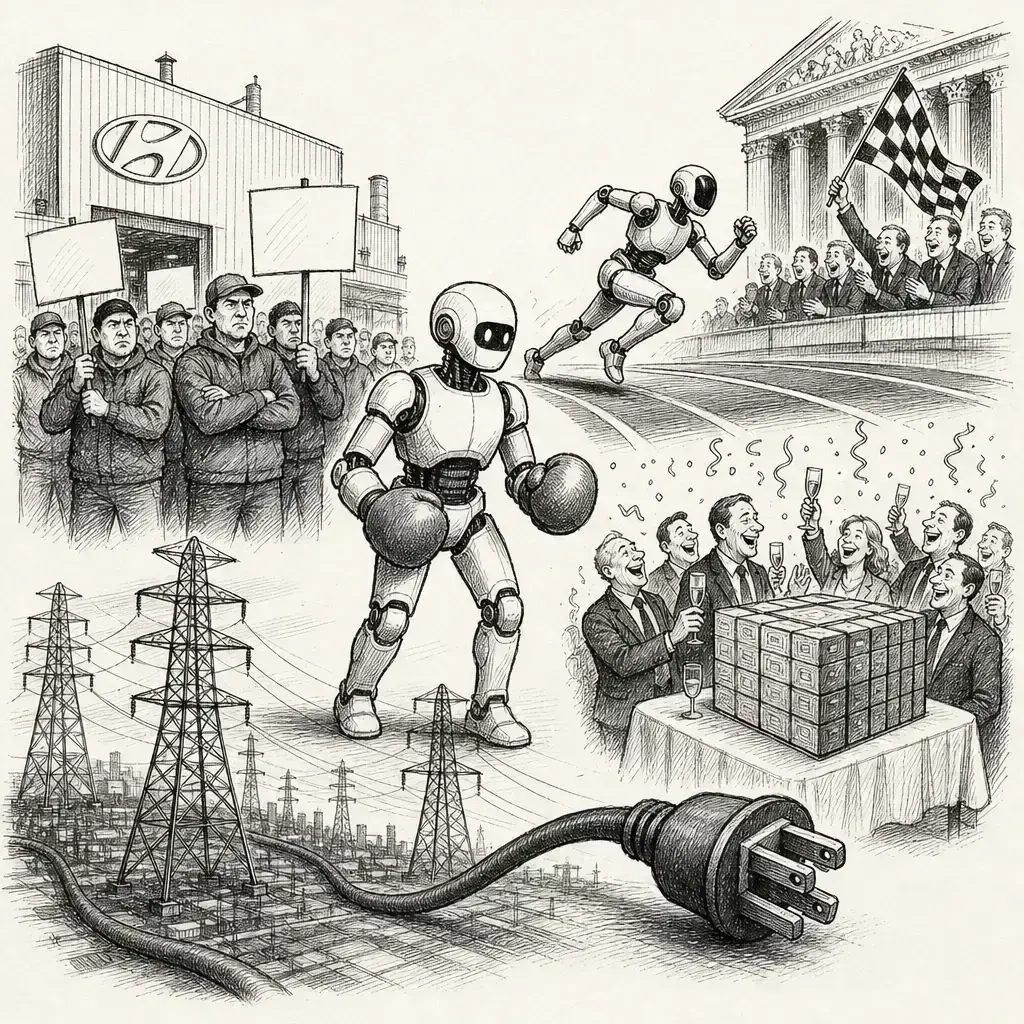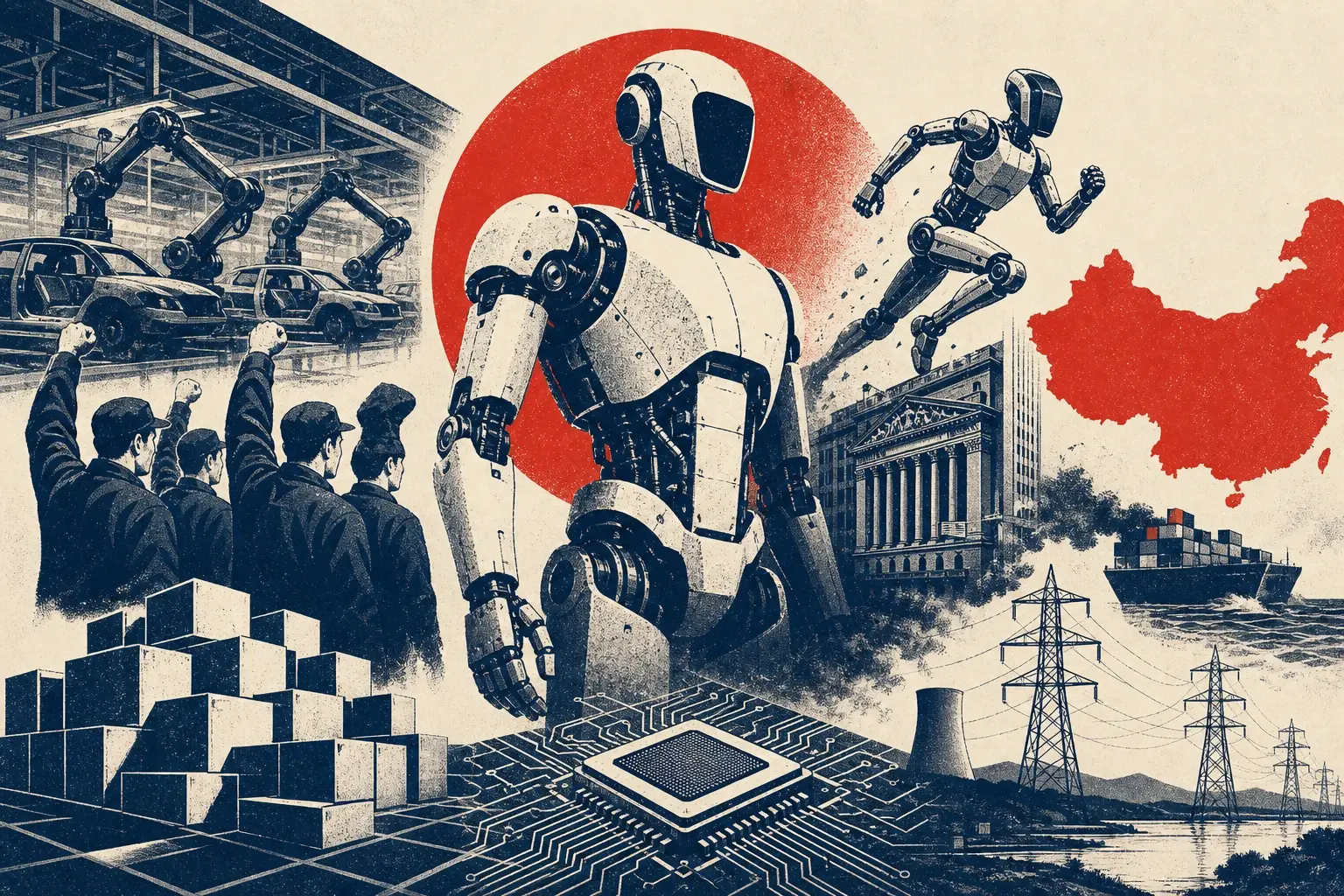
For most of this year, the loudest arguments about AI have played out somewhere abstract — inside a chat window, a benchmark leaderboard, a training-data lawsuit. This week the arguments moved somewhere harder to ignore: a factory floor, a SPAC filing, a power-grid auction. The technology didn’t get any less abstract, exactly, but its costs did.
Start on the factory floor. Thousands of unionized Hyundai workers in Ulsan, South Korea walked off shifts early for three straight days last week, with four-hour stoppages scheduled again for July 20–22 — what’s being called the auto industry’s first strike triggered explicitly by humanoid robots. The strange part: the robot at the center of it, Boston Dynamics’ Atlas, hasn’t done a single shift on a Korean line yet. Hyundai’s own rollout plan doesn’t have it touching parts sequencing until 2028. The union isn’t fighting a robot that took a job; it’s trying to lock in fixed salaries, a higher retirement age, and a bigger profit share before one arrives, rather than negotiate from a weaker position after.
Wall Street has the opposite read on the same machines. Agility Robotics confirmed its SPAC filing this week, teeing up a $2.5 billion merger with Churchill Capital Corp XI that would make it the first pure-play humanoid robotics company on a US exchange — backed by a Foxconn-led PIPE and, unlike most robotics debuts, actual paid deployments rather than demo reels. One workforce is bracing for the robots; one company is selling shares on the promise that everyone else will want them too.
Both bets run on the same river of money. Databricks signed a term sheet this week for a new round at a $188 billion valuation, up from $134 billion in February — a five-month jump that says more about how much capital is chasing AI infrastructure than about any single product Databricks shipped in between. It’s the same appetite that’s pushed TSMC to add another $100 billion to its Arizona buildout and Meta to nearly quintuple its original budget for a single Louisiana data center.
Eventually, someone has to generate the power for all of it, and this week showed what that actually costs. PJM’s capacity auction cleared at a record $16.4 billion for 2028–2029 delivery, with data centers responsible for roughly $6.3 billion of that bill — and the grid operator still fell 6.8 gigawatts short of its reliability target, the third straight auction to miss. That shortfall doesn’t stay abstract either; it shows up as a line item on someone’s electric bill in Ohio or Virginia, whether or not they’ve ever opened a chatbot.
None of these four stories share a company or an outcome. But they’re all measuring the same transition: AI stopping being a subscription line and starting to be a labor contract, a public listing, a term sheet, and a power bill — the unglamorous mechanics underneath a year of benchmark charts. The chatbots didn’t get more capable this week. The bill for building them just got easier to see.