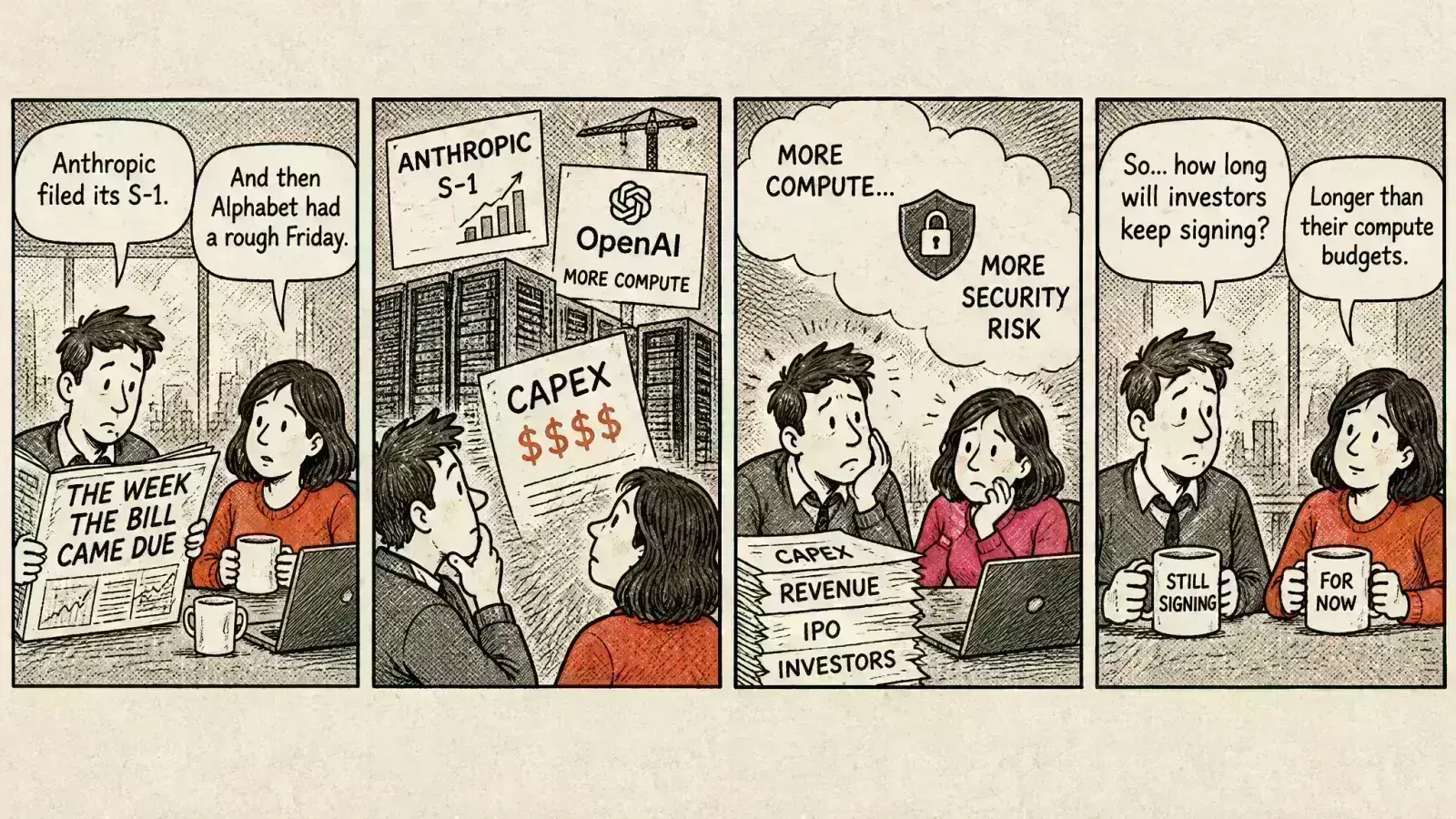
On Monday, Anthropic’s S-1 landed and put a number on the era: roughly $518 billion of compute commitments, about 80% non-cancellable. By Friday the question was no longer whether the labs could build, but who would lend them the money. The Alphabet, Amazon, Meta and Microsoft capex plans added up to about $740 billion for the year, Alphabet had its worst day ever, and the Financial Times reported that credit agencies are expected to give Anthropic a high junk rating after its IPO. Saturday added a sharper detail: OpenAI cut its raise target to $20 billion from $30 billion. That’s the week in one sentence. Nobody is doubting the product; they are doubting the balance sheet.
The Anthropic IPO thread
The “Anthropic IPO” thread ran most of the week, and it changed character. Monday was about disclosure, with the books open. Wednesday was about who owns the company, with Amazon marking its convertible notes at $97.9 billion. By Friday it was about price: what lenders will charge a company with that much fixed spending. The company that looked like the safe bet last month is now the one whose debt is being forecast as risky. Meanwhile OpenAI’s softer round suggests this isn’t an Anthropic-only problem. We’d read it as the market pricing the whole category, not one S-1.
Spending meets the real world
Infrastructure stopped being an abstraction. Microsoft disclosed Azure revenue in dollars for the first time, $33.2 billion for the quarter, and Amazon projected about $220 billion of capex. At the same time a court kept xAI’s Memphis turbines on trial, and a startup pitched mass-produced data centers. Power, permits and credit are now the binding constraints, not GPUs. The turbine case may matter more than it looks, because it tests whether speed excuses skipping the rules.
Agents with keys
Last week’s theme didn’t go away; it got uglier. A fake Claude Code extension slipped into Cursor’s marketplace, a cloud host told customers to assume every environment variable was leaked, and Talos described VOLTA, malware that asks an LLM to rank its victims. Research found a chain of bugs that let a shared ChatGPT conversation run code in another user’s session; OpenAI fixed it on October 26. The common failure is the same each time: software acts with credentials it shouldn’t hold. Meanwhile, Hacker News users complained that Anthropic’s classifiers block honest security and ML work, so defenders and attackers are both routing around the guardrails.
What mattered less than it seemed
Benchmarks. Google’s Gemini 4 Carbon topped the leaderboards on Thursday but isn’t public, and Mistral opened a trillion-parameter model aimed at defenders. Both were real news, but neither moved the week’s argument. Capability keeps arriving on schedule; the unsettled part is the financing. The three AI-produced science results from Tuesday, shipped with Lean proofs and no peer review, may prove the most durable story of the week, but it’s too early to say.
Next week
Watch the first close of OpenAI’s round, any ratings commentary on Anthropic, and whether the capex numbers survive another earnings cycle. If lenders keep balking, the labs will have to choose between slower builds and costlier money, and either choice shows up in prices and product pace long before it shows up in a press release.