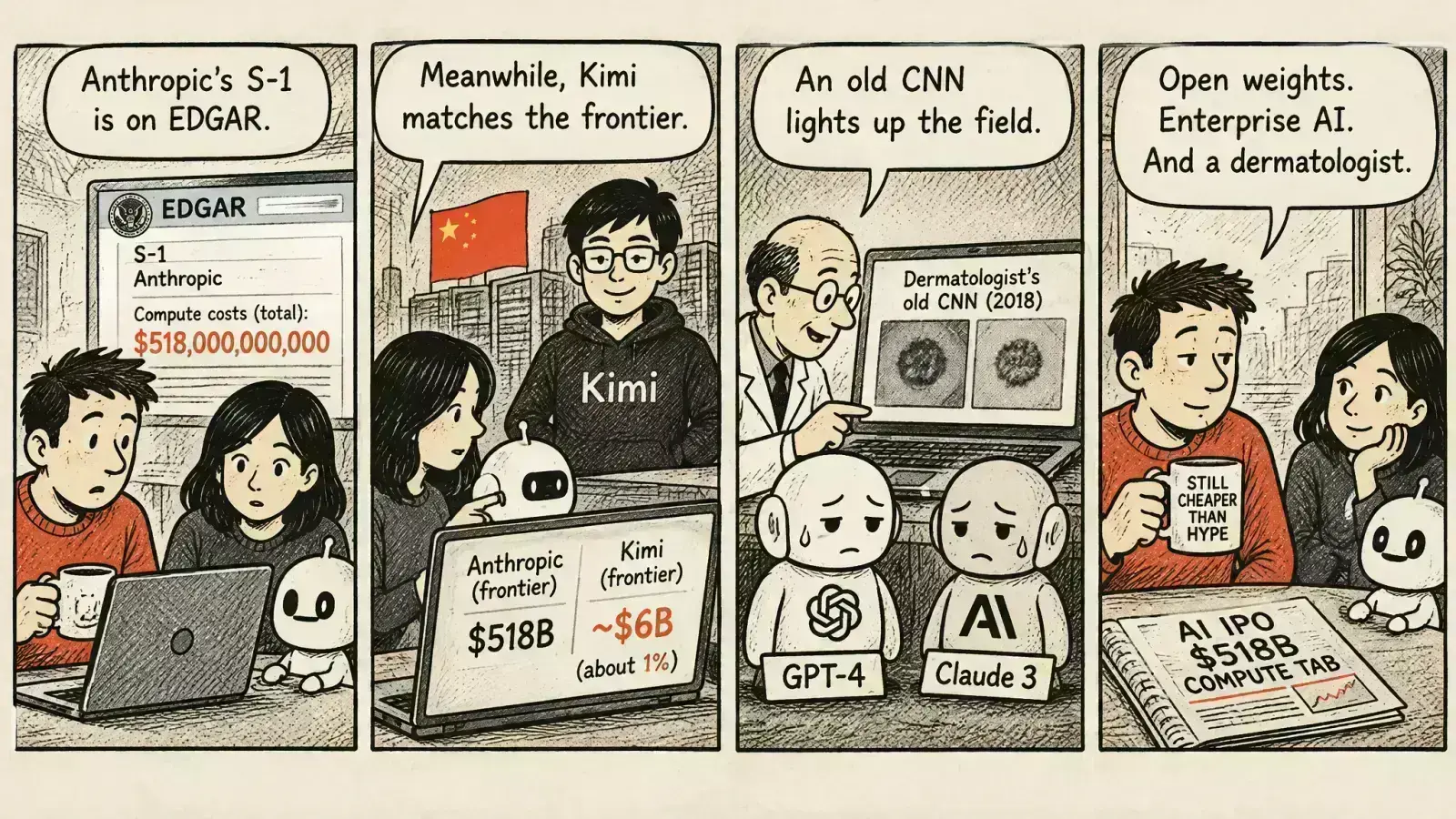
Anthropic’s S-1 is now public on EDGAR, and it reads like the moment the AI boom stops being a vibe and becomes a balance sheet. We could not parse the full filing from here, so the numbers below come from WSJ-sourced reporting on the draft and the Hacker News thread, and should be checked against the document. First-half revenue was about $16.3B against $4.6B for all of 2025. The reported net loss was $80.7B, though most of that is non-cash accounting for convertible instruments. About a quarter of revenue comes from two unnamed customers. And the reported compute commitments, roughly $518B over ten years with about 80% non-cancellable, are the number to stare at. That is a bet that demand keeps compounding, written in ink.
Commenters on HN are already arguing that Q3 growth, reportedly $16.8B, is slowing, and that open-weight competition will squeeze margins. Which brings us to the other side of the ledger.
The cheap seats are catching up
Moonshot’s Kimi K3.1 Pro scored 55 on Artificial Analysis’s index, behind only Claude Opus 5.5 (58) and ahead of Fable 5.1, GPT-6 Astra and Gemini 4 Argon (all 53). It costs $2 per million input tokens and $10 per million output, and Moonshot promises open weights by November 4. Benchmarks are one lab’s and one index’s view, but the shape is hard to ignore.
IBM’s Arvind Krishna made the enterprise version of the argument on an earnings call, per The Register: open-weight models cost 10 to 25 percent as much per token and are about 90 percent as effective, which is plenty for summarizing email or reviewing contracts. IBM sells mainframes and consulting, so it has a stake in on-prem AI. Still, a company that big saying “good enough and cheap” out loud is a data point against a $518B commitment.
Where the money is supposed to show up
Apollo economist Torsten Slok argues in a note covered by TechCrunch that the “S&P 493”, the index minus seven tech giants, shows flat margins and flat revenue per worker, so AI has paid off “zero” outside tech. That is a macro read and a blunt one; adoption lags, and flat aggregates can hide winners. But it is the question the S-1 invites: who, exactly, is the revenue coming from, and will they keep paying?
Meanwhile, a reminder that bigger is not always better. Dermatologist Magnus Lynch pitted GPT-6 Astra and Claude Fable 5.1 against a fine-tuned Inception v3 CNN on 200 biopsy-proven lesions. The old CNN got 62% right on the first guess; both LLMs got 42%. The LLMs also discharged only 22 to 32 of the 100 safe lesions, which is safe but not useful, while the CNN’s more aggressive threshold let some melanomas through. It’s a small sample, each model ran once, and the LLMs may have seen the public dataset. It is still a neat counterweight to the idea that one general model eats everything.