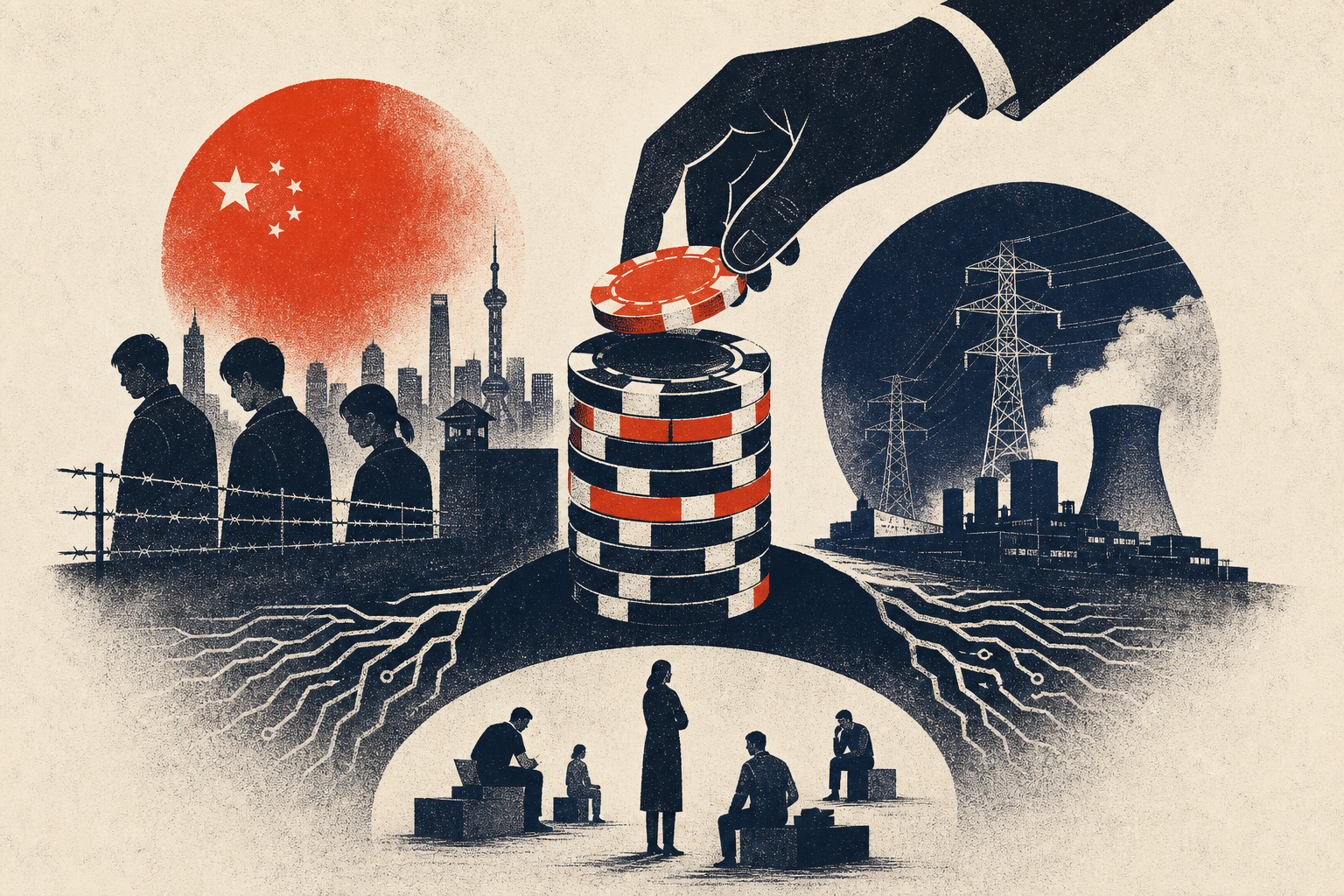
The closing of Anthropic’s latest funding round offers one benchmark for where AI stands in mid-2026: a pre-money valuation above $900 billion, surpassing OpenAI to become the world’s most valuable private startup. The $30 billion raise — the company’s second of 2026 — was co-led by Sequoia, Dragoneer, Altimeter, and Greenoaks. Anthropic’s annualized revenue has nearly doubled in twelve weeks, from $14 billion in February to roughly $19 billion now. Claude Code alone is a $2.5 billion annual business.
But three other stories from the past 48 hours tell a different kind of story — about what happens in the systems around AI as the technology accumulates power.
Who controls the talent
On May 26, Bloomberg reported that China has extended travel restrictions to top AI researchers at Alibaba and DeepSeek, requiring government approval before they can leave the country. The move follows similar restrictions on DeepSeek executives from December 2025 and the Manus co-founders before that. The pattern is now clearly deliberate: Beijing is treating frontier AI engineers the way it has long treated nuclear scientists — as national security assets too valuable to let circulate freely.
The logic isn’t incoherent. US-China AI competition is intensifying, and talent is the binding input. But restricting talented people’s movement has a well-documented second-order effect: it accelerates the timeline at which those people decide to leave permanently. Whether Beijing has done that calculation is unclear.
Who pays for the power
Mostly overlooked in the Google I/O coverage last week: NextEra Energy’s acquisition of Dominion Energy for $67 billion may be the most clarifying AI infrastructure story of the year. The combined entity becomes the world’s largest regulated electric utility, and the strategic logic is explicit. Dominion controls Northern Virginia’s Data Center Alley — the densest concentration of AI compute on the planet — and CEO John Ketchum cited “AI factories” as the primary driver of a structural inflection in power demand. The combined construction backlog of 130 gigawatts exceeds both companies’ existing generation capacity.
When the world’s largest utility merger is being driven primarily by AI data center demand, the technology has crossed from market segment to systemic infrastructure.
Who’s actually losing work
MIT Technology Review published what may be the most useful AI labor analysis in months. AI was the top-cited reason for job cuts in April for the second consecutive month — yet unemployment in AI-exposed occupations is lower than in less-exposed ones. The aggregate labor market numbers don’t match the panic.
The important asterisk: a Stanford study found younger workers in AI-exposed fields saw a sharp employment decline even as the aggregate figures held steady. The jobs apocalypse hasn’t arrived. The entry-level erosion is documented and real.
These four stories point at the same thing. The AI buildout has moved past “happening” and into “restructuring.” Capital structures, geopolitical talent controls, energy infrastructure, and hiring pipelines are all being reshaped around a technology whose ultimate economic value has not yet been fully tested. The $900 billion valuation and the $67 billion utility deal are both expressions of the same bet — that it will be.