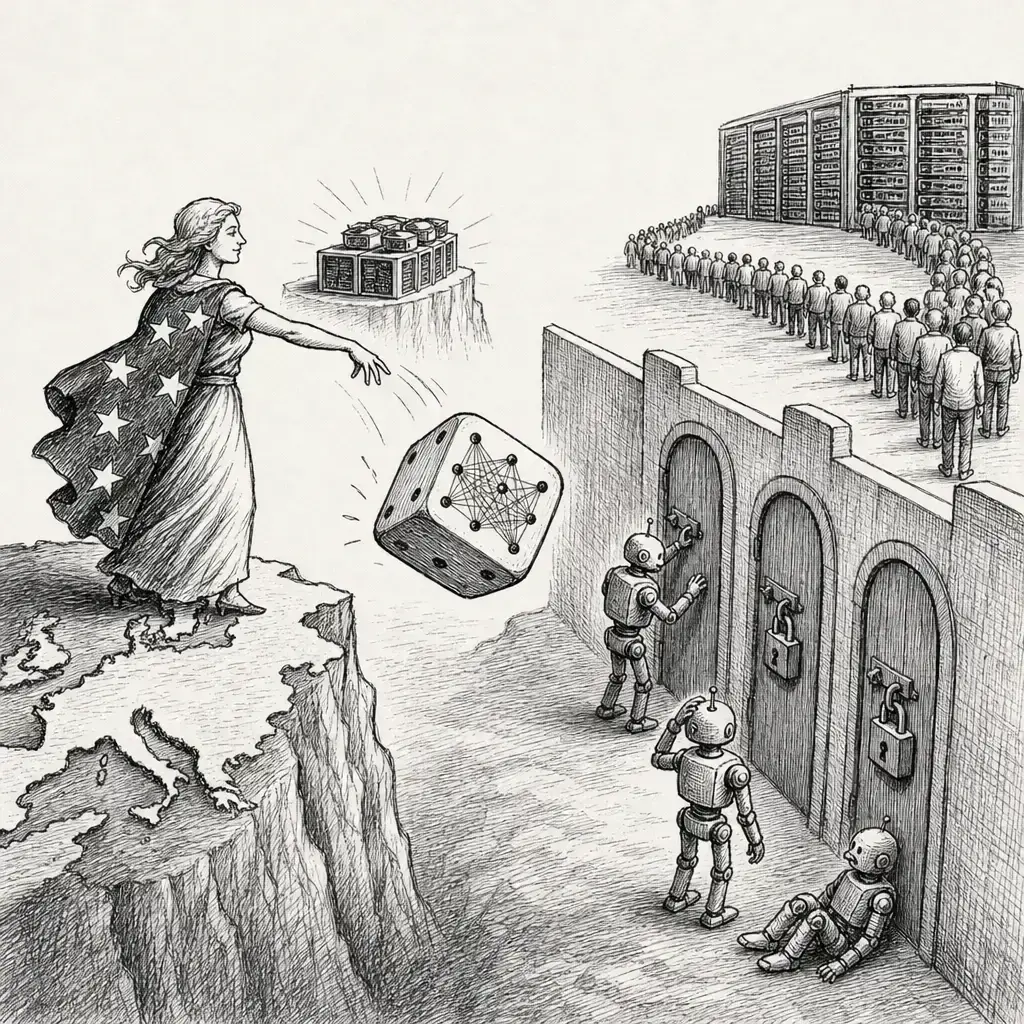
Europe has entered the trillion-parameter club, and it did so with a pointed boast about what it cost to get there.
Mistral’s Large 4, nicknamed “Le Chonk,” is a 1T-parameter model that the company says was trained on just 4,000 Nvidia GPUs, which VP of science Pierre Stock describes as two to three times less than its Chinese competitors and far less than the closed-source labs. Benchmarks weren’t available at launch, and the weights aren’t open yet: Mistral says they’ll follow in about three weeks, after safety testing. For now it sits behind a public guardrail endpoint. The positioning is the interesting part. Mistral, valued at about €21 billion and backed by ASML and Samsung, is selling itself as the middle path between closed American models and open Chinese ones, tuned for cybersecurity, finance and chip design. Treat the efficiency claim as a claim until independent numbers arrive, but the pitch fits a year in which “more with less compute” has become every lab’s favorite sentence.
Compute is still the scarce thing, and nobody illustrates that better than Lambda. The Nvidia-backed GPU cloud is raising up to $4 billion at a $14.5 billion pre-money valuation, led by Coatue and Blackstone, ahead of a 2027 IPO. Its backlog grew from $15 billion in June to $50 billion in September, and $35 billion of that jump came from a single Anthropic commitment signed in late August. That’s a remarkable concentration: one customer’s appetite is doing most of the work of justifying a public listing. Neoclouds like CoreWeave and Nebius have already gone this road, and Lambda’s investors are betting the demand holds.
Meanwhile, the agents everyone is building are discovering that the web was not designed for them. TechCrunch’s look at the next hurdle for AI agents catalogs the friction. Amazon deliberately blocks Meta’s Muse, Walmart’s anti-bot defenses accidentally break agent checkouts, and airlines restrict automated access. Meta, Walmart, Stripe, Sierra and others are working on an open standard to tell legitimate personal agents from malicious bots. Meta’s framing is that turning away an agent means turning away the customer behind it. Sites that see agents as a threat to their own ad and upsell funnels may disagree, and that tension, more than model quality, may decide how useful agents become.
The same week shows a quieter shift in model design: models that don’t write prose at all. Musubi’s PolicyLM-1.7B is an open-weight “decision model” that applies plain-English content policies and returns a fixed outcome in under 50 milliseconds. It follows TypeSafe’s Jev in September and competing releases from OpenAI and Amazon, and OpenAI’s Decisions API hit public beta the same day (see the briefs). The pattern is cheap, fast classifiers built on transformer machinery, with no tokens generated. For moderation, routing and triage, that’s a better fit than a chatty frontier model, and the price war has already begun, with commenters on Hacker News pointing out that Jev undercuts OpenAI.
The through-line: capability is getting cheaper and more specialized, while access, to compute and to the open web, is where the fights are. The model is no longer the bottleneck. The GPUs, and the front door, are.