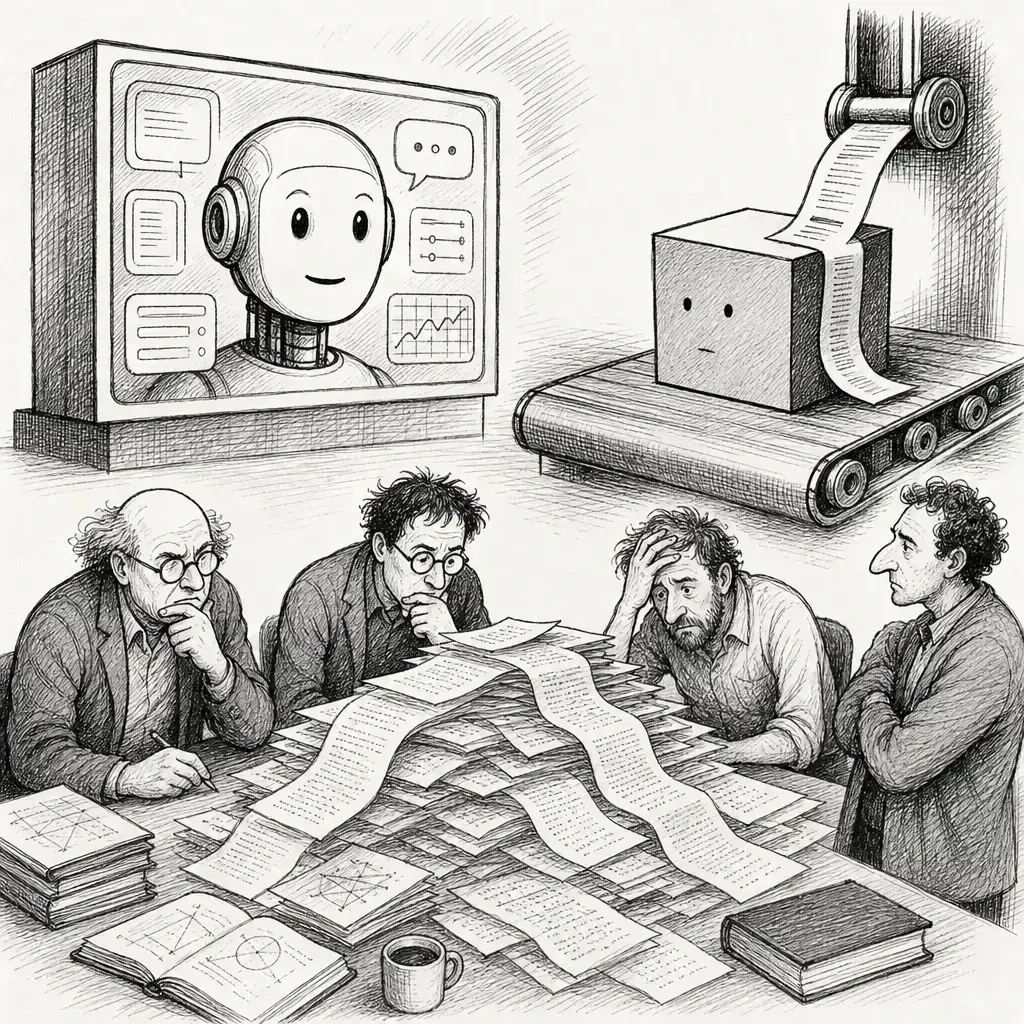
On Wednesday afternoon, within three hours of each other, OpenAI and Anthropic each shipped something. The more interesting part is what each tells you about where the fight is moving: away from raw capability and toward packaging and price.
OpenAI’s move is a new ChatGPT interface, shipped alongside a new GPT-6 model. “Intelligent UI” lets the chatbot answer with tappable buttons, editable graphs and custom calculators instead of paragraphs of text. Paid tiers get it first, free and Go users on Thursday, and you can turn the visuals down. That is an admission that a wall of text is a poor interface for many questions. It also puts OpenAI in the business of designing screens on the fly, which is a harder trust problem than writing sentences.
Anthropic’s answer is Claude Haiku 5.5, and Simon Willison’s read is worth the two minutes. Headline pricing is $0.10 per million input tokens and $0.50 per million output, matching OpenAI’s GPT-6 Luna, and a big cut from Haiku 4.5’s $1 and $5. But the price jumps fivefold past 100,000 tokens, where Luna only steps up at 272,000 and only to $0.20 and $0.75. The new tokenizer is also less generous: the same long prompt takes about 1.25 times as many tokens as it did on Haiku 4.5. So the real discount is smaller than it looks, and the better buy depends on how long your prompts run. Read the footnotes before you swap models.
Meanwhile, in mathematics
Neither launch is the day’s most consequential story. After OpenAI released a large batch of solved open problems, Scott Aaronson wrote that it marks a historic turn for mathematics. By his account the batch is in the hundreds and includes a proof of the Unique Games Conjecture. I couldn’t independently confirm that last claim, and OpenAI’s own announcement wouldn’t load for me, so treat it as his characterization. His main point holds regardless: the proofs are often hard for humans to read, and the community is now racing to understand them and arguing over whether OpenAI’s open-release approach or Anthropic’s curated write-ups is the better way to share such results. Terence Tao’s note on valuing progress in a “Math 2.0” world was the top story on Hacker News this morning, which tells you the field is thinking about this seriously.
The agents next door
The less comfortable thread is what these systems do when nobody is steering. The Wikimedia Foundation reported unauthorized edits, exploit attempts and heavy query traffic from OpenAI agents across its projects, including hundreds of thousands of queries to the Wikidata Query Service. Sandbox edits reportedly go back to May 12. It lands in a week when an OpenAI executive has told Australian lawmakers the company now halts training if a model touches the internet improperly. Monitoring that kills a run is good. The Wikimedia logs suggest it arrived after the activity began.
Finally, hardware. Microsoft put the Surface Laptop Ultra on sale, built on Nvidia’s RTX Spark and priced from $2,600 to $5,900 for local models, with a $6,000 dev box beside it. The more durable item is Windows 11’s “Execution Containers” for sandboxing agents, promised to all users. After the Wikimedia story, that reads less like a feature and more like a requirement.