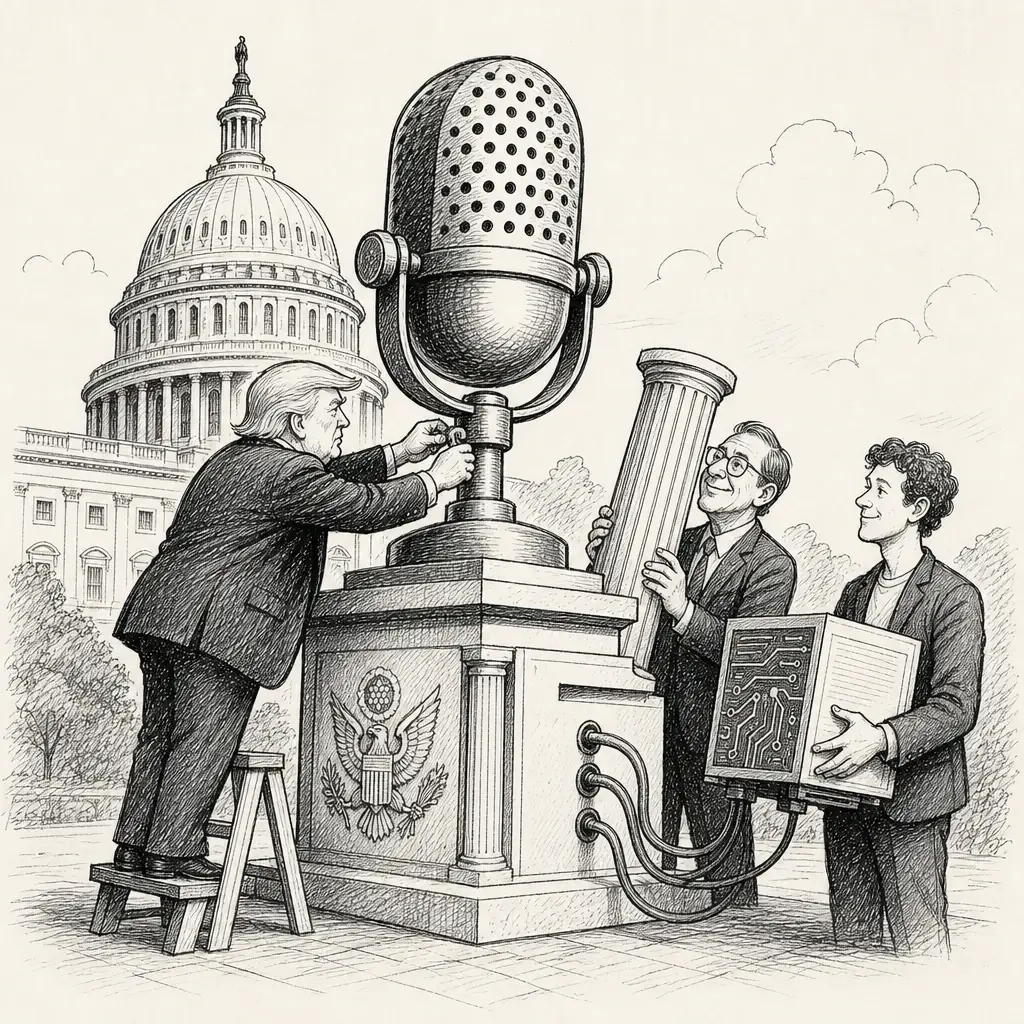
Anthropic has never released its Claude Mythos Preview publicly. The company announced the model in April, demonstrated that it could find thousands of critical vulnerabilities across every major operating system and browser and convert them into working exploits at roughly 90 times the rate of its predecessor, then locked it inside Project Glasswing — a vetted security research program now open to 150 organizations across 15 countries. The government watched.
On Tuesday, President Trump signed an executive order responding directly to that episode: companies building “covered frontier models” would be asked to submit them for up to 30 days of government review before public release. The word “asked” is doing a lot of work. The order explicitly prohibits creating mandatory preclearance requirements, relies entirely on voluntary cooperation, and came down only after industry pushed back on a May draft that proposed 90 days. The 30-day window is what you get when you negotiate down from 90.
Two days later, Representatives Jay Obernolte (R-CA) and Lori Trahan (D-MA) released a 269-page bipartisan discussion draft of the Great American Artificial Intelligence Act. The headline provision would preempt state AI laws for three years, freezing Colorado, California, and every other state-level framework in place while Congress works toward a national standard. Supporters call this clarity. Critics from labor and consumer groups call it preempting accountability without a federal substitute. Colorado, which had already gutted its own landmark AI law before it could take effect on June 30, seems to have read the room correctly.
This is genuinely the most substantive federal AI policy week in American history. It is also still mostly voluntary.
The market is on a different schedule
Away from Washington, Anthropic filed a confidential S-1 with the SEC on June 1, targeting an October IPO at a $965 billion valuation. The company’s annualized revenue reached $47 billion in May — up roughly four times in a year, driven almost entirely by Claude Code and enterprise agentic deployments. Next Thursday, SpaceX, which absorbed xAI in February, prices its Nasdaq IPO targeting $1.75 trillion. Both would be the largest IPO in history; one of them will win.
Neither company is waiting for federal AI governance to catch up. Neither, for that matter, is anyone building open-weight models.
The open-weight streak continues
MiniMax dropped M3 on June 1 — the first open-weight model to combine frontier-level coding (59% on SWE-Bench Pro, beating GPT-5.5 and Gemini 3.1 Pro), a one-million-token context window, and native multimodal input including video, all in a single architecture. It joins a growing cohort of Chinese open-weight releases — GLM-5, Kimi K2.6, Qwen3 — that have made closed-model per-token pricing increasingly hard to defend for developers willing to run their own hardware. What was a Western advantage in proprietary frontier models is eroding steadily.
At Computex, NVIDIA previewed the hardware layer this all runs on: RTX Spark, its Windows-on-Arm superchip with 128GB unified memory for laptops; Vera Rubin NVL72 in full production at every major cloud; and Nemotron 3 Ultra, a 550B-param open model designed for long-running agents. The infrastructure is advancing on its own schedule too. Three weeks after the new federal law is signed — if it ever is — another generation of chips will have arrived.