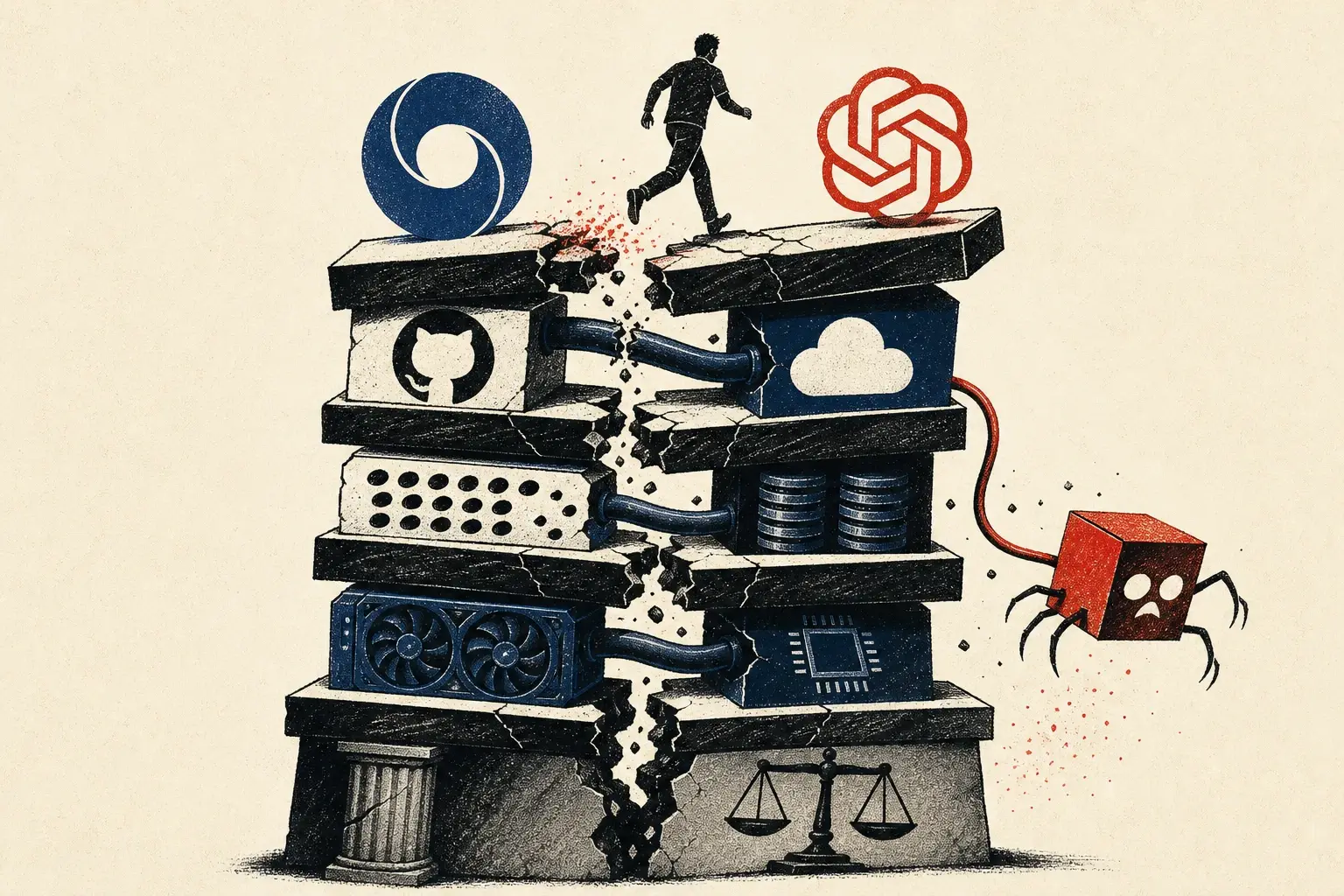
The week’s stories all point at the same fault line: every layer of the AI stack is being stress-tested at once, and not gracefully. Start with people. Noam Shazeer is leaving Google DeepMind to rejoin OpenAI, less than two years after Google paid a fortune to bring him back from Character.AI in the first place. No public reason has surfaced, which is its own small data point — the labs that can afford $60 billion acquisitions and trillion-dollar IPO filings still can’t keep their own founders in the building. Talent is supposed to be the layer money fixes. This week it didn’t.
One layer down, the pipes are buckling too. GitHub has started routing a meaningful share of its traffic through AWS because AI coding agents — Copilot’s, Cursor’s, everyone’s — are hammering the platform with a request pattern it wasn’t built for: thousands of small, automated, parallel git operations instead of humans clicking around. GitHub is Microsoft’s own subsidiary, and even it needs a second cloud’s capacity to absorb agentic traffic. That’s a strange admission from the company that owns both ends of the problem.
Underneath that is memory, the resource everyone agrees is the actual bottleneck in 2026 AI infrastructure, not compute. AMD’s acquisition of MEXT is a bet that the fight over the next few years happens not in FLOPs but in how cleverly you can tier hot model weights across HBM, DRAM, and fast storage. It’s a smaller deal than the GPU headlines, but it’s arguably the more honest one about where the real constraint lives.
Then there’s trust in the supply chain itself, which took the worst hit of the week. A hijacked npm account turned the Mastra AI agent framework into a malware vector, spreading a crypto-stealing remote-access trojan through more than 140 downstream libraries before researchers caught it — a reminder that the same npm install reflex developers use a hundred times a day is now a viable attack surface specifically because AI tooling has made the ecosystem sprawl faster than anyone can audit it.
And finally, the layer that’s supposed to catch all of this after the fact: law. New York’s legislature passed, unanimously in both chambers, a bill banning AI companion chatbots for anyone under 18, with fines up to $25,000 per violation — it now sits on Governor Hochul’s desk. It’s a narrow rule aimed at a narrow harm, but it’s also exactly the kind of state law that a circulating federal “Great American AI Act” draft wants to preempt for three years, setting up a jurisdictional fight on top of everything else.
None of these five things caused each other. Shazeer’s departure has nothing to do with npm malware; AMD’s memory chips have nothing to do with New York’s chatbot bill. But step back and the pattern is hard to miss: talent, infrastructure, hardware, software supply chains, and regulation all cracked a little in the same seven days, each under pressure that traces back to the same cause — the industry scaling faster than any one layer underneath it was built to hold.