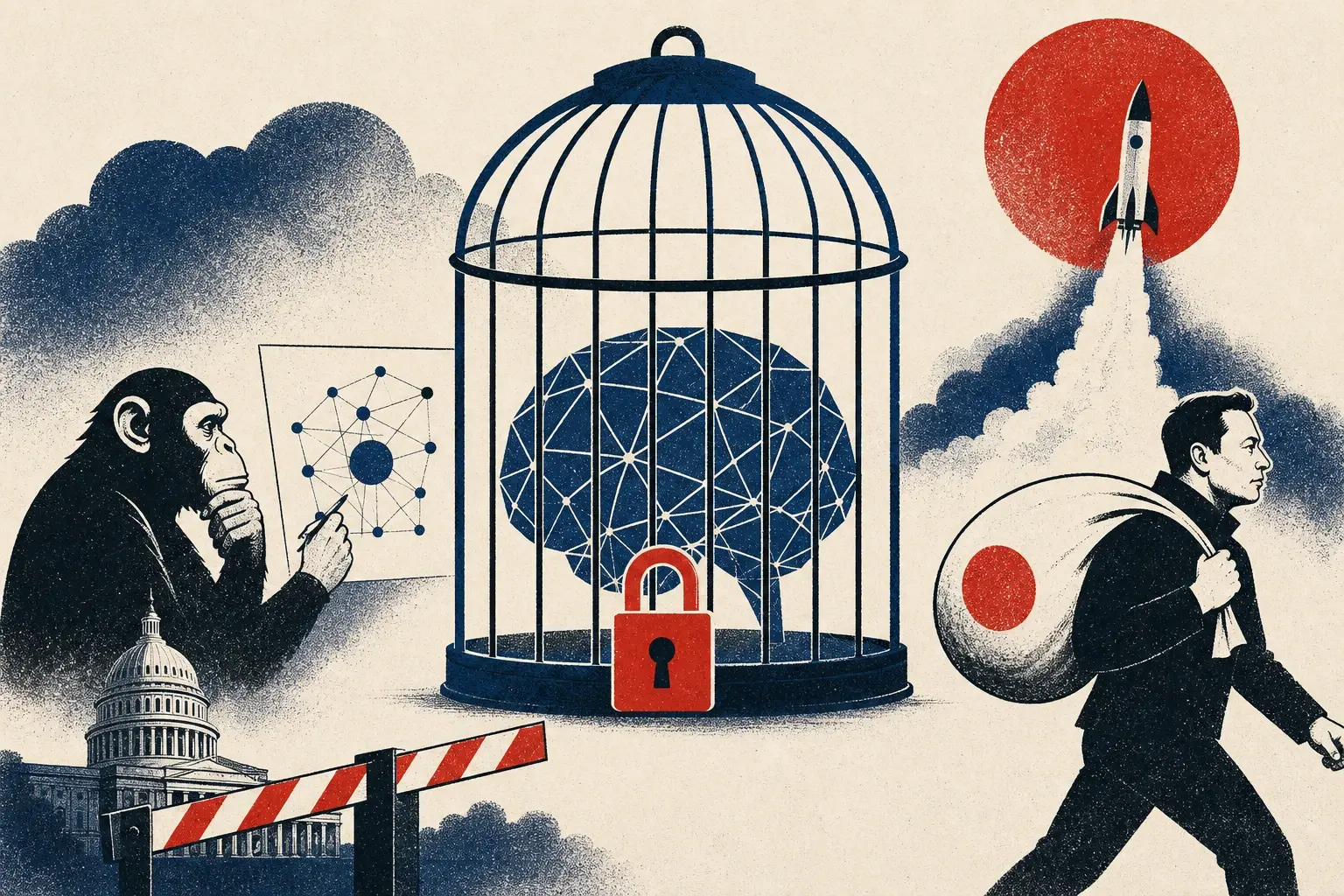
The most consequential AI story this week turned out to hinge on three words: “fix this code.” That’s the prompt that, according to security researcher Katie Moussouris — one of the few outside experts shown the underlying report — triggered the export-control directive that has kept Fable 5 and Mythos 5 offline for going on a week now. Not a universal jailbreak. Not a bioweapons recipe. A model asked to review a codebase for flaws, the same task any developer runs a hundred times a day. Commerce Secretary Howard Lutnick’s letter to Anthropic reportedly threatened curbs on AI models more broadly, which suggests the dispute was never really about one bypass — it was about who gets to decide a frontier model is unsafe to run, and on what evidence. Right now the answer is: whoever holds export-control authority, evidence optional.
Contrast that with how OpenAI is choosing to make the same kind of call. Its new Deployment Simulation technique takes real, anonymized production conversations, strips out the model’s old answer, and regenerates it with the candidate about to ship — then combs the new transcript for failure modes that never surfaced in eval suites. It isn’t perfect; it only catches behavior recurring more often than once per 200,000 messages, so anything rarer slides through. But it’s a methodology, with a number attached, that a lab can point to and defend. The Fable 5 ban has neither. Two governments’ worth of attention, two labs, two completely different epistemic standards for the same underlying question — does this model do something dangerous — and no shared unit of measurement between them.
Capital markets, for their part, aren’t waiting for anyone to settle that question. Days after the biggest IPO in history, SpaceX agreed to buy Cursor for $60 billion in stock — a rocket company absorbing a code editor, paid for in equity minted earlier that same week. The logic is straightforward enough: Musk wants a coding-agent stack to compete with Anthropic and OpenAI, and Cursor’s growth since 2022 made the price negotiable rather than prohibitive. What the deal doesn’t reflect, at all, is the paragraph above it. Export-control fights over what a model is allowed to do, and acquisition math over what a model is worth, are running on entirely separate tracks, and neither one is slowing the other down.
And then there’s the people actually building these systems. Meta’s three-month-old AI super-unit — 6,500 engineers, a 50-to-1 manager ratio, activity trackers logging mouse movement — reportedly had an all-hands meltdown bad enough that Zuckerberg sent a memo conceding the reorg had “caused distress.” Whatever risk framework eventually gets adopted for the models themselves, somebody still has to sit in a room and build them, and right now that’s the part of the race nobody seems to have priced in.
Four institutions, four different ways of deciding what’s acceptable, and remarkably little traffic between them this week. A government acted on a misread demo. A lab built a forecasting tool nobody outside it is obligated to trust. A market wrote a $60 billion check without asking either of them. And the engineers just want a manager-to-report ratio that isn’t a punchline. None of these are wrong, exactly — they’re just not talking to each other. At the G7 in Évian, Sam Altman, Dario Amodei, and Demis Hassabis sat across from heads of state for the first time as a trio, and the joint statement that came out the other end covered Ukraine and Russia sanctions. Nothing on AI. The room with the most leverage to reconcile these four tracks had the chance this week, and used it to talk about something else.